

Bulgaria ended a yearlong timeout Tuesday and agreed to move forward on hosting a stretch of the Gazprom-backed South Stream pipeline, a deal Prime Minister Boyko Borissov said would be two or three times more profitable for his country than first estimated.
Borissov may have exaggerated the potential benefits to glean political support for the project's smooth development, an analyst said, but Russia most likely did offer additional rewards to gain the government's support.
The announcement came days after Prime Minister Vladimir Putin and Borissov spoke by telephone, and weeks after Gazprom said June 16 that it was looking at another Black Sea country, Romania, as an alternative partner for the undersea pipeline.
“Having come to terms on the outstanding issues, we are increasing the profitability of the South Stream project for Bulgaria twofold or threefold,” Borissov said, Interfax reported.
Moscow and Sofia will finish drawing a “road map” on Thursday to move toward setting up a joint company that would conduct a feasibility study, he said.
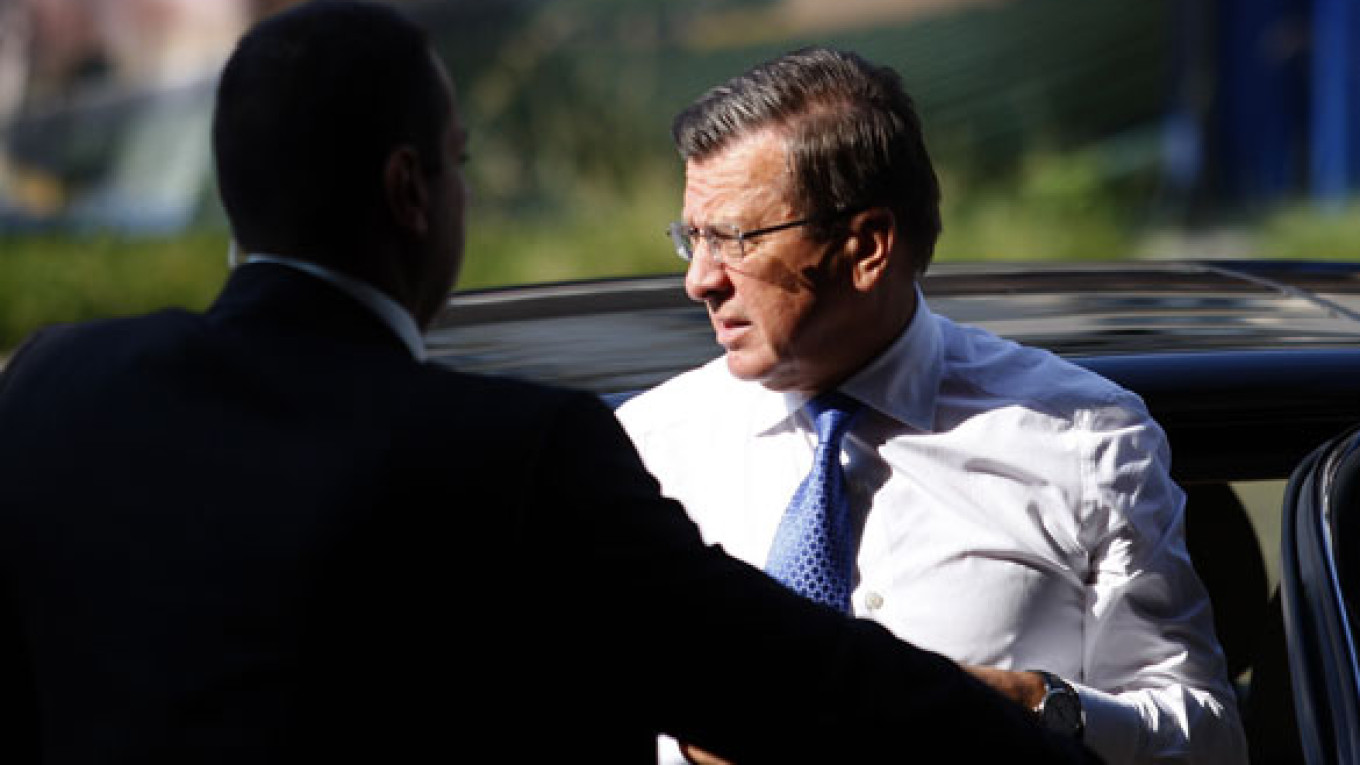
Borissov made the statements after talks with Russia's First Deputy Prime Minister Viktor Zubkov, who is chairman of state-controlled Gazprom, and Gazprom's deputy chief Alexander Medvedev.
“We will make this project beneficial both for Bulgaria and Russia,” Zubkov said.
South Stream, a joint venture between Gazprom and Italy's Eni, is designed to snap Russia's dependence on Ukraine as the principal route for its gas exports to the European Union. The pipeline will have the capacity to carry 63 billion cubic meters of gas across the Black Sea, surfacing in Bulgaria and bifurcating to snake on overland to Italy and Austria.
Talk of soaring benefits for Bulgaria is cover for Borissov to shepherd the project through his coalition Cabinet, where other members may still be doubtful of the plan, said Dmitry Abzalov, an energy expert at the Center for Political Studies, a think tank.
Gazprom probably did sweeten the deal by agreeing to buy more pipeline work from local contractors and ceding to Bulgaria a greater portion of potential receipts from the local sales of the gas that will travel in the pipeline, he said.
“Gazprom traditionally insists that it get most of the revenue,” Abzalov said. “It most likely offered Bulgaria special terms.”
All in all, the rewards would bump up Bulgaria's revenues by 30 percent to 40 percent, he said.
Gazprom declined comment Tuesday afternoon. A spokeswoman for the Bulgarian government requested that questions be sent by e-mail, but the message went unanswered Tuesday.
Gazprom combined the carrot for Bulgaria with a stick, which was its threat to lay the pipeline through Romania instead, Abzalov said.
“That was one of the rare, utterly effective decisions by Gazprom. It was media-borne pressure,” he said, adding that talks with Romania had been difficult because of political disagreements over Moldova.
Russia stations troops in Transdnestr, a breakaway region of the Romanian-speaking country, saying they support peace after violent clashes during an independence bid in the 1990s.
Borissov also said Bulgaria would wait until September to decide on the planned 4 billion euro ($5 billion) Belene nuclear plant. Russia's state-run Atomstroiexport had begun building the facility before Sofia suspended the deal for more considerations.
A Message from The Moscow Times:
Dear readers,
We are facing unprecedented challenges. Russia's Prosecutor General's Office has designated The Moscow Times as an "undesirable" organization, criminalizing our work and putting our staff at risk of prosecution. This follows our earlier unjust labeling as a "foreign agent."
These actions are direct attempts to silence independent journalism in Russia. The authorities claim our work "discredits the decisions of the Russian leadership." We see things differently: we strive to provide accurate, unbiased reporting on Russia.
We, the journalists of The Moscow Times, refuse to be silenced. But to continue our work, we need your help.
Your support, no matter how small, makes a world of difference. If you can, please support us monthly starting from just $2. It's quick to set up, and every contribution makes a significant impact.
By supporting The Moscow Times, you're defending open, independent journalism in the face of repression. Thank you for standing with us.

Remind me later.