

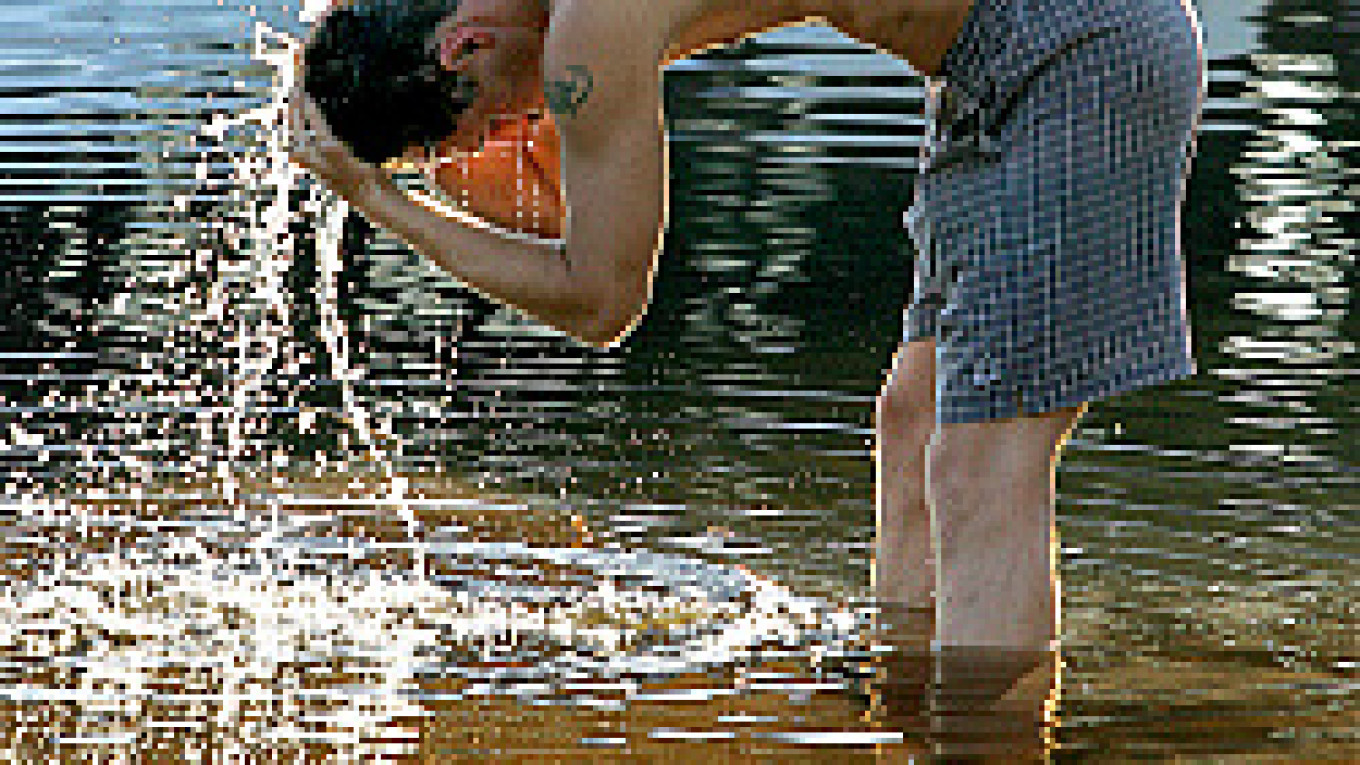
Beginning just after the Victory Day holiday, the city of Moscow starts turning off the hot water in residential buildings. Over the course of the summer, every building in the capital is doomed to have only cold running water for three weeks. The reason for this unpleasant summer ritual, according to the authorities, is the need to fix and replace the hot water pipes. Buildings in the same region lose their hot water at different times, encouraging residents to pay "washing visits" to their neighbors. For those not on friendly terms with their neighbors, there is always the option of heating up water in big pots on the stove or washing with cold water. Taking a shower at the gym or the banya is also a possibility, but during this time of year, there are usually long lines.
The situation is bad for everyone -- except those companies selling electric boilers, which can easily exploit the tradition for their advertisements. Some buildings, including hotels, install boilers, but not every family can afford to put in a small water heater, and some don't see the point in spending the money for something that will only be used for three weeks a year. Additionally, some apartments don't have the space for the boilers, and the circuitry in others can't handle the extra voltage.
During this time of year, Moscow's most dilapidated districts have something in common with the city's most fashionable regions. No one bothers to protest the water shortage. Muscovites are used to the argument that the extreme wear and tear on the pipes requires annual maintenance.
This anachronism of life in a city recently declared one of the world's top luxury destinations originates in the centralized system of the Soviet Union. Moscow apartment buildings were designed to receive their hot water directly from a series of plants located throughout the city, a system that is still in place today. The system was developed without any proper consideration of the conditions in which it would function. The recommended parameters of water, temperature, pipe quality and regulations were not met when they were first installed, and the problems only increased as Moscow expanded. The way the pipes were laid into the ground was also not optimal, which led to loss of heat into the ground and a decrease in efficiency. It takes only about six or seven years for pipes to decay -- at which point they have to be replaced. Additionally, hot water plants need to undergo regular maintenance, and as a result, the hot water faucets run dry.
 Vladimir Filonov / MT The hot water goes off so that pipes can be repaired. |  |
| |
Moscow officials said they have been spending hundreds of millions of dollars in recent years on replacing pipes and hoped the process would be complete in about five years.
"This year we are going to reconstruct yet another 340 kilometers of pipelines," said a spokeswoman for the Moscow United Energy Company (MOEK).
RIA-Novosti reported that this year water woes in Moscow will begin May 12. Traditionally, the hot water is suspended for 21 days, but Peter Biryukov, the head of the city management body that oversees the outages, said the situation this summer should be somewhat better, at least for a few Muscovites. Newly constructed buildings in which modern pipes were installed during construction will still face water suspensions, but they will not be as long as for older buildings. Biryukov said the outages may only last a few days since only the plants will require repairs -- not the pipes themselves.
In the Moscow suburb of Butovo, where new, modern pipelines have been laid the water will only go off twice, each time for a day, according to the MOEK press service. And the regions of Lublino, Nagatino-Sadovniki and Pokrovskoye-Streshnevo will only be without water for 14 days. The detailed schedule for each particular building, arranged by district, can be found on the web site of the Moscow United Energy Company, www.oaomoek.ru.
A Message from The Moscow Times:
Dear readers,
We are facing unprecedented challenges. Russia's Prosecutor General's Office has designated The Moscow Times as an "undesirable" organization, criminalizing our work and putting our staff at risk of prosecution. This follows our earlier unjust labeling as a "foreign agent."
These actions are direct attempts to silence independent journalism in Russia. The authorities claim our work "discredits the decisions of the Russian leadership." We see things differently: we strive to provide accurate, unbiased reporting on Russia.
We, the journalists of The Moscow Times, refuse to be silenced. But to continue our work, we need your help.
Your support, no matter how small, makes a world of difference. If you can, please support us monthly starting from just $2. It's quick to set up, and every contribution makes a significant impact.
By supporting The Moscow Times, you're defending open, independent journalism in the face of repression. Thank you for standing with us.

Remind me later.