

ST. PETERSBURG — Censorship is forbidden by the Constitution, although the past decade has seen attempts to partly reintroduce a censorship body governed by the state or the Russian Orthodox Church, or both.
In the most recent attempt last week, Vsevolod Chaplin, the Orthodox Church’s top cleric for public affairs, said classic works by Vladimir Nabokov and Gabriel Garcia Marquez should be examined to see whether they condone pedophilia.
“Forbidden Art” (Zapretnoye Iskusstvo), a 158-page documentary graphic novel published by Boomkniga Publishers in St. Petersburg earlier this month, deals with a situation in which the state and church joined forces to suppress dissent in present-day Russia.
With drawings by artist Viktoria Lomasko and text written mostly by artist and former political journalist Anton Nikolayev, both from Moscow, the book documents the legal trial of the organizers of the ?€?Forbidden Art 2006?€? exhibition held at the Andrei Sakharov museum and community center in Moscow in 2008. The trial was brought by the Orthodox Christian nationalist movement Narodny Sobor (People?€™s Council).
During the trial, critics found similarities with the Soviet show trials held under Josef Stalin in the 1930s.
?€?Forbidden Art 2006?€? featured works that were rejected by Russian galleries and museums for political or religious reasons. The artworks were put behind a false wall with peep holes in it high above the floor, and visitors had to climb up onto a bench in order to peep at the works through the holes.
Originally, curator Andrei Yerofeyev had planned to hold the exhibition as part of the Second Biennale of Contemporary Art in Moscow in 2007, but failed to find a venue, as every gallery or museum that he approached refused to have the collection on its premises.
Last year, Yerofeyev and his co-organizer Yury Samodurov were found guilty of inciting religious hatred and were given substantial fines (the state prosecutor had called for three-year prison sentences for both).
Additionally, both lost their jobs during the course of the trial, while a strong message was sent to galleries and museums, warning them to avoid dealing with controversial subjects, either political or religious.
A similar exhibition had previously been held at the Sakharov Center in January 2003. Called ?€?Caution, Religion?€? ?€” an ironic reference to the Soviet anti-religious cliche ?€” it comprised artworks dealing with religion and was vandalized by a group of Orthodox Christian nationalists, who destroyed a number of the exhibits four days after the opening. The event?€™s organizers filed a lawsuit against the vandals, who they said caused $15,000 of damages.
The criminal investigation into the incident took a bizarre twist later that year, when a Moscow court dismissed the case against the vandals as ?€?illegal,?€? and a case against the exhibition?€™s organizers was filed instead. In 2005, organizers Samodurov and Lyudmila Vasilovskaya, an employee of the Sakharov Center, were found guilty of inciting national and religious hatred and fined 100,000 rubles (about $3,000) each.
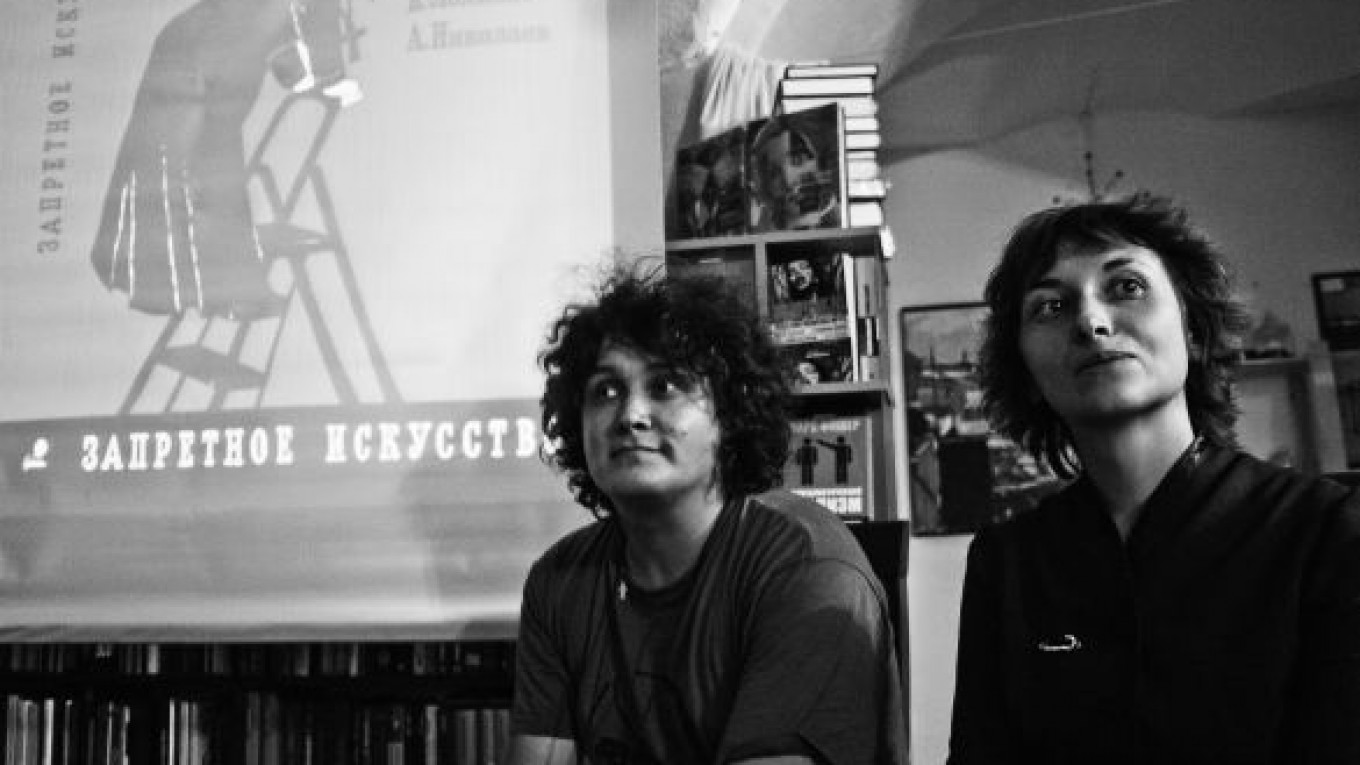
Speaking at a presentation of the book at the bookstore Vse Svobodny, Nikolayev said he had the idea of documenting Yerofeyev and Samodurov?€™s trial, which he described as a ?€?social comedy,?€? because he felt it would expose the characters of the people involved as well as new social trends.
?€?Anton used to be a political journalist, while I was an illustrator for political publications, and we got together some time before the trial to make ‘graphic reports,?€™?€? said Lomasko, who co-authored a small book called ?€?Province?€? (Provintsia) with Nikolayev in 2010.
?€?We wanted to achieve a synthesis of text and imagery that would be so solid and aesthetically beautiful that it could make the grade as a work of art.?€?
According to Lomasko, the two went to the hearings against Samodurov and Vasilovskaya, where Lomasko made live sketches, while Nikolayev recorded the developments and his own thoughts. Both recorded remarks made by participants during the trial.
?€?We sat next to each other and said, ?€?What a scene. It should be drawn,?€™?€? Lomasko said.
At times, the trial resembled a farce. One illustration shows an improbable scene in which the female judge sprays a group of old religious women who have come to support the prosecution with a bottle of French perfume.
?€?When the trial was coming to a close, it was summer and it was abnormally hot, almost 39 degrees, while the courtrooms are small rooms that they hardly ever air out, and it stank horribly of sweat in there,?€? Lomasko said.
?€?Suddenly, Judge Alexandrova produced her French perfume and started spraying the Orthodox women with the words ?€?People should wash.?€™ And they replied, ?€?You go and get washed.?€™?€?
Lomasko said she had heard opinions that such scenes could only be artistic devices or fantasies.
?€?No, they are all genuine incidents,?€? she said. ?€?As to the comments, we simply shortened them and chose the most significant ones.?€?
Lomasko said she was not sure whether it was correct to call them Orthodox Christians.
?€?They don?€™t follow Orthodox Christian ideology ?€” quite the opposite, they?€™re very aggressive, they don?€™t want to understand other people and they call for physical punishment,?€? she said.
?€?But in fact, we even grew to love them a little. Their appearances were very interesting to me as an artist ?€” how they looked, how they were dressed, their gestures, their faces.?€?
Lomasko said she and Nikolayev were not biased when they started working on the series.
?€?We didn?€™t come there thinking that the artists were cool and that the Orthodox Christians were bad. Maybe they were sincere in believing that they had been insulted [by the exhibition],?€? she said.
According to Nikolayev, the majority of those who supported the prosecution were in fact deceived.
?€?They were set up by the court system and by the FSB [Federal Security Service] men, who set them upon the artists,?€? he said.
?€?[The authorities] often scare the intelligentsia by hounding certain marginal groups that seem threatening to them. It?€™s simply a tool. This trial was set up to scare the intelligentsia.?€?
Last year in July, Samodurov and Yerofeyev were found guilty of inciting religious hatred and fined 200,000 rubles ($6,160) and 150,000 rubles ($4,620), respectively.
In June, Yerofeyev was fired from his job as the head of the contemporary art department of the State Tretyakov Gallery. In August, Samodurov resigned from his position as the director of the Sakharov Center, citing disagreements with the U.S.- based Sakharov Foundation?€™s board of directors, who reduced funding drastically in the wake of the 2008 presentation of ?€?Forbidden Art 2006.?€?
Soon after the verdict, Patriarch Kirill I, who has headed the Russian Orthodox Church since February 2009, condemned the exhibition?€™s organizers, saying they were involved in ?€?demonic activities.?€?
?€?Forbidden Art?€? by Viktoria Lomasko and Anton Nikolayev is available at selected bookstores.
A Message from The Moscow Times:
Dear readers,
We are facing unprecedented challenges. Russia's Prosecutor General's Office has designated The Moscow Times as an "undesirable" organization, criminalizing our work and putting our staff at risk of prosecution. This follows our earlier unjust labeling as a "foreign agent."
These actions are direct attempts to silence independent journalism in Russia. The authorities claim our work "discredits the decisions of the Russian leadership." We see things differently: we strive to provide accurate, unbiased reporting on Russia.
We, the journalists of The Moscow Times, refuse to be silenced. But to continue our work, we need your help.
Your support, no matter how small, makes a world of difference. If you can, please support us monthly starting from just $2. It's quick to set up, and every contribution makes a significant impact.
By supporting The Moscow Times, you're defending open, independent journalism in the face of repression. Thank you for standing with us.

Remind me later.