

Over the four years immediately preceding the 2014 Winter Olympic Games, the Culture Ministry has taken it upon itself to provide the host city of Sochi with a so-called "Cultural Olympics." This year, as in both 2010 and 2011, a major event on the latter Olympics' schedule has been the International Winter Festival of the Arts, under the artistic direction of violist and conductor Yury Bashmet. Dropping in on the festival for the second year running, I had a chance to see and hear most of what it had to offer during its first four days.
While the festival was principally focused on concerts of classical music, most of them featuring Bashmet either as violist or as conductor of Novaya Rossia State Symphony Orchestra and the Soloists of Moscow chamber orchestra, it also included an evening of ballet, appearances by Emir Kusturica and his No Smoking Orchestra and French jazz violinist Jean-Luc Ponty, a reading by poet Vera Polozkova of her own works, a performance by Moscow's Vakhtangov Theater, a retrospective of films by Finnish director Aki Kaurismaki and exhibitions of video art, jewelry and cinema posters.
Opening night on Feb. 3 found the Novaya Rossia players on stage at Sochi's Stalinist Imperial-style Winter Theater, playing a marathon of a concert, mostly under Bashmet's baton. The highlight of the program, beyond any doubt, was the performance by Maxim Vengerov — his first since 1999 — of Pyotr Tchaikovsky's Concerto for Violin and Orchestra. Four years ago, having well established himself as one of world's leading violinists, Vengerov put aside his instrument and turned to conducting. But in May 2011, while not forsaking the orchestral podium, he again took up the violin. To judge by his idiomatically Russian-sounding account of the Tchaikovsky concerto, he seems completely back in form, which is good news indeed for the many who admired his playing in the past.
Virtuoso French horn playing is practically nonexistent in Russia. So it was a special pleasure the same evening to hear one of the great present-day masters of the instrument, Croatian-born Radovan Vlatkovic, in a stunning account of Carl Maria von Weber's extraordinarily difficult Concertino for Horn and Orchestra. Also of particular note on the opening program was the quite gorgeous singing of Bolshoi Theater soprano Dinara Aliyeva in arias from operas by Jules Massenet, Francesco Cilea and Giuseppe Verdi.
Things turned rather weird on the third night of the festival with a performance of Bashmet's adaptation of Tchaikovsky's "Eugene Onegin," which turned out to be simply a series of excerpts, in very semi-staged form, strung together with readings from Alexander Pushkin's novel in verse on which the opera is based. Apart from some fine singing by Aliyeva, as Tatyana, and Bolshoi bass Dmitry Beloselsky, as Gremin, it all proved quite disappointing and, at times, downright ludicrous.
Bashmet was listed as conductor, but appeared only to lead the first-act introduction, the second-act waltz and the third-act polonaise, the rest being left to the none-too-commanding direction of young conductor Denis Vlasenko. Among the numerous "staging" oddities was the dual scene, in which Lensky disappeared following his farewell duet with Onegin, leaving the latter to fire his pistol shot into thin air.
My final evening in Sochi was split between a chamber concert featuring Bashmet on viola and a trio of superb young Russian instrumentalists, violinist Alyona Baeva, pianist Katya Skanavi and cellist Alexander Buzlov, and part of dancer-turned-impresario Andris Liepa's ongoing "tribute" to Sergei Diaghilev titled "Russian Seasons of the 21st Century."
The chamber concert was streamed live on the Internet by festival sponsor Rostelecom. From what little I managed to hear, the very impressive assemblage of talent on hand seemed in need of a bit more rehearsal.
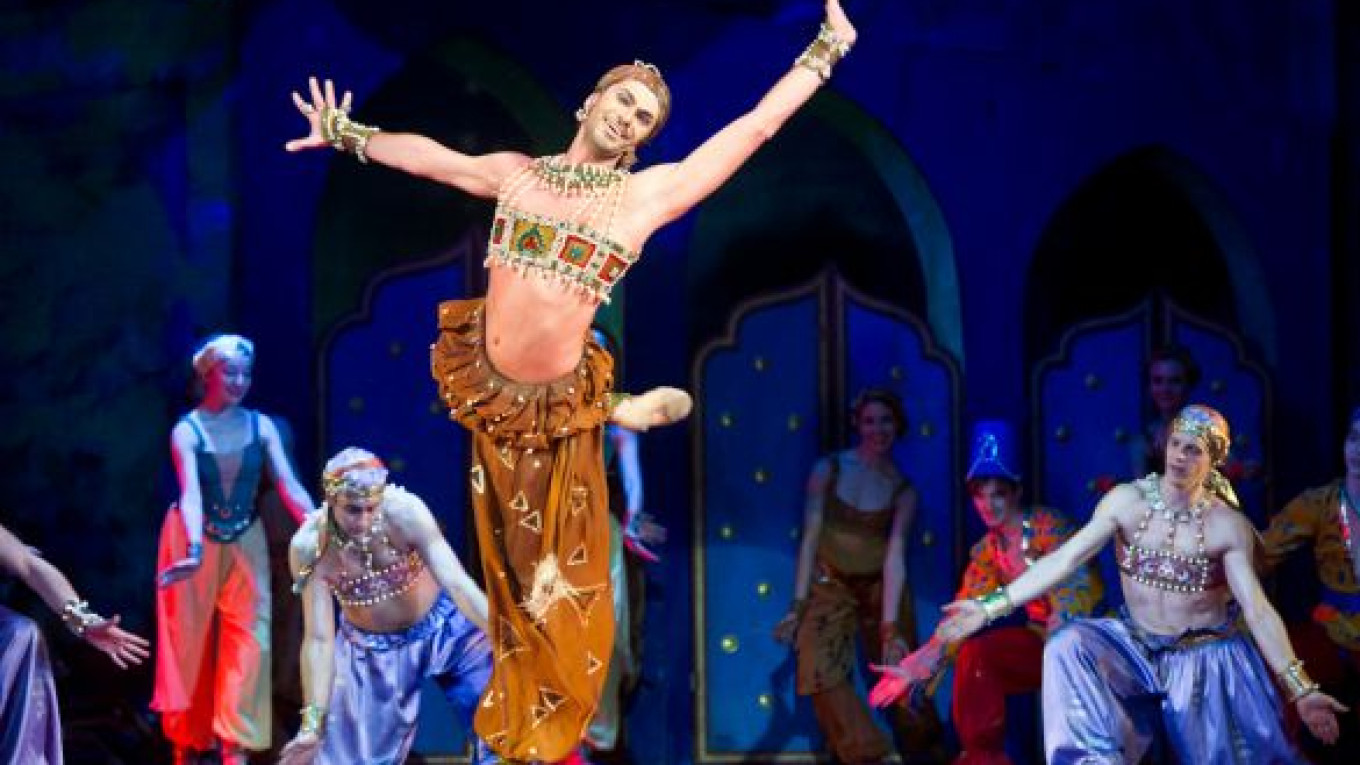
The Sochi audience seemed at least moderately to enjoy the Liepa-produced productions of Mily Balakirev's "Tamara" and Nikolai Rimsky-Korsakov's "Scheherazade," which is more than I can say for myself. Diaghilev performed a great service by introducing so much in the way of top-flight Russian dancers, choreographers, composers and scenic designers to audiences in the West. But, with a few exceptions, the Diaghilev "Saisons Russes" ballets seem hopelessly dated today, especially so as brought to the stage under Liepa's auspices over the past decade.
Both ballets on the Sochi program were choreographed by Mikhail Fokin, with sets and costumes by Lev Bakst. About the only virtue of each production lay in the meticulously reproduced designs of Bakst. In the case of "Tamara," the original choreography has been lost and a rather banal substitute for it created by Lithuanian Jurijus Smoriginas. Kremlin Ballet prima ballerina Alexandra Timofeyeva did her best to bring it alive, but could hardly be faulted for failing to do so. "Scheherazade" came across as little more than a glorified nightclub act, with the principal roles less than inspiringly danced by Mariinsky Theater prima ballerina Yulia Makhalina and Bolshoi principal Nikolai Tsiskaridze.
A Message from The Moscow Times:
Dear readers,
We are facing unprecedented challenges. Russia's Prosecutor General's Office has designated The Moscow Times as an "undesirable" organization, criminalizing our work and putting our staff at risk of prosecution. This follows our earlier unjust labeling as a "foreign agent."
These actions are direct attempts to silence independent journalism in Russia. The authorities claim our work "discredits the decisions of the Russian leadership." We see things differently: we strive to provide accurate, unbiased reporting on Russia.
We, the journalists of The Moscow Times, refuse to be silenced. But to continue our work, we need your help.
Your support, no matter how small, makes a world of difference. If you can, please support us monthly starting from just $2. It's quick to set up, and every contribution makes a significant impact.
By supporting The Moscow Times, you're defending open, independent journalism in the face of repression. Thank you for standing with us.

Remind me later.