

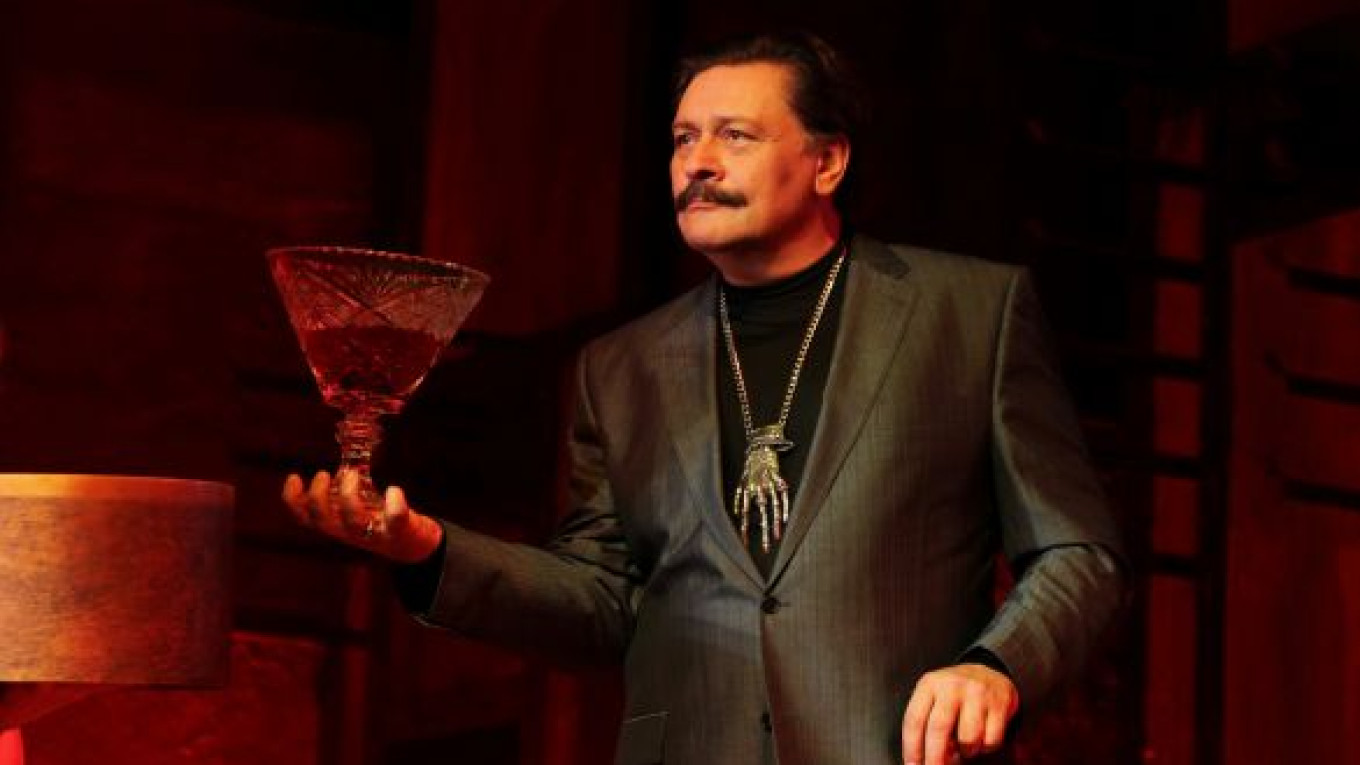
If you are going to do it big, “The Master and Margarita” is a good place to start. Few literary works in the last century have been as popular in Russia as this novel finished by Mikhail Bulgakov in 1940. Its mythology, its spirituality, its take on history, and its images of talented, thinking individuals navigating dangerous territory occupied by hacks, nuts, bureaucrats and Satan are viewed by some as a handbook for living in the Russian capital.
Janos Szasz is a Hungarian film and theater director with numerous major productions to his name in his homeland and the United States. One can imagine how seductive the idea must have been for him to stage “The Master and Margarita” at the storied Chekhov Moscow Art Theater — one of Russia’s favorite books at one of the world’s most famous playhouses.
What Szasz definitely did was make it big. His production features 36 named characters plus an additional cast of 30 extras. Designer Nikolai Smirnov constructed a huge underground world where the action of “The Master and Margarita” is updated to the present. Instead of events taking place on Moscow streets, they unfold in the cavernous tunnels of the local metro.
If you know the novel, you may have guessed it already — instead of falling victim to an unstoppable streetcar, here the pompous atheist editor Berlioz falls beneath the wheels of a passing subway car.
The notion of Bulgakov’s novel taking place in the underground is clever on paper. It accentuates the notion of the Master as an outsider on the run from society. This concerns his meeting the poet Bezdomny in an insane asylum; his hiding place in a tiny, godforsaken apartment with his love Margarita; and the Master and Margarita’s meetings with Woland-as-Satan, who seems quite at home in the depths below the Earth’s surface.
Where it is less successful is in the execution of the idea. Smirnov’s grimy subway is a colorless and uninteresting backdrop. It occasionally transforms into a slick station entrance, as layers of glass doors effortless slip into place, but the grungy, gaping hole of the stage is usually monotonous to an irritating degree.
Szasz sought to enliven things by using film screens that show action taking place beyond the stage, or at times give us a view of onstage events from unexpected angles.
Most, if not all, of the novel is here, although it plays out in a radically different chronology. Things begin as the Master visits Bezdomny in the asylum, where he learns that the latter witnessed the arrival in Moscow of an odd figure named Woland who claimed to be present at the crucifixion of Jesus after Pontius Pilate refused to stay the execution. These scenes from a novel that the Master wrote and destroyed also come to life onstage, as do Woland’s famous foray to a variety theater where he ridicules the ignorant spectators, and Woland’s sinister midnight ball at which Margarita occupies a place of honor.
Curiously, Szasz excised entirely the scenes at the writer’s club, where Bulgakov turned some of his best-loved satire on talentless people worming their way into positions of power.
For all the size and scope of Szasz’s vision, this production underachieves. The acting, with some exceptions, is gratingly flat. True, the director parodies television talk shows, variety shows and cop blockbusters at times, but more often it appears that the performers stepped out of television land without bothering to change clothes or frame of mind. At its best, Bulgakov’s novel is a sweeping, incisive exploration of a chosen few maintaining dignity and spirituality against all odds. On stage at the Art Theater, it most often looks like a portrait of crass, modern pop culture.
Oddly enough, the pair of the Master (Anatoly Bely) and his Margarita (Natasha Svets) largely blends anonymously into the background. His place as a tortured artist, and hers as a self-
sacrificing muse, are largely reduced to that of a man who does not know what to do and a woman who was lucky enough to cross paths with the devil.
Genuine standouts in the overall picture are Dmitry Nazarov’s Woland, a towering figure of cunning and intellect, and Sergei Medvedev, who has the small but crucial task of playing Jesus’ ragged disciple Matthew Levi.
This “Master and Margarita” struck me as a production that primarily aimed to entertain, a curious objective for a work that has such deep meaning for Russian culture.
“The Master and Margarita” plays Oct. 22 and 23, Nov. 12 and 13 at 7 p.m. at the Chekhov Moscow Art Theater, located at 3 Kamergersky Pereulok. Metro Okhotny Ryad. Tel. 629-8760, . Running time: 3 hours, 40 minutes.
A Message from The Moscow Times:
Dear readers,
We are facing unprecedented challenges. Russia's Prosecutor General's Office has designated The Moscow Times as an "undesirable" organization, criminalizing our work and putting our staff at risk of prosecution. This follows our earlier unjust labeling as a "foreign agent."
These actions are direct attempts to silence independent journalism in Russia. The authorities claim our work "discredits the decisions of the Russian leadership." We see things differently: we strive to provide accurate, unbiased reporting on Russia.
We, the journalists of The Moscow Times, refuse to be silenced. But to continue our work, we need your help.
Your support, no matter how small, makes a world of difference. If you can, please support us monthly starting from just $2. It's quick to set up, and every contribution makes a significant impact.
By supporting The Moscow Times, you're defending open, independent journalism in the face of repression. Thank you for standing with us.

Remind me later.