

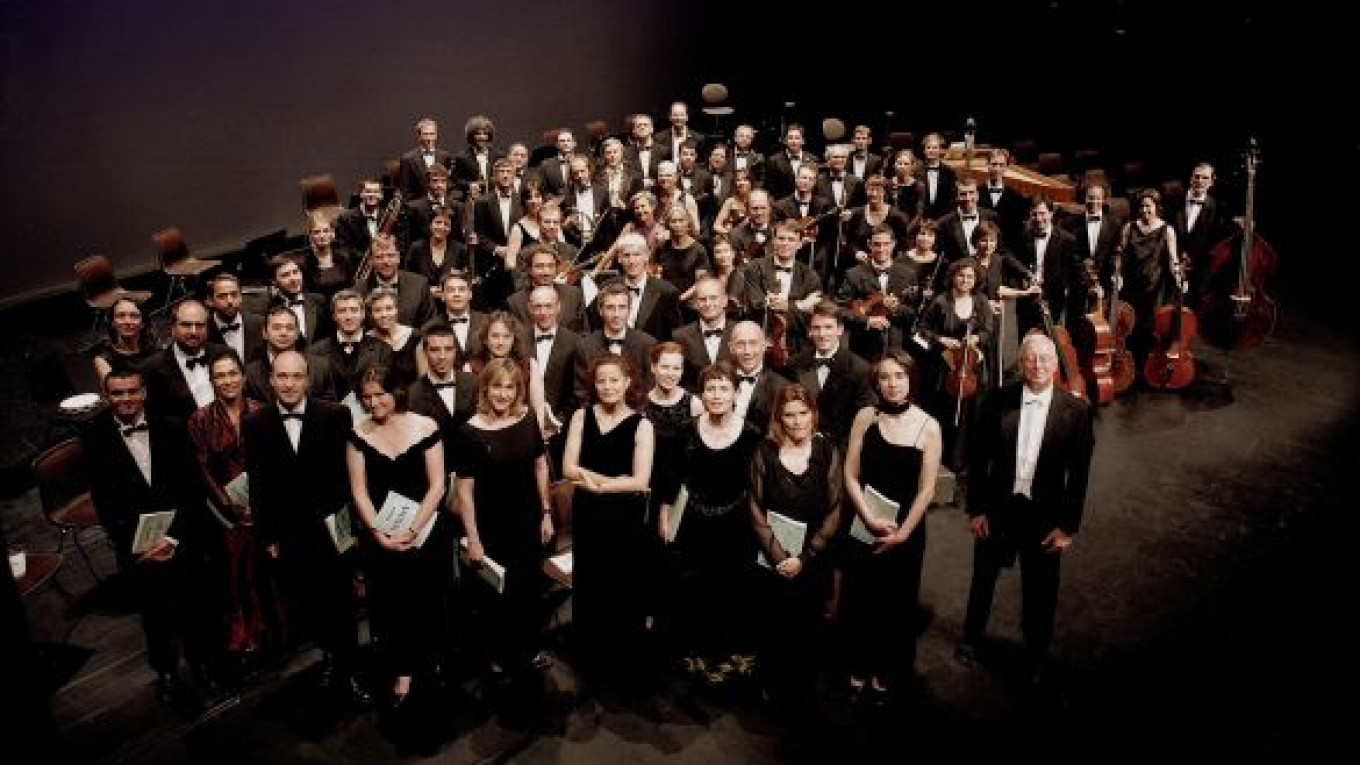
The current Year of France in Russia is likely to reach its musical high point Friday evening, when France’s most distinguished early music ensemble, Les Arts Florissants, makes its Russian debut at Tchaikovsky Hall.
On the program are two supremely beautiful short operas written in close succession during the next-to-last decade of the 17th century: French composer Marc-Antoine Charpentier’s “Acteon,” which dates from 1684; and Englishman Henry Purcell’s much better-known “Dido and Aeneas,” written five years later. Both works will appear in brand-new stagings specially designed for the ensemble’s tours.
The story of “Acteon” is taken from Ovid’s “Metamorphoses” and tells of a young hunter, Acteon of the title, who accidentally comes upon the goddess Diana bathing nude with her attendants. The furious Diana transforms Acteon into a stag, whereupon he is torn to pieces by a pack of hounds. The story of “Dido and Aeneas” comes from another familiar Latin text, Virgil’s “Aeneid,” and concerns the love of Dido, the Queen of Carthage, for Aeneas, a hero of the Trojan War, and Dido’s despair at his abandoning her.
The performance Friday evening will be led by U.S.-born William Christie, who founded Les Arts Florissants in Paris in 1979 and has been its artistic director and source of inspiration ever since.
In its earliest days, the ensemble concentrated on the music of Charpentier, then known almost exclusively for the exuberant opening fanfare of a Te Deum adopted as theme music by the European Broadcasting Union. With a series of beautifully produced recordings, Christie and the ensemble put Charpentier back on the musical map, revealing him to be a composer of exceptional genius.
Little is known about the personal life of Charpentier, born in 1643 and an almost exact contemporary of Louis XIV, but it is clear that he cut a wide swath in the musical life of Paris during the second half of the 17th century, employed as a composer by the playwright Moliere and the cream of the aristocracy and, for sacred works, by the Jesuits and by Sainte-Chapelle in the courtyard of the royal palace on the Ile de la Cite, as well as tutoring King Louis’ son, the Dauphin.
In 1984, while living in Paris and writing occasionally about music for an American magazine, I became acquainted with Christie, and during my two remaining years in France I was privileged to attend a host of Les Arts Florissants’ rehearsals, concerts, opera performances and recording sessions. As a result, I developed a lasting affection for the music Christie chose to play, not only Charpentier’s but also that of other French (and non-French) composers of the 17th and early 18th centuries, and a deep respect for the quality of singing and playing Christie drew from his band of young musicians, plus his rigorous approach to performance in a historically authentic style.
As the 1980s progressed, Les Arts Florissants began its rise to international fame and recognition, while Christie has since pursued a highly successful career conducting opera, particularly works by Monteverdi, Jean-Philippe Rameau, George Frideric Handel and Wolfgang Amadeus Mozart, in opera houses and at festivals throughout Western Europe.
Although this evening marks Les Arts Florissants’ debut in Russia, it had a memorable earlier encounter with a Russian audience almost exactly a quarter of a century ago.
At the beginning of October 1985, the ensemble was scheduled to present a double bill of “Acteon” and Rameau’s “Anacreon,” written in 1757, before an invited audience in the ornately decorated opera house of the Chateau of Versailles. But the date of the performance, as it turned out, coincided with an official visit to France by Mikhail Gorbachev, then recently elected General Secretary of the Communist Party of the Soviet Union. To entertain Gorbachev, French President Francois Mitterrand chose to commandeer Versailles for the very same evening.
A compromise was finally reached, whereby the scheduled performance was delayed to allow time for one of the operas to be played for the Soviet leader and his entourage. Gorbachev was probably best-known at the time for the anti-alcohol campaign he had unleashed back home shortly after taking office. For the crowd of elegantly clad guests waiting outside the gates of Versailles for the official entertainment to end, it caused no little amusement when word was passed around that the opera chosen for Gorbachev was “Anacreon,” a work devoted in large part to the pleasures of consuming wine.
Whether Gorbachev was offended by “Anacreon,” with a text full of such lines as “Reign, divine Bacchus. Enflame our spirits,” was never publicly revealed. If he was indeed offended, the faux pas had no perceptible effect on Franco-Soviet relations. But it certainly did provide a bit of comic relief to the crowd enduring a nearly two-hour wait for the Gorbachev party and its French hosts to emerge from the chateau and ascend to the nearby Grand Trianon for dinner.
Les Arts Florissants perform Friday at 7 p.m. at the Tchaikovsky Concert Hall, located at 4/31 Triumfalnaya Ploshchad. Metro Mayakovskaya. Tel. 299-3957, www.meloman.ru.
A Message from The Moscow Times:
Dear readers,
We are facing unprecedented challenges. Russia's Prosecutor General's Office has designated The Moscow Times as an "undesirable" organization, criminalizing our work and putting our staff at risk of prosecution. This follows our earlier unjust labeling as a "foreign agent."
These actions are direct attempts to silence independent journalism in Russia. The authorities claim our work "discredits the decisions of the Russian leadership." We see things differently: we strive to provide accurate, unbiased reporting on Russia.
We, the journalists of The Moscow Times, refuse to be silenced. But to continue our work, we need your help.
Your support, no matter how small, makes a world of difference. If you can, please support us monthly starting from just $2. It's quick to set up, and every contribution makes a significant impact.
By supporting The Moscow Times, you're defending open, independent journalism in the face of repression. Thank you for standing with us.

Remind me later.