

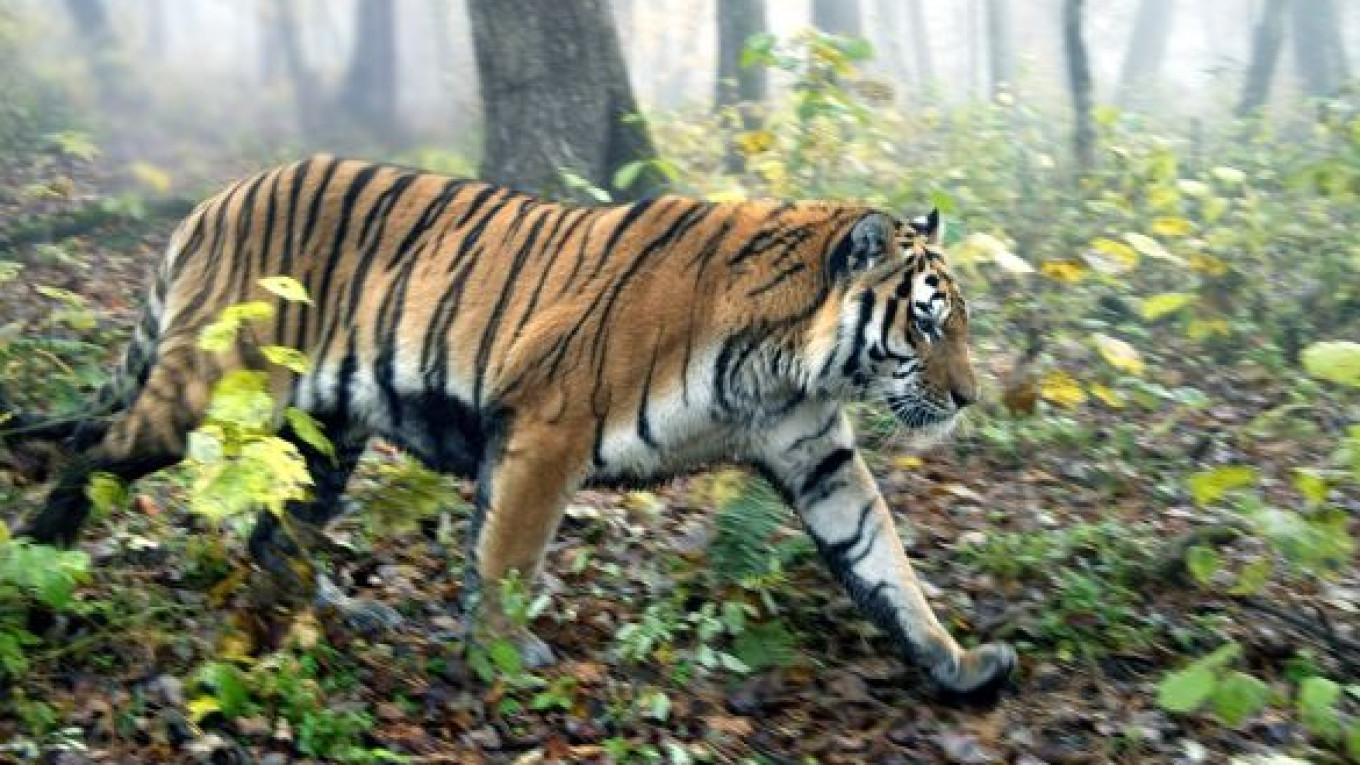
All that remained of beekeeper Vladimir Markov were stumps of bone sticking out of his boots, a bloodied shirt with an arm still inside, a severed hand, a faceless head and a gnawed femur.
A Siberian tiger carried out the gruesome 1997 slaughter in the remote Primorye region of Russia’s Far East, sparking a grim investigation that John Vaillant chronicles in “The Tiger: A True Story of Vengeance and Survival.”
Vaillant, who wrote about logging, conservation and a sacred tree in “The Golden Spruce: A True Story of Myth, Madness, and Greed” (2005), takes a wilderness adventure saga and enriches it with historical, political and economic context. Maybe it is too rich for some: His look at the philosophy of predators and prey includes a section on why young children are fascinated by dinosaurs.
The core story, though, will carry most readers through the heavy bits. One of the principals is Yuri Trush, a squad leader with a group of game wardens called Inspection Tiger, which Vaillant describes as a “wilderness SWAT team” formed to investigate cat-related crimes. Trush must sort out why the tiger attacked so viciously, while also finding and killing it.
Before 1992, there were about 400 wild Siberian tigers in Russia. By 1994, a quarter of them had been killed, with most sold to China, where parts are prized for use in traditional medicine. The whiskers, for example, make you bulletproof, while the penis addresses other shortcomings.
One of the names given to tigers in the Far East is Toyota, “because during the 1990s, that is what you could buy with one,” Vaillant writes. Pressure from foreign conservation groups caused the formation of Inspection Tiger in 1994.
He attributes the surge in poaching to perestroika and the reopening of the Russian-Chinese border. Primorye, like all of Russia, became a place where “the line between politicians and mafia, and between legitimate business and crime, has blurred,” Vaillant writes.
The author also points to other contributing factors in Markov’s case that might explain why this cat seemed to target the beekeeper specifically, and why the big cats and the people in Primorye’s forests lost what had once been a mostly peaceful coexistence.
Markov’s town depended entirely on a state-owned logging company for its livelihood.
The economic restructuring of perestroika killed many such businesses that had come to rely on state support (and so, the movement was soon nicknamed “Katastroika”). Those, like Markov, who chose to stay had to rely on the forest to survive.
He started a honey operation and began poaching with homemade bullets and unregistered guns, using game to barter for essentials like sugar.
Markov could not hunt legally because licenses and approved guns were too expensive.
Russia’s policy “effectively re-created the medieval laws that forbade peasants to own weapons or to hunt,” Vaillant writes.
For Markov, it was “poach or starve,” and his situation set the stage for a desperate act, like bagging a tiger to sell on the black market.
Vaillant writes that a Russian gang member offered a game warden $50,000 for a tiger he shot.
The story takes many twists and turns as Vaillant uses pointed digressions to flesh out and add tension to the pursuit.
He also offers a stark surprise in the final section: another victim whose fate attests to the tiger’s determined stalking.
Trush does not have an easy time of it. The townsfolk are frightened, knowing the injured man-eater is among them. Yet Markov’s friends do not trust Inspection Tiger; they withhold information and hide Markov’s shotgun.
As Vaillant explains, Russian people “have learned through painful experience that information is a weapon that can and will be used against them.”
“The Tiger: A True Story of Vengeance and Survival” is from Random House (329 pages, $26.95).
A Message from The Moscow Times:
Dear readers,
We are facing unprecedented challenges. Russia's Prosecutor General's Office has designated The Moscow Times as an "undesirable" organization, criminalizing our work and putting our staff at risk of prosecution. This follows our earlier unjust labeling as a "foreign agent."
These actions are direct attempts to silence independent journalism in Russia. The authorities claim our work "discredits the decisions of the Russian leadership." We see things differently: we strive to provide accurate, unbiased reporting on Russia.
We, the journalists of The Moscow Times, refuse to be silenced. But to continue our work, we need your help.
Your support, no matter how small, makes a world of difference. If you can, please support us monthly starting from just $2. It's quick to set up, and every contribution makes a significant impact.
By supporting The Moscow Times, you're defending open, independent journalism in the face of repression. Thank you for standing with us.

Remind me later.