

The concept of fashion designers did not exist in the Soviet Union. Huge factories produced tons of clothes and shoes that could not be called fashionable by any stretch of the imagination. People were so keen to get their hands on jeans that they were prepared to pay out half their monthly salary for them. A British friend once told me that in Moscow in the 1980s he had been offered a Russian army officer's uniform in exchange for his trainers.
When access to Western brands opened up after 1991, Russians reacted against this monotony by seeking out the brightest, most striking, and often most garish garments. No one talked about style -- it was all about owning lots of clothes from famous brands.
But now, with designers such as Alyona Akhmadullina and Denis Simachyov gracing the catwalks of Paris and Milan with their collections this year, Russian fashion is starting to make its mark on the international stage. And Russian designers are staying true to their roots, said Swiss stylist Saskia Weber, who spent eight years in Moscow as Russian Marie Claire's fashion and beauty director. "I would use one word to characterize Russian fashion -- luxury. Gold. Fur. Diamonds."
Among Russian designers, Weber said, one name stands out. "Simachyov is the only designer who is successful at home and in the West." His success, she said, comes from his ability to use Russian cliches -- the balalaika, a portrait of Putin -- in a humorous way to create quality clothes.
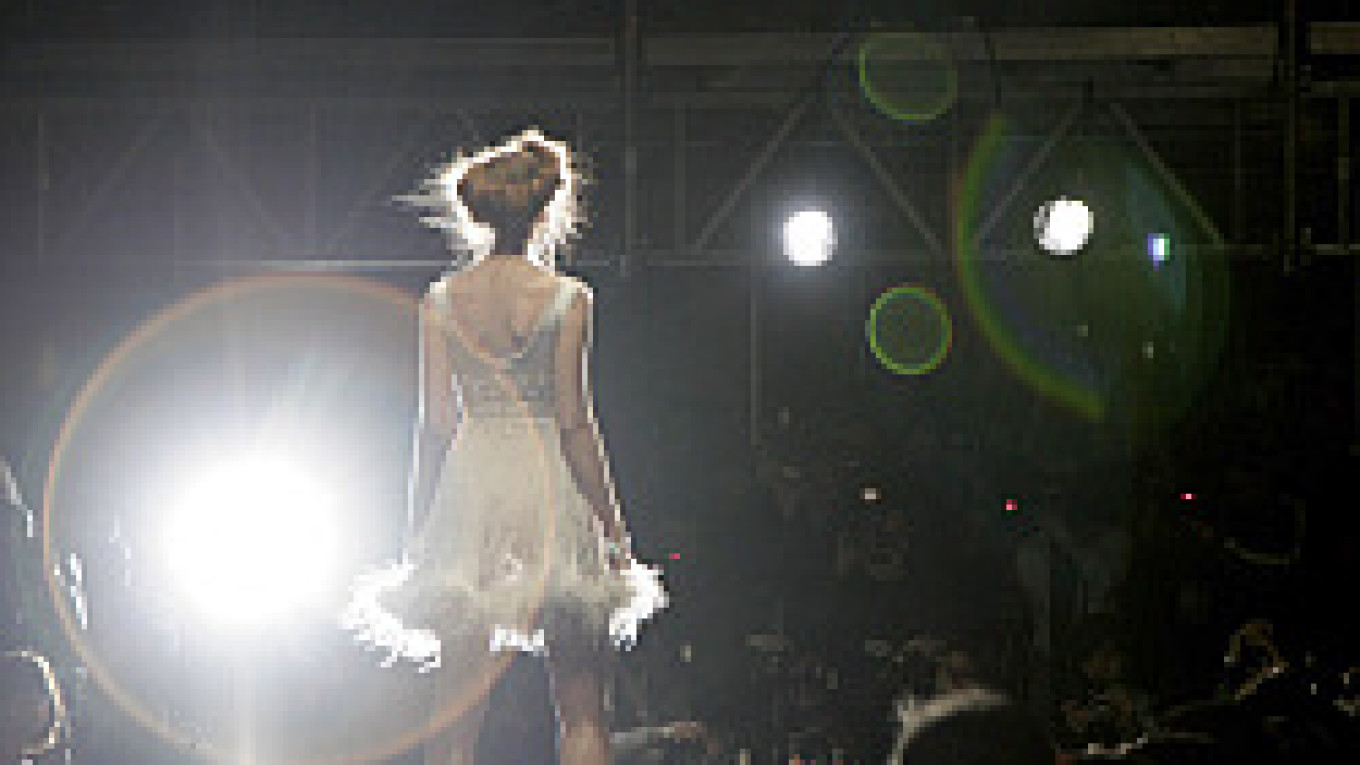
The domestic market is on the up, too. Russian Fashion Week, which opened on Sunday, is an interesting mix of emerging Russian and CIS talent, alongside more established Western designers. Over fifty designers from Russia, Ukraine, Georgia, Spain, Britain, Greece and France are showing their work at this event, which last year featured Vivienne Westwood's Fall/Winter collection. One of the stars of this year's week is the British designer Jenny Packham, who is known as the queen of evening dresses and has been showing in Moscow for the past five seasons. The collection at her show on Wednesday exuded the glamour and femininity for which she has become famous -- floor-length, figure-hugging dresses with open shoulders and backs and complex use of materials such as silk and feathers. The look was sexy with a touch of vintage elegance.
 Thomas Peter / AP Konstantin Gayday's collection was simple but provocative. |  |
| |
"There's a real enthusiasm to get things moving here," Packham said in an interview after her show. "I've really noticed an improvement in the designers' work in the four years I have been coming here. I suppose we could compare it to the '60s in London." Packham was originally invited to take part in a day for British designers and has been coming back ever since. "The market is growing, and the week is well organized. I just bring my show from London," she said.
Things in the Russian fashion world, then, would appear to be on the up -- an article in the New York Times this week ran under the headline, "Russia Challenges West ... On Runway."
But Weber warned that there's still a long way for Russian fashion to go if it wants to be taken seriously in the West.
"Until clothes take precedence over presentation, there won't be any changes in Russian fashion. No one will buy their clothes." This problem of priorities, she said, is above all noticeable at the shows. "You don't see people there taking notes. People come for the show, to show themselves and to look at others, not to work. In other words, the fashion industry in Moscow is not yet a business."
Indeed, anyone who has been present at one of Moscow's two fashion weeks can confirm that it often seems more important which stars are on the catwalk and on the front row than how innovative the clothes are.
This all plays into another problem for Russian designers -- they are not taken seriously as professionals in the West. "Although I have worked for many years with European material producers, they still don't really respect Russian designers," said Ukrainian designer Irina Karavay, who has brought her brand NB & Karavay to Russian Fashion Week for the past five years. "It's hard to work with them, as they do not see us as long-term partners."
But there is hope for the Russian fashion industry -- young designers, many of whom are showing at Russian Fashion Week. "They have passion," Weber said. "When a person is lively and passionate they can make up for their lack of money with talent and the desire to bring an idea to people."
Konstantin Gayday is one such designer with a passion for fashion, rather than show. "I've always only done things that interest me," he said in an interview this week. "The fact that a huge number of people like it just pleases me, and actually surprises me."
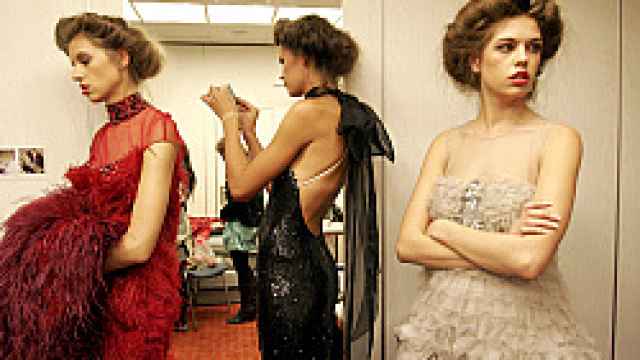 Oxana Onipko / MT Models prepare for British designer Jenny Packham's show on Wednesday evening. | |
| |
He rejects the title of a specifically Russian designer. "I think this idea doesn't really mean anything. There are clothes that people want to wear, and the designer's origin is irrelevant."
Gayday has presented his collections at Russian Fashion Week since 2006. In July 2007, British fashion magazine i-D called him a "national star."
He combines a love of fashion with a hardheaded attitude toward the industry. "Fashion is a business. That's the most important thing. Otherwise, there's no point being involved." Gayday lives off the profits of his work, so the commercial side takes precedence over show. "I don't invite stars to model for me. I think people should stick to their own thing."
But for some designers, the show element creates the high point of their careers, he said. Karavay voiced a similar opinion: "It's an event for high society. It's like a game, rather than a business. Five years ago, going to the shows was cool and prestigious. But things have improved -- it's becoming more and more commercial, for professionals."
Gayday's collection, shown on Wednesday, was faithful to his eclectic style. The assortment of clothing was simple -- tracksuit pants, hoodies and T-shirts with original prints of cartoon-style horror images and giant letters declaring "Fuck Off," worn with fur coats and vests and traditional Russian headscarves.
Gayday has a wide range of clients, from students to famous actresses and directors. And his work is becoming more and more popular: At the moment, his clothes can be bought in Russia and Ukraine, but from autumn they will also be sold in Japan, China, Denmark, Sweden and France.
The most noticeable change in the industry in the last 10 years, Gayday said, has been in mass production. "This has enabled light industry to develop -- new materials, new technology, new design possibilities." In short, it has increased the possibility of making a profit.
But financing and the weak development of light industry remain the main problem in Russia's fashion industry, he said. "Every year, huge numbers of specialists graduate from fashion institutes, and they don't work in the industry as there's just nowhere for them, and no one thinks about it."
For some, though, money isn't an obstacle to breaking into the fashion industry, but other, less tangible barriers are. Kira Plastinina, 16, daughter of milk mogul Sergei Plastinin, found out rather expensively that the world of fashion in the West cannot be so easily bludgeoned by money as in Russia. Paris Hilton, who, it was reported, was paid $2 million to attend Plastinina's show at last autumn's Moscow Fashion Week, was said to have promised to wear one of the young designer's diamond-studded creations at this year's Oscars. There was just one hitch -- Hilton wasn't invited to the ceremony.
Russian Fashion Week runs to Apr. 6. For more information, see www.rfw.ru.
Svetlana Lizogubenko is a fashion stylist based in Kiev.
A Message from The Moscow Times:
Dear readers,
We are facing unprecedented challenges. Russia's Prosecutor General's Office has designated The Moscow Times as an "undesirable" organization, criminalizing our work and putting our staff at risk of prosecution. This follows our earlier unjust labeling as a "foreign agent."
These actions are direct attempts to silence independent journalism in Russia. The authorities claim our work "discredits the decisions of the Russian leadership." We see things differently: we strive to provide accurate, unbiased reporting on Russia.
We, the journalists of The Moscow Times, refuse to be silenced. But to continue our work, we need your help.
Your support, no matter how small, makes a world of difference. If you can, please support us monthly starting from just $2. It's quick to set up, and every contribution makes a significant impact.
By supporting The Moscow Times, you're defending open, independent journalism in the face of repression. Thank you for standing with us.

Remind me later.