

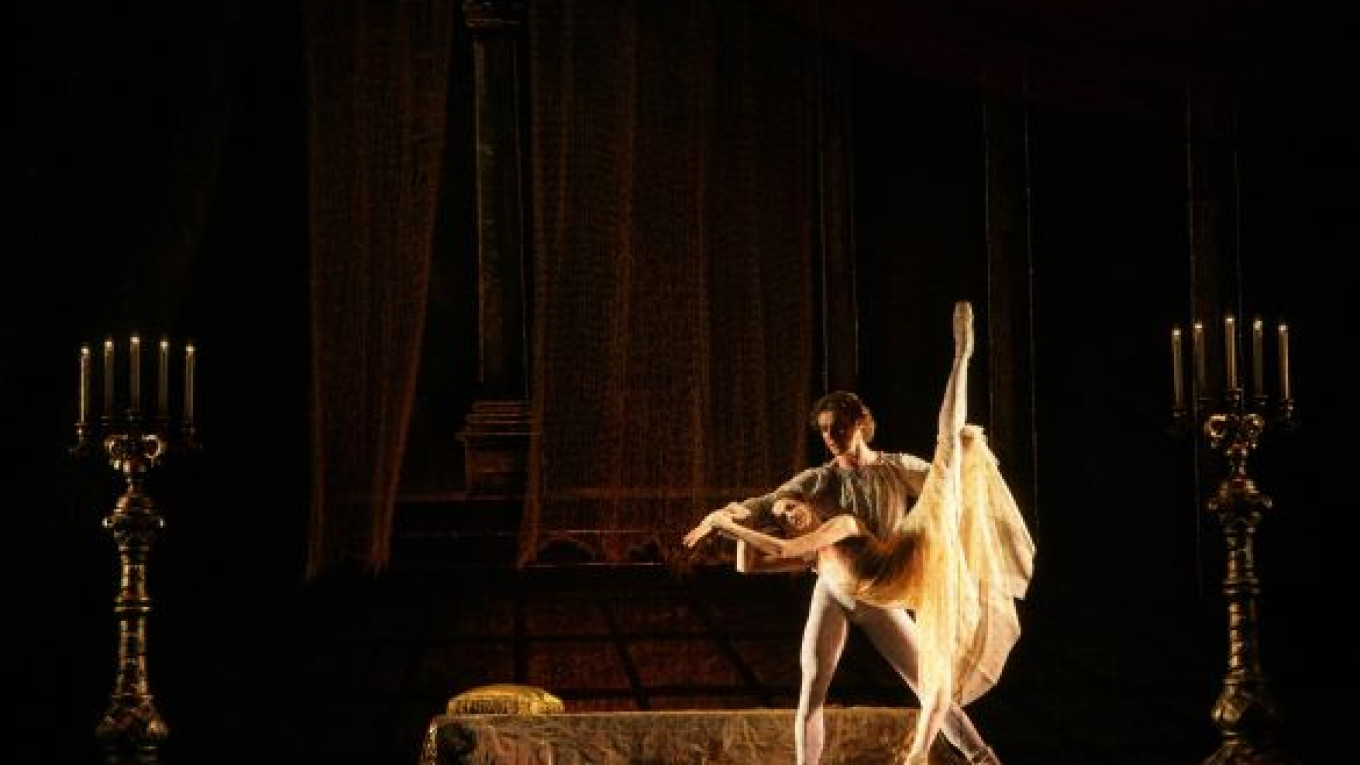
Last week the Bolshoi Theater brought back its 1979 production of Sergei Prokofiev’s ballet “Romeo and Juliet,” with somewhat modified versions of Yury Grigorovich’s original choreography and of the original decor and costumes by Grigorovich’s long-time collaborator, Simon Virsaladze.
Fifteen years after Grigorovich ended his three-decade-long reign as the Bolshoi’s ballet artistic director, he still remains a looming presence at the theater. With the addition of “Romeo and Juliet,” the Bolshoi now has no less than 10 full-length ballets by Grigorovich in its repertoire (or possibly 11, if his “The Age of Gold” has not been definitively discarded). During the current season, those ballets fill nearly half the performances that the Bolshoi is devoting to dance.
With one of the greatest of all love stories for its libretto and one of the most brilliant ballet scores ever written for its music, one can certainly understand why the Bolshoi would want “Romeo and Juliet” in its repertoire. But what could have been its reason for choosing Grigorovich’s version, one of the master’s least successful creations, hardly to be spoken of in the same breath as his early masterpieces, “Stone Flower,” “Legend of Love” and “Spartacus,” or much of what he brought to his reworking of such classics as “Swan Lake,” “Giselle” and “La Bayadere”?
The answer probably lies, at least in part, in the present dearth of choreographers willing and/or able to effectively handle works on the scale of “Romeo and Juliet.” Among Russian choreographers, only the Bolshoi’s sorely missed former ballet artistic director, Alexei Ratmansky, readily comes to mind. But chances are that Ratmansky was either not approached to take it on or had no interest in doing so.
Grigorovich’s “Romeo and Juliet” was preceded at the Bolshoi by the original Russian production, choreographed by Leonid Lavrovsky, which was initially staged at Leningrad’s Kirov (now Mariinsky) Theater in 1940 and brought to the Bolshoi six years later.
The Bolshoi took a third shot at “Romeo and Juliet” in 2003, in what turned out to be one of the brightest and also saddest chapters in modern Bolshoi history. The production was an utterly stunning modern-dress version, jointly concocted by Moldovan choreographer Radu Poklitaru and British director Declan Donnellan. But it lasted for barely more than a year, forced off stage by order of Prokofiev’s heirs, ostensibly because of tampering with the music, but most likely meant as a slap in the face of Poklitaru, who had undertaken, at a theater in Latvia, to turn the heroine of the composer’s ballet “Cinderella” into the housemaid of a brothel.
As I sat through Grigorovich’s “Romeo and Juliet” last week, I couldn’t help but compare it with the Lavrovsky and Poklitaru/Donnellan versions, to say nothing of the greatest of all in my experience, the one created by Kenneth MacMillan for Britain’s Royal Ballet. With those in mind, the term for Grigorovich’s version that kept occurring to me, I somewhat hesitate to say, was “Romeo and Juliet Light.” For the principal problem with the Grigorovich version is the lack of a truly serious-minded approach to both a story and a score of enormous power and gravity.
Best of all in the production are its big scenes — the melee in the square in Verona that opens the ballet, the ball at the Capulets and the carnival scene at the beginning of Act 2. No other choreographer alive can handle crowds on stage with the dexterity and imagination of Grigorovich. The death of Mercutio is also well-constructed and benefited on opening night from its superb interpretation by Vyacheslav Lopatin.
But apart from the final death scene in the Capulets’ vault, there is nothing much in the encounters of the young lovers — particularly their crucial meetings in the Capulets’ garden and Juliet’s bedroom — to stir the blood.
Anna Nikulina, a lovely wisp of a Juliet on opening night, danced acceptably and every so often produced a moment of real pathos. But that was all. Her Romeo, Alexander Volchkov, did little more than dutifully execute his part, at the expense of creating anything remotely like the character.
The less said the better about the raucous, mistake-ridden playing of the Bolshoi orchestra and the wayward leadership of St. Petersburg-based conductor Andrei Anikhanov.
The production would undoubtedly benefit from a better pair of dancers in the title roles and a more sensitive interpretation of Prokofiev’s score. But even with those added to the moments of brilliance that Grigorovich does manage to produce along the way, one is still likely to come away hungry for a “Romeo and Juliet” that digs far deeper into Shakespeare’s tragedy and does much more to exploit the choreographic possibilities of Prokofiev’s score.
“Romeo and Juliet” (Romeo i Dzhulyetta) is not scheduled to appear again during the Bolshoi Theater’s current season, which ends in July.
A Message from The Moscow Times:
Dear readers,
We are facing unprecedented challenges. Russia's Prosecutor General's Office has designated The Moscow Times as an "undesirable" organization, criminalizing our work and putting our staff at risk of prosecution. This follows our earlier unjust labeling as a "foreign agent."
These actions are direct attempts to silence independent journalism in Russia. The authorities claim our work "discredits the decisions of the Russian leadership." We see things differently: we strive to provide accurate, unbiased reporting on Russia.
We, the journalists of The Moscow Times, refuse to be silenced. But to continue our work, we need your help.
Your support, no matter how small, makes a world of difference. If you can, please support us monthly starting from just $2. It's quick to set up, and every contribution makes a significant impact.
By supporting The Moscow Times, you're defending open, independent journalism in the face of repression. Thank you for standing with us.

Remind me later.