

I previously noted that 20 years have passed since I began writing about theater for the Moscow Guardian, a precursor to The Moscow Times. I also gave a clear warning that, throughout the season, I would occasionally exploit this space to reminisce about those times in the theatrical Wild, Wild East. Since I take my warnings as seriously as I do my promises, here are some more thoughts on the ancient past.
Moscow has changed drastically since the early 1990s. There was no Givenchy. Imagine. The Bolshoi Theater was still crumbling. There was no FSB; the KGB was being reformed under the name of the FSK. The notion of a ruling tandem was patently absurd — Boris Yeltsin and Mikhail Gorbachev despised each other.
And theater — well, if you believed what everybody was howling, theater was dead. D-e-a-d. As in deceased and gone forever. Never to return.
“Oh! There are no directors!” “Oh, there are no playwrights!” “Oh, there are no theaters worth attending!” “It’s all over! Russian theater is a thing of the past! History!”
I once sat next to a woman at a conference at the Theater Union, and I told her about a show I had just seen that I really liked. She looked at me with pity and scorn and said, “Oh, come now. There can’t be anything worth watching in Moscow these days!”
I demurred, but she was not to be swayed. “I was brought up on Meyerhold,” this woman aged 40 said with an entirely straight face. “Nobody now can compare to what I was brought up on.”
Let’s skip the fact that my interlocutor was born at least a decade after the great innovator Vsevolod Meyerhold was murdered in the basement of the Lubyanka in 1940. And let’s forget the fact that when she was growing up Meyerhold’s legacy was kept tightly under wraps — what could she really have known about him? Let’s just consider the logic of someone firmly declaring that only theater made 50 or 60 years ago could be of interest.
I remember another incident, one that acquired the flush of controversy for a few weeks. A small theater newspaper called Dom Aktyora (Actor’s House) ran the results of a poll asking theater people to give contemporary directors a military rank — commander, general, captain, private, etc. It turned out that not one single contemporary director was considered to have the authority of a commander or general — the highest ranks were lieutenant, if I remember correctly. Several accomplished directors were labeled as grunts.
Obviously, it was a tempest in a teapot, but it was also highly indicative of the age. If you were a living, breathing maker of theater, you could not possibly be of interest to anyone.
I remember reading and hearing how, in addition to everything else it lacked, Russia had no stars. Hollywood had stars. Cannes had stars. Moscow? Don’t be silly.
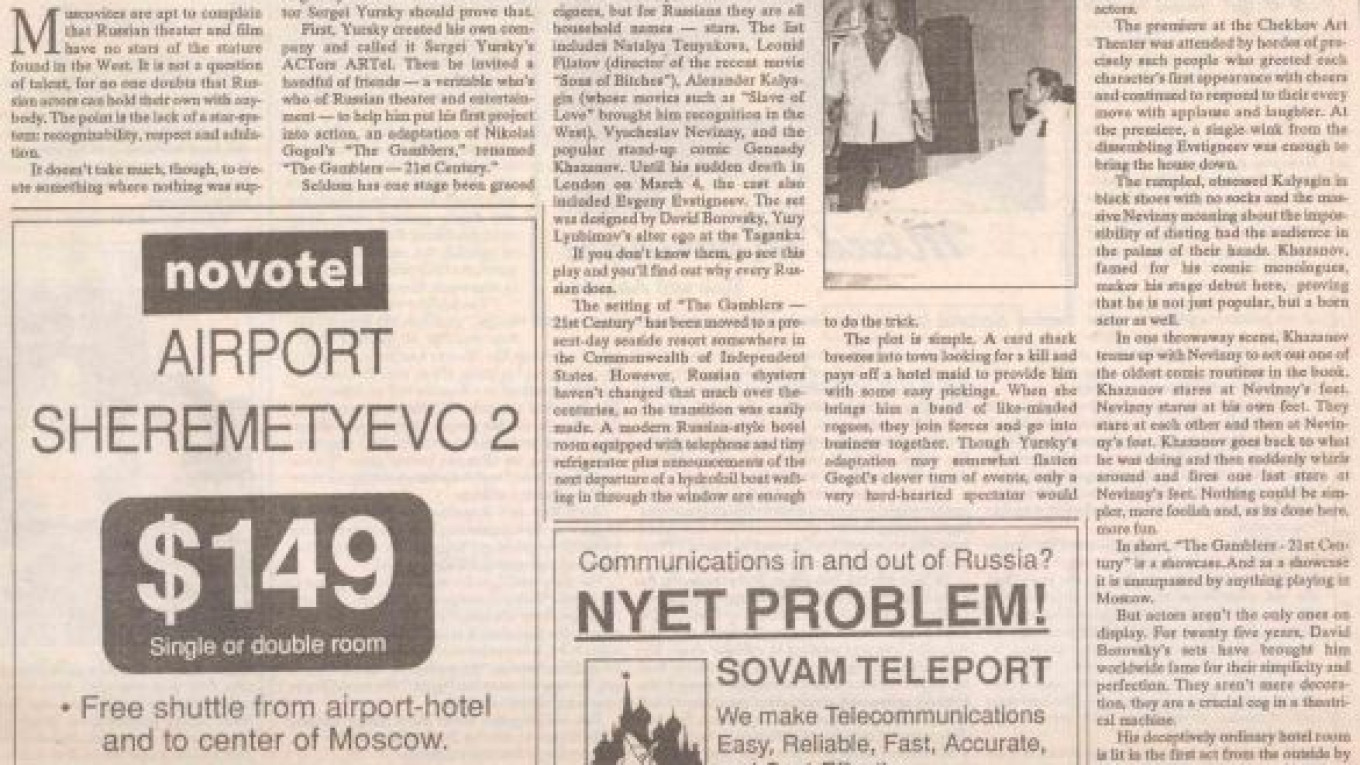
Don’t be silly, indeed! Which brings me to a show that I consider a turning point in recent Russian theater history. Produced by an independent company called ACTors ARTel, the show opened in the early spring of 1992. Its title — “The Gamblers – 21st Century” — implied that director Sergei Yursky was purposefully looking to shake up the doldrums of the ’90s.
Yursky is a star. He was one of the most famous actors in Leningrad at the Bolshoi Drama Theater in his early career, and then he moved to Moscow in the later 1970s where he built on his reputation and popularity. He starred in many popular films, including such all-time Russian favorites as “The Man From Nowhere,” “The Golden Calf,” “The Meeting Place Cannot Be Changed” and “Cherchez la femme.”
In casting “The Gamblers,” a rendition of Nikolai Gogol’s play about a bunch of crooks cheating a bunch of cardsharps, Yursky surrounded himself with nothing but stars. The cast included the great Yevgeny Yevstigneyev (in his final role), as well as the extremely popular Natalya Tenyakova, Alexander Kalyagin, Leonid Filatov and Vyacheslav Nevinny. For good measure, Yursky gave a prominent role to one of Russia’s most beloved, and funniest, comedians — Gennady Khazanov.
Imagine Al Pacino, Robert De Niro and Meryl Streep — with Robin Williams thrown in — joining forces to do a show together. So much for the “no star” stuff.
“The Gamblers” was one of the funniest shows I’ve ever seen. The audience was in stitches from beginning to end. It was fast-paced, it was smart, it was dark, and it cut like a blade. It was everything a Russian comedy should be.
The premiere, held on the stage of the Moscow Art Theater, was a huge success. Packed house. Great performances. What else could you want?
Well, the Moscow pundits wanted anything but what they got. They didn’t like the fact that this was a so-called “commercial” production, that it was not a show conceived and nurtured in the bowels of a repertory company. Why are all these actors from different places playing together? This was a brand new idea at the time and no self-respecting critic (is there any other kind?) would be caught dead supporting that idea. These days it’s just the opposite — everyone is howling at the top of their lungs to dismantle the repertory system. That’s what 20 years will do to you.
But to get back to my point, “The Gamblers – 21st Century” flew in the face of expectations and opinion, and Yursky pretty much took it on the chin for his efforts. The show enjoyed a successful run with the public, but the theater community turned its back and stuck its nose in the air.
That’s what it was like in the early 1990s. If you dared say something was good, you were labeled a softy. If you dared create something good, you were razzed.
Now let’s be honest. Everyone knows Moscow is a tough town. Anyone with any knowledge of Russia knows the phrase, “Moscow does not believe in tears.” Nope. Not a sentimental city. But I have never seen Moscow harder or more obstinate than it was in the early 1990s when I began writing about theater.
There was plenty of good theater around. But you had to open your eyes and heart — and close your ears — to find it.
A Message from The Moscow Times:
Dear readers,
We are facing unprecedented challenges. Russia's Prosecutor General's Office has designated The Moscow Times as an "undesirable" organization, criminalizing our work and putting our staff at risk of prosecution. This follows our earlier unjust labeling as a "foreign agent."
These actions are direct attempts to silence independent journalism in Russia. The authorities claim our work "discredits the decisions of the Russian leadership." We see things differently: we strive to provide accurate, unbiased reporting on Russia.
We, the journalists of The Moscow Times, refuse to be silenced. But to continue our work, we need your help.
Your support, no matter how small, makes a world of difference. If you can, please support us monthly starting from just $2. It's quick to set up, and every contribution makes a significant impact.
By supporting The Moscow Times, you're defending open, independent journalism in the face of repression. Thank you for standing with us.

Remind me later.