

"The only thing changing about 'the problem of the year' is the date on the calendar -- the heart of the matter is what it's always been," Luzhkov wrote in state-owned daily Rossiiskaya Gazeta in late January. "It is the expanding and progressive deterioration of our entire national infrastructure."
As an indication of dangers to come -- and in an eerie forewarning of the Basmanny market disaster -- Luzhkov cited the December roof collapse at a Perm region swimming pool that killed 13 people, and the Transvaal water park roof collapse that killed 28 people in February 2004.
Disasters like these are only the most visible signs of a problem that has become all too common in the city, officials and construction experts said.
"It's no secret that things like this happen periodically in Moscow," said Denis Plotnikov, head of the city buildings inspection agency's branch for southern Moscow. "Walls and roofs collapse all the time."
Across the country, officials have reported a spate of roof collapses in recent days.
On Friday, a Kazan market's roof collapsed, killing one woman.
On Monday, three roof collapses were reported in the Moscow region alone, the regional branch of the Emergency Situations Ministry said.
Also Monday, the roof of a children's health clinic in the Altai region caved in. On Tuesday, 40 residents escaped from a Kursk apartment building as its roof collapsed.
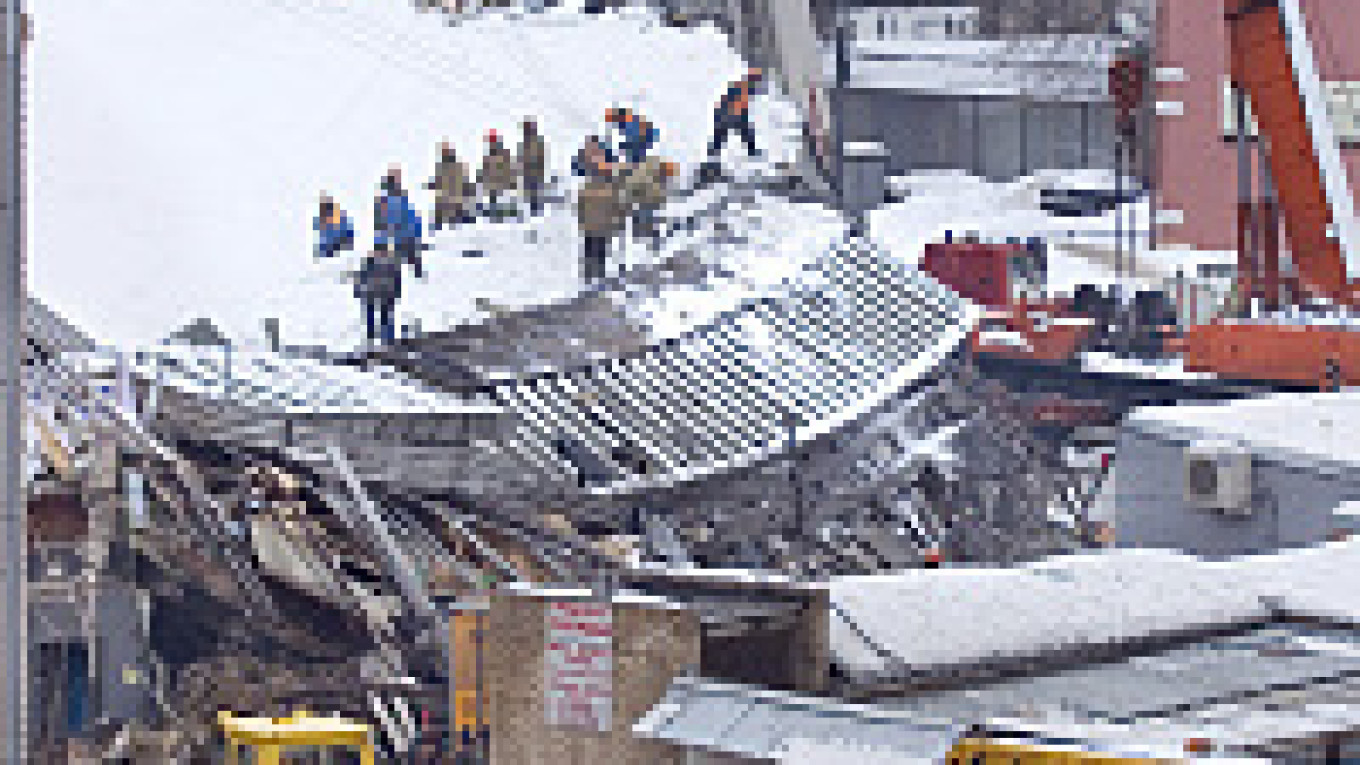
The Feb. 23 Basmanny collapse was one of five partial or total building collapses in the capital in the three months to March 1, according to Denis Voloshchuk, president of the Moscow-based Indeks Independent Inspection Bureau.
In the finger-pointing that followed the collapse of the Basmanny market roof, much criticism was leveled at its architect, Nodar Kancheli, who also designed the roof of the Transvaal water park.
Another target was the market's director, Mark Meshiyev, who was arrested on charges of causing death by negligence. He faces up to five years in jail if convicted.
Voloshchuk, however, said the problem went far beyond design flaws or individual negligence.
"For 20 years, since perestroika, no one has done anything about this problem of aging Soviet buildings -- the money isn't being spent, the inspections aren't being done," Voloshchuk said. "Now, we're starting to see the consequences all the time."
Since the Basmanny market collapse, a wave of building inspections has swept the country in an apparent display of concern about poorly maintained Soviet-era buildings in all categories of real estate.
Shortly after the Basmanny collapse, the head of the Federal Culture and Cinematography Agency, Mikhail Shvydkoi, ordered inspections at all the agency's properties, at least one of which -- the Moscow Conservatory Great Hall -- had already been declared in dire need of repairs by government inspectors in January. Concerts will continue to be held in the hall until May 8, according to the conservatory's web site.
Twenty public swimming pools in the Penza region were closed earlier this month after the regional prosecutor's office declared they had been operating for two to three decades without being properly repaired, Interfax reported. And two residential buildings near the Basmanny market were undergoing intensive inspections, requiring the resettlement of 67 families and 35 other residents, the online news agency Rosbalt.ru reported.
But even when inspections identify dangerous buildings before it is too late, finding the money to fix them can be a struggle, city officials said.
"For a long time after the fall of the Soviet Union, the arrival of the market economy and other financial issues led to the chronic under-funding of reconstruction work," said Tatyana Fillipova, a spokeswoman for the city inspection agency responsible for residential buildings. "It's hard to make up for the lost time all at once."
Out of 29,000 residential apartment buildings listed by the city government's Bureau of Technical Inventory, 150 need to be torn down, and another 1,672 are officially designated as "dilapidated," meaning that they would need to be more than 80 percent rebuilt.
"The amount of major repairs being carried out is directly related to the financing available in the city budget," Fillipova said. While that amount is increasing each year, "it's still not enough," she said.
The city government last year allocated a total of 10.1 billion rubles ($362 million) for major repairs of residential properties, and this year raised the allocation to 13.4 billion rubles ($479 million), a 13.3 percent increase.
But with a government inflation target of 8.5 percent for 2006 -- and prices already having risen 4 percent in the first two months of the year -- much of the increase could be wiped out in real terms.
Further complicating the situation is the ambiguity about how to finance reconstruction in partially privatized apartments. According to the new Housing Code that went into effect March 1, individual owners should contribute to major building repairs.
Fillipova, however, said that the city budget was likely to foot most of the repair bills for the foreseeable future.
"Sooner or later, this situation should change," she said. "But for now, apartment owners aren't ready to pay for major repairs to their buildings."
Aside from crumbling walls and roofs, the widespread deterioration of electrical, gas, and water infrastructure brings its own risks, said Viktor Beltsov, a spokesman for the Emergency Situations Ministry.
"According to various estimates, 60 to 80 percent of the nation's utilities infrastructure needs to be replaced -- we're talking about gas pipelines, water pipes, the electrical system, all the basic assets," Beltsov said.
Beltsov said that while individual ministries were carrying out some preventative repairs, the problem had reached "a critical phase."
City Residential Insurance spokeswoman Vera Lapkina said it was "quite likely" that deteriorating infrastructure was to blame for a considerable number of domestic accidents, such as gas explosions and fires.
"Improvements are being made, but not to all buildings, and not to as many as need it; that's quite clear," Lapkina said.
Voloshchuk, whose company conducts construction audits for the government and private clients, was vague about what improvements would happen as a result of officials' reaction to the Basmanny accident.
"We're starting to hear a dialogue" about the need for stricter laws governing building inspections in the wake of the collapse, Voloshchuk said.
But he warned that any new laws would be meaningless without the technical expertise and money to carry them out.
"Conducting a proper, thorough inspection costs tens of thousands of dollars," Voloshchuk said. "You can't spend as little money as possible, look a building over and say everything's OK."
A Message from The Moscow Times:
Dear readers,
We are facing unprecedented challenges. Russia's Prosecutor General's Office has designated The Moscow Times as an "undesirable" organization, criminalizing our work and putting our staff at risk of prosecution. This follows our earlier unjust labeling as a "foreign agent."
These actions are direct attempts to silence independent journalism in Russia. The authorities claim our work "discredits the decisions of the Russian leadership." We see things differently: we strive to provide accurate, unbiased reporting on Russia.
We, the journalists of The Moscow Times, refuse to be silenced. But to continue our work, we need your help.
Your support, no matter how small, makes a world of difference. If you can, please support us monthly starting from just $2. It's quick to set up, and every contribution makes a significant impact.
By supporting The Moscow Times, you're defending open, independent journalism in the face of repression. Thank you for standing with us.

Remind me later.