

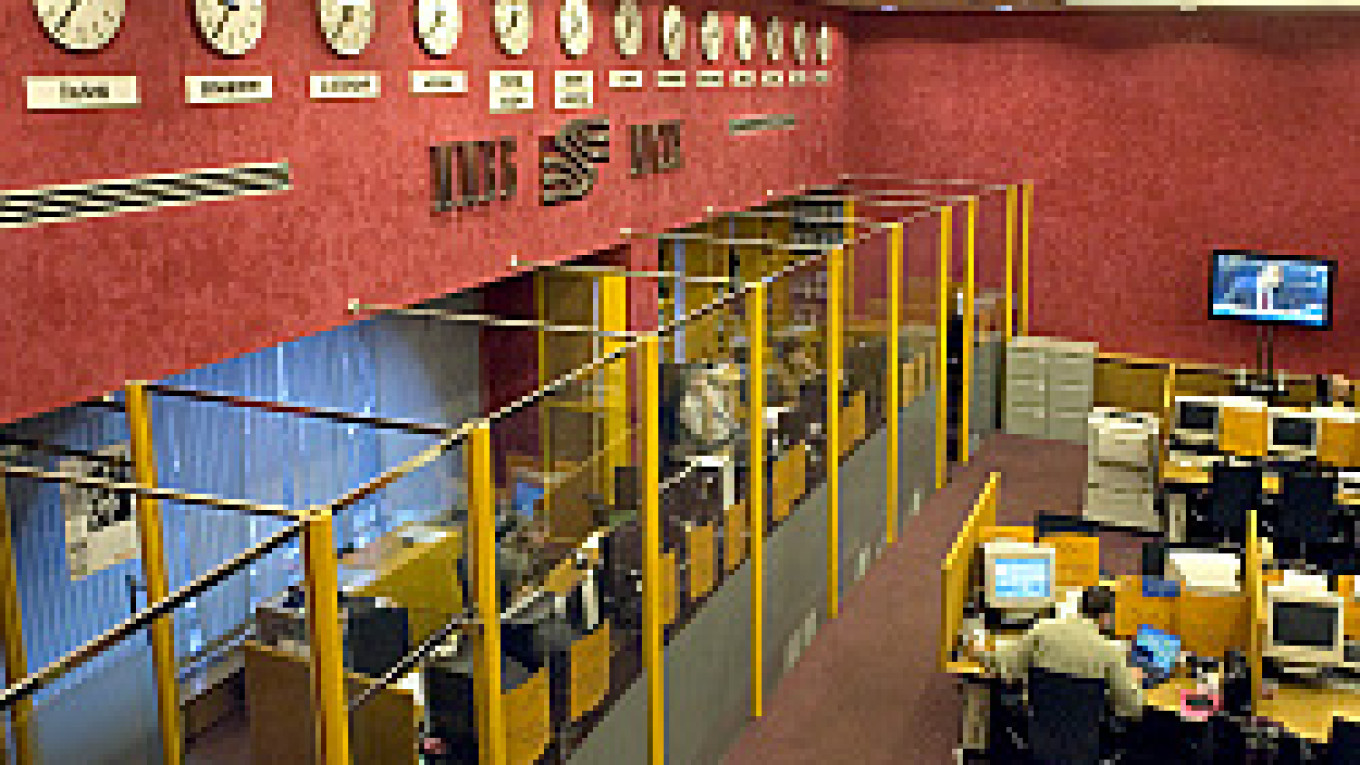
"It actually could triple at the MICEX, because in the last week we've had three record days of trading," said Alexei Rybnikov, the CEO of the MICEX stock exchange.
It's been a record-breaking year for Russian trading, especially for local exchanges, which have continued to take market share from bourses in London and New York, where some Russian blue chips have listed depositary receipts.
High commodity prices, a bumper crop of initial public offerings, and strong growth in corporate earnings have combined to boost stock and bonds trading at the MICEX to $658 billion from January to November, up 191 percent over the 12-month total for 2005. RTS trading was $139 billion through November, up 122 percent from its 2005 total.
"Most of the blue chips I trade on the MICEX. For second-tier stocks I go to the RTS," said Derick Pearlin, managing director and head of equities trading at MDM Bank. Even though the RTS lists MDM among its most frequent traders, Pearlin says more and more of his trades are going through the MICEX.
By Rybnikov's reckoning, the ruble-denominated MICEX stock exchange has processed about 95 percent of the country's stock and bond trading over the past three months, and he estimates the exchange is about 15th in the world in stock trading, not far behind Hong Kong and Shanghai.
The RTS said in a statement that it retained its leading position for certain types of trading, that it quoted more stocks than any other Russian exchange and that it was the leader in derivatives such as futures and options. Also, foreign investors generally prefer getting dollar-denominated stock quotes from the RTS, although Pearlin says brokers and traders can easily convert the MICEX ruble quotes to dollars or any other currency.
The dollar-denominated RTS is also the main benchmark for Russian stocks, both within Russia and for foreigners. In the last week, it passed its previous high, reached in May, and topped 1800.
"For better or worse, it's been the benchmark," Alfa Bank strategist Erik DePoy said. "RTS is dollar-denominated -- it's easier to understand for foreigners."
Not just in trading volume, but also in value, Russian equities have soared this year, although not quite achieving their attention-grabbing 2005 performance. The so-called correction that hit emerging markets in May caused Russian stocks to lose one-quarter of their value. Still, Thomson Financial said this week that Russian equities had rallied and returned 68 percent since the start of the year, trailing behind only Venezuela and China in the list of major emerging markets.
By Alfa Bank's count, the total market value of Russian publicly traded equity reached the $1 trillion mark in early December. About 70 percent of Russian stock trading now takes place within Russia, up from 55 percent one year ago.
"In the second quarter we experienced massive capital inflows, which also stimulated trading," said Yevgeny Gavrilenkov, the chief economist at Troika Dialog.
Gavrilenkov said the removal of the "ring fence" restriction on Gazprom shares and the liberalization of currency regulations helped jump-start stock and bond trading, and he forecasts a significant but smaller increase in trading next year, assuming similarly high oil prices and a reasonable current-account surplus.
Also, the Central Bank's clear indications that it would let the ruble strengthen helped attract money to Moscow, he said.
Rybnikov said he expects MICEX stock and bond trading volume to grow by 45 percent in 2007. "It's a fairly ambitious forecast -- we think it's achievable," he said.
Rybnikov admitted that the MICEX generally costs brokers more in fees than the RTS, but said the higher fees were offset by the narrower spread between the bid and ask price for a stock, typically saving them money in the long run.
Of course, the RTS will continue to get business for special types of trades and for second-tier stocks that rarely trade elsewhere. Some well-known stocks, such as Yukos and pipe maker TMK, do not trade on the MICEX at all.
The RTS also launched a Urals crude futures contract this year that was later imitated by the New York Mercantile Exchange.
The RTS and MICEX, as well as the handful of other tiny exchanges in the country, will continue to compete for trading in stocks and, in the future, derivatives, which are still a relative novelty for Russian traders and legislators.
"Between the two of them, you've got the whole spectrum," DePoy said. "I call that healthy competition between the two bourses."
A Message from The Moscow Times:
Dear readers,
We are facing unprecedented challenges. Russia's Prosecutor General's Office has designated The Moscow Times as an "undesirable" organization, criminalizing our work and putting our staff at risk of prosecution. This follows our earlier unjust labeling as a "foreign agent."
These actions are direct attempts to silence independent journalism in Russia. The authorities claim our work "discredits the decisions of the Russian leadership." We see things differently: we strive to provide accurate, unbiased reporting on Russia.
We, the journalists of The Moscow Times, refuse to be silenced. But to continue our work, we need your help.
Your support, no matter how small, makes a world of difference. If you can, please support us monthly starting from just $2. It's quick to set up, and every contribution makes a significant impact.
By supporting The Moscow Times, you're defending open, independent journalism in the face of repression. Thank you for standing with us.

Remind me later.