

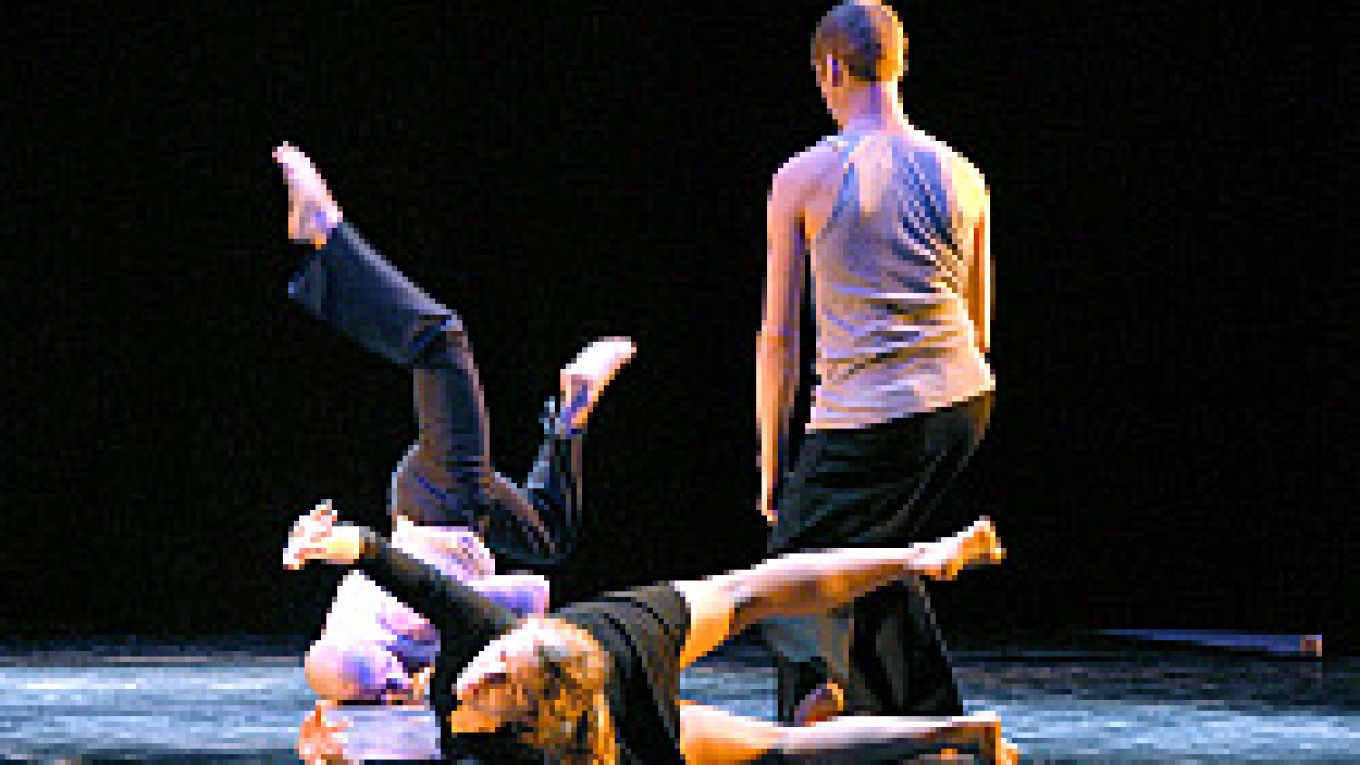
The festival, which has run annually since 2001, is organized by the Moscow dance agency TsEKh. "Our aim is to unite the Russian contemporary dance community," said Yelena Tupyseva, director of TsEKh, in an interview Wednesday. This community, while not large, is spread all over Russia, she explained.
Contemporary dance developed in Europe and North America in the 20th century as a reaction against the constraints of ballet's formal style. "It was an attempt to find a new vocabulary," said The Independent's dance critic, Nadine Meisner, in a telephone interview Tuesday. "This vocabulary is intense and expressionistic: Movements express feelings."
This form of dance only took off recently in Russia. "We have had 15 years to catch up on a whole century of development in the West," said Tupyseva. But this freedom from baggage allows Russian contemporary dance to develop in new and unique ways. Choreographers don't bear the burden of history, she said. "They are free to invent."
Progress was fast in the 1990s, as choreographers and dancers brought ideas from abroad and came into contact with groups touring Russia. Different centers soon emerged, most notably in Chelyabinsk and Yekaterinburg, as there was plenty of rehearsal space there, unlike in Moscow, Tupyseva explained.
This combination of innovation and imitation has led Russian contemporary dance in a European direction, Meisner said. "It's orientated towards German dance theater with its use of props, stage designs and cutting of music."
In fact, many of the choreographers who will be at the festival prefer to view the performances as a whole work of art rather than simply a dance. "Many of them get very involved with the sound engineers and the design of the stages," Tupyseva said.
Like contemporary artists, choreographers are not primarily interested in telling a story, Tupsyeva said. The shows are "about feelings and common experience."
There will be two different parts to the program -- small-scale and large-scale productions. The smaller productions will take place in Aktovy Zal, the former assembly hall of the still-functioning Oktyabr paper factory, and will feature a number of new names.
The relatively compact size of the venue -- Aktovy Zal holds around 200 people at a squeeze ?€“ allows the audience to be close to the dancers, as if they are taking part in the performance, Tupyseva said. Productions will range in style and scale from those of single artists, such as Tatyana Gordeyeva's "Gallina Aquatica" to larger projects with 10 or 12 dancers.
The top names will stage performances at the bigger venues, such as Teatr Modern, which can hold 300 to 400 people. Two of the big names at the festival are Olga Pona -- choreographer at the Chelyabinsk Theater of Contemporary Dance -- and Tatyana Baganova -- choreographer of the Yekaterinburg-based Provincial Dances company. "Along with Sasha Pepelyayev [TsEKh's artistic director], they were part of the first wave in Russian contemporary dance," Tupyseva said.
All the works presented at the festival will be premieres, she said. "Pona's performance [called "Attraction"] will actually be a work in progress, something she started in the autumn."
TsEKh contemporary dance festival runs to Sun. at various venues. For more information, see the Calendar listings and www.tsekh.ru.
A Message from The Moscow Times:
Dear readers,
We are facing unprecedented challenges. Russia's Prosecutor General's Office has designated The Moscow Times as an "undesirable" organization, criminalizing our work and putting our staff at risk of prosecution. This follows our earlier unjust labeling as a "foreign agent."
These actions are direct attempts to silence independent journalism in Russia. The authorities claim our work "discredits the decisions of the Russian leadership." We see things differently: we strive to provide accurate, unbiased reporting on Russia.
We, the journalists of The Moscow Times, refuse to be silenced. But to continue our work, we need your help.
Your support, no matter how small, makes a world of difference. If you can, please support us monthly starting from just $2. It's quick to set up, and every contribution makes a significant impact.
By supporting The Moscow Times, you're defending open, independent journalism in the face of repression. Thank you for standing with us.

Remind me later.