

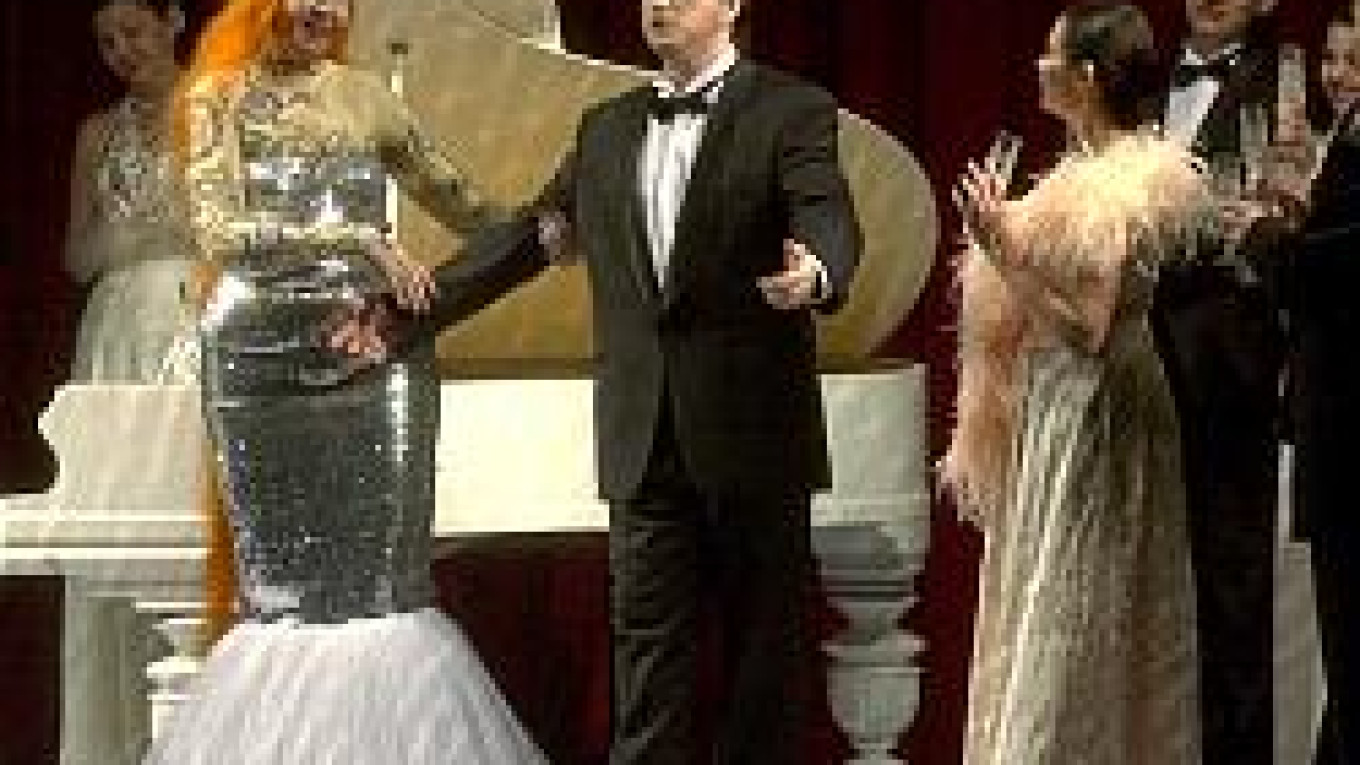
Doing "The Rake's Progress" in Russian would, of course, also have its drawbacks, as well as violate the Bolshoi's current policy of performing operas only to their original words. But, as became abundantly clear when the singers turned to their own language for the opera's brief epilogue, a Russian translation does far less damage to the work's vocal line than English sung with thick and gooey Russian accents.
"The Rake's Progress" made its debut in Venice in 1951 and appeared once before in Moscow, in a 1978 Russian-language production at the Pokrovsky Chamber Musical Theater. Inspired by a set of engravings with the same title by 18th-century English artist William Hogarth, the opera tells the story of Tom Rakewell, a penniless young country gentleman who suddenly finds himself the heir to a fortune left by a previously unknown uncle. Tom instantly sets off to conquer London, in the company of a mysterious figure named Nick Shadow, who volunteers to be his guide, on the condition that "[a] year and a day hence we will settle our account."
With Shadow at his side, Tom indulges himself in luxury and dissipation, marrying a bearded circus performer called Baba the Turk and investing what is left of his fortune in a machine purported to convert stones to bread. Sensing trouble, Tom's country sweetheart, appropriately named Anne Truelove, travels to London in search of him. But alas, she arrives too late. His fortune is gone, his possessions have been auctioned off and the day of reckoning with Shadow has arrived. Shadow proposes a card game, with Tom's soul as the stakes. With Anne at his side, Tom picks the winning card, but the whole experience has driven him mad and he ends his days locked away in a lunatic asylum.
Stravinsky's score harks back to the time of Hogarth, employing a chamber-size orchestra, including a harpsichord, and arias, ensembles and recitatives akin to those found in the operas of Wolfgang Amadeus Mozart. Fast-paced like the story itself, the composer's music is filled with charm, wit and good tunes.
The work of director/designer Chernyakov bears much resemblance to that seen in his Mariinsky Theater staging of Nikolai Rimsky-Korsakov's "The Tale of the Invisible City of Kitezh," which last year earned him a Golden Mask award. Once again, he has chosen a modern setting, which does "The Rake's Progress" no harm and, indeed, is carried out with considerable imagination. And once again as well, unlike certain other young directors of opera, he neither interferes with the music nor loads the story down with obscure sub-texts. Much use is made of videotape. Like any other modern celebrity, Tom loves being filmed and seems mesmerized by his image, as it is projected on screens that appear in several of the opera's central scenes.
Chernyakov claims no training as an artist. But yet again, as with "Kitezh," he shows himself a master of stage design. The first and final two of the opera's nine scenes play on the full stage, with the remainder set in cubicles of various sizes placed on and above the stage floor. Opening with a bucolic scene of breathtaking beauty -- rows of orchard trees in purple bloom, a huge greenhouse and tall cypresses looming in the background -- Chernyakov uses the same set, now surreally robbed of color, as his lunatic asylum at the opera's end. In the middle scenes, his cubicles, which caused some technical problems at the premiere, are filled with all sorts of clever touches, though at times they create a rather disconcertingly claustrophobic atmosphere.
Of the eight principals in the cast of the premiere, only two, both basses and both in relatively minor parts, came from the Bolshoi's regular roster. For the central role of Tom, the theater chose a tenor from St. Petersburg named Vitaly Panfilov. Had I not been told, I would never have known that this was his professional stage debut. With a fine clear voice and a stage manner both confident and winning, he sang and played Tom to the hilt. Perfectly matched to him were the Helikon Opera's Yelena Voznesenskaya, as Anne -- combining lovely soprano singing, as usual, with the only English diction that came close to sounding authentic -- and baritone Sergei Moskalkov, once of the Helikon and lately of Novaya Opera, as a splendidly diabolical Nick Shadow.
The Stanislavsky and Nemirovich-Danchenko Musical Theater provided the generously proportioned figure of Vyacheslav Voynarovsky, doing one of his familiar comic tenor turns as the auctioneer Sellem, and mezzo-soprano Margarita Mamsirova, suitably lusty as the brothel-keeper named Mother Goose. The opera's other mezzo-soprano role, that of Baba the Turk, fell to Tatyana Gorbunova, a singing actress of real quality from Novosibirsk.
In the pit, yet another guest artist, the Mariinsky Theater's Alexander Titov, led Stravinsky's often extremely complex score with great precision and, for the most, at an appropriately lively pace.
Were it not for the mostly terrible English, the Bolshoi could be said to have struck gold with "The Rake's Progress." Almost certainly, it should consider redoing the work in Russian, not simply to avoid offending the ears of those with English as a native tongue, but, much more important, to achieve a vocal line with less distortion than at present. Judging by what was heard at the premiere, no amount of additional language coaching is likely bring serious improvement. English, like German, with guttural sounds and words that need clipping off at the end, seems to be a language that few Russian singers can truly master.
"The Rake's Progress" (Pokhozhdeniye Povesy) is next scheduled to play at 7 p.m. on March 19, 22 and 25 at the Bolshoi Theater New Stage, located at 1 Teatralnaya Ploshchad. Metro Teatralnaya. Tel. 250-7317.
A Message from The Moscow Times:
Dear readers,
We are facing unprecedented challenges. Russia's Prosecutor General's Office has designated The Moscow Times as an "undesirable" organization, criminalizing our work and putting our staff at risk of prosecution. This follows our earlier unjust labeling as a "foreign agent."
These actions are direct attempts to silence independent journalism in Russia. The authorities claim our work "discredits the decisions of the Russian leadership." We see things differently: we strive to provide accurate, unbiased reporting on Russia.
We, the journalists of The Moscow Times, refuse to be silenced. But to continue our work, we need your help.
Your support, no matter how small, makes a world of difference. If you can, please support us monthly starting from just $2. It's quick to set up, and every contribution makes a significant impact.
By supporting The Moscow Times, you're defending open, independent journalism in the face of repression. Thank you for standing with us.

Remind me later.