

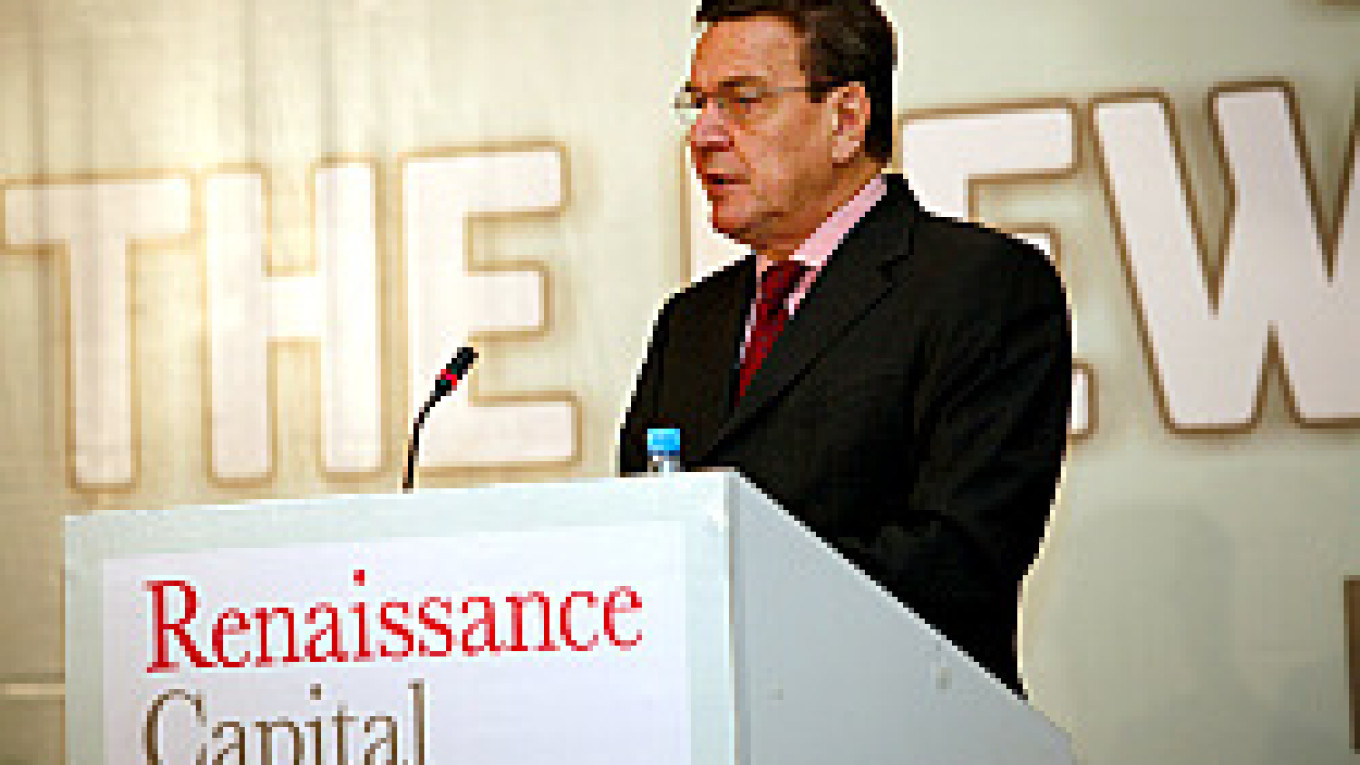
"The stability of Central Asia, the stability of Kazakhstan, will not be affected by the situation in the Caucasus," Kazakh Prime Minister Karim Maximov said in response to a question at an investment forum in Almaty.
Gone are the days when international investors jumped headfirst into the markets of Russia and its resource-rich neighbors. Kazakh officials instead found themselves on the defensive, eager to disassociate themselves from Russia's war in Georgia and prove that they could? weather the global liquidity crisis.
Risk-averse investors, already reeling from a steady flow of glum economic data from the United States and Europe, have pushed the Russian market down about 24 percent since the war over Georgia's separatist enclaves on Aug. 8. It has tanked 44 percent since mid-May, as oil prices began to fall and worries over Russia's investment climate skyrocketed as the TNK-BP and Mechel conflicts unfolded.
"The Kazakh market is still viewed as somewhat linked" to Russia's, said Adel Kambar, Renaissance Capital's CEO for Central Asia, said at a briefing on Monday at the bank's new office in Almaty. "When people panic, people really panic. Kazakhstan has been hit by the Russian fall."
The Kazakh Stock Market Index has dropped 23 percent since Aug. 8.
Rich in natural resources and a key corridor to ship Central Asian and Caspian energy to Europe and China, Kazakhstan is a strong investment site in its own right. Kazakhstan's $100 billion economy should double by 2015, according to Renaissance Capital, which hosted the investment forum, its first in Central Asia, and flew reporters to the event.
Yet the specter of Russia's war in Georgia hovered over many conversations at the forum Tuesday.
Former German Chancellor Gerhard Schr??der, now chairman of the Nord Stream pipeline that is due to skirt Russia's former Soviet neighbors to bring gas directly to Western Europe, lauded Kazakhstan for building an "anchor of stability" in Central Asia before turning to chide the West for its Russia policy.
"There have been serious mistakes in Western policy against Russia," Schr??der told the conference.
"Peace and stability in Central Asia and the Caucasus are only possible with Russia and not against Russia," said Schr??der, who has been criticized at home for acting as Russia's greatest champion in Europe.
He urged the European Union to play a stronger role in helping end the "spiral of confrontation" between Russia and the West.
Maximov, the Kazakh prime minister, said his country would not rethink its investments in Georgia, where it is the top foreign investor, namely through state-run KazMunaiGaz, which owns an oil export terminal in Adzhara's capital, Batumi. Kazakhstan has invested about $2 billion in Georgia, according to RenCap estimates.
Schr??der also failed to see the link between the war and investors' increasing nerves over Russia and its former Soviet neighbors. "I don't think there is a problem or situation for businessmen because of this conflict," he said.
RenCap CEO Alexander Pertsovsky took an even more sanguine view. "The role of Central Asia and Kazakhstan in part will continue to grow as a result of this conflict," he said. "The role of the region, of Kazakhstan, as a trade center and conduit between China, India and Russia on the one hand, and Europe on the other" will strengthen, he said.
The war has called into question Georgia's role as a key transit corridor for Caspian oil and gas. It prompted many observers to question the viability of the U.S.-backed Nabucco pipeline, which would cut Russia out of the equation in a bid to decrease European dependence on Russian energy supplies and infrastructure.
Youngho Youn, president of Seven Rivers Capital, an Almaty-based Korean-Kazakh fund, said that while he blamed Georgia for starting the war, investors hoped mainly for a swift resolution of the longer-term conflict.
"Investors love calm," he said. "We need Russia and Georgia to go back to the pre-war situation."
His fund, which invests 80 percent of its holdings in Kazakhstan and the remaining 20 percent around the CIS, has halved its holdings in Georgia's largest retail bank, the Bank of Georgia, in the wake of the war, he said.
Igor Danilenko, an associate director at Prosperity Capital Management, said he saw no increased risk relating to Kazakhstan because of Russia's increased tension with the West.
"Kazakhstan has always been forced to look to Russia and to the West," he said. "They don't give preference to Western investors or Russian investors ?€” both are here.
"What makes Kazakhstan unique is it's a stable political situation," he said, joining a chorus of analysts and investors who lavish praise on President Nursultan Nazarbayev, who has led the country since independence in 1991. "Nazarbayev has played that balance [between Russia and the West] very well."
Kazakh markets were underperforming mainly because of decreasing commodity prices, he said.
"It's not tit-for-tat correlated with Russia," Danilenko said. "But when people become more risk averse, less money will come into Russia and Kazakhstan."
A Message from The Moscow Times:
Dear readers,
We are facing unprecedented challenges. Russia's Prosecutor General's Office has designated The Moscow Times as an "undesirable" organization, criminalizing our work and putting our staff at risk of prosecution. This follows our earlier unjust labeling as a "foreign agent."
These actions are direct attempts to silence independent journalism in Russia. The authorities claim our work "discredits the decisions of the Russian leadership." We see things differently: we strive to provide accurate, unbiased reporting on Russia.
We, the journalists of The Moscow Times, refuse to be silenced. But to continue our work, we need your help.
Your support, no matter how small, makes a world of difference. If you can, please support us monthly starting from just $2. It's quick to set up, and every contribution makes a significant impact.
By supporting The Moscow Times, you're defending open, independent journalism in the face of repression. Thank you for standing with us.

Remind me later.