

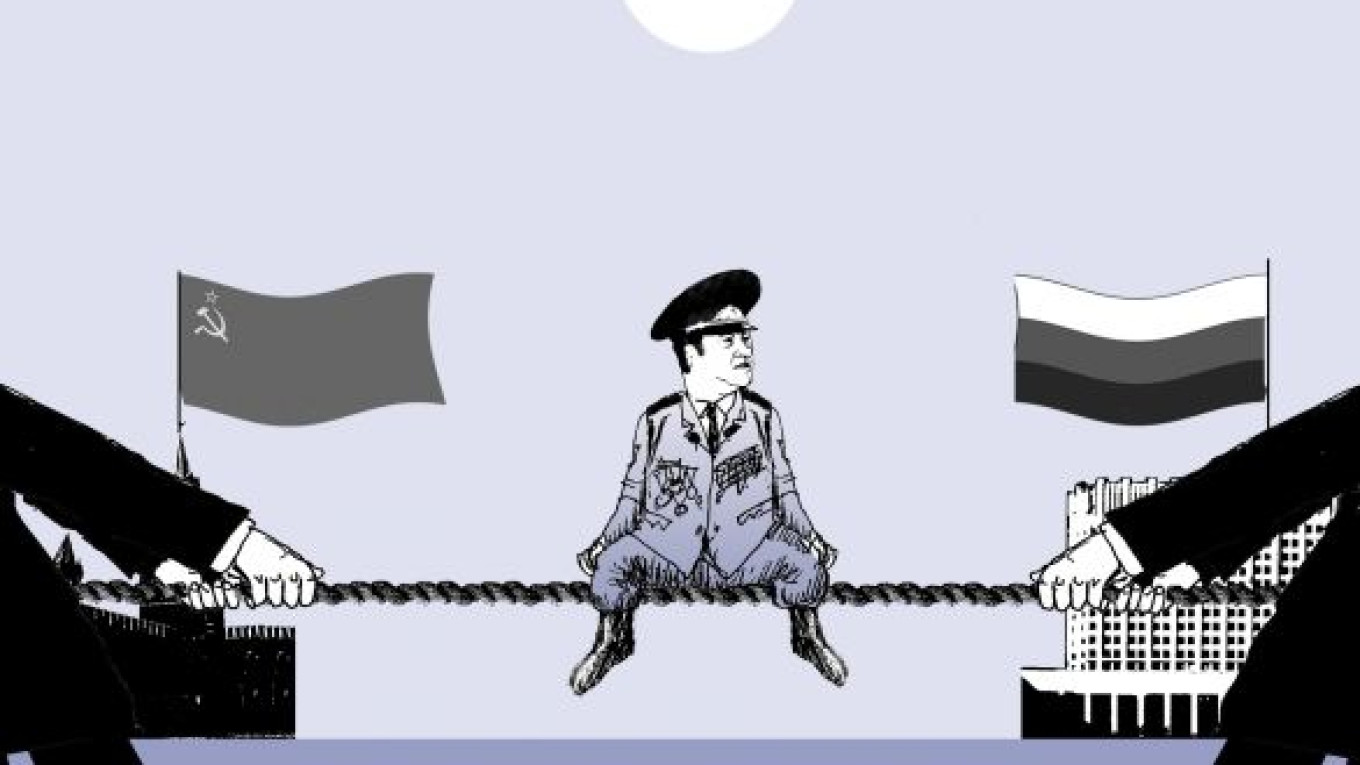
There is an old saying about the Soviet army: After every victory, the slackers are rewarded and the heroes are punished. This expression came to mind in connection with the 20th anniversary of the 1991 coup attempt. Analysts on television and the radio talk about the standard heroes: the Muscovites who set up blockades and threw themselves at the tanks and Boris Yeltsin, then-president of the Soviet Russian Republic, who led the movement against the coup plotters. For hard-line Communists, even the conspirators are heroes to this day because they selflessly tried to save the Soviet empire from collapse, we are told.
But there has been little praise for the Soviet officers who defied the coup plotters’ orders to shoot into crowds of civilians. Of course, their refusal was not necessarily based on moral principles. After all, there are plenty of instances when Soviet officers compliantly fulfilled their superiors’ orders to fire on civilians. Take, for example, the shooting of peaceful demonstrators in Novocherkassk in 1962, or when the Kremlin used the army to suppress nationalist movements in Armenia, Azerbaijan, Georgia and the Baltic states from 1988 to 1990.
But the killing of civilians in the Caucasus and the Baltic states in the final years of the Soviet Union fundamentally changed the relationship between the armed forces and the Communist leadership. For the first time, the Communist Party general secretary and the defense minister were afraid to admit that the army was acting on their orders. What’s more, the Communist leadership lost its most important ally when it tried to shift the blame for the civilian deaths onto the military.
The violence in Tbilisi in 1989 is a case in point. Transcaucasus Military District commander Igor Radionov carried out a Kremlin order to break up a peaceful demonstration and then ended up as the scapegoat during the subsequent backlash. Alexander Lebed, a paratrooper commander during this unrest, recalled the cowardice of the Soviet leaders in a 2001 interview with Noviye Izvestia. “Starting from 1988, I never received a single written order [to deploy troops against civilians] — only phone calls. … And then Gorbachev acted as if he had no idea how those troops and airplanes had been deployed,” he said.
During the August 1991 putsch, relations between Soviet politicians and the military reached an all-time low. To be sure, generals had no respect for Gorbachev, whom they blamed for the collapse of what had once been the most powerful army in the world. But when the order came from the putschists to use force against unarmed protesters, they drew the line. Military leaders refused to obey orders because they had no faith in the bumbling coup leaders and suspected that the army would once again be held responsible for any bloodshed — particularly since the coup plotters refused to put their orders in writing for fear of leaving a paper trail of their crimes.
It is not surprising, then, that on Aug. 19, Airborne Troops commander Pavel Grachyov, who had received direct orders from KGB head Vladimir Kryuchkov to develop a military plan to transfer authority from Gorbachev to another leader, acted as if he supported both sides in the conflict. Grachyov sent a battalion to the Supreme Soviet under the command of his deputy, Alexander Lebed, and the coup plotters were informed that the paratroopers had “established control” over the parliament building. At the same time, Grachyov told Yeltsin that he had sent paratroopers to protect Russia’s leaders.
The moment of truth came on the evening of Aug. 19 when Deputy Defense Minister Vladislav Achalov ordered Grachyov to arrest Yeltsin and his inner circle. According to Grachyov, he and all his deputies refused to carry out the order, although they knew that if the putschists came out victorious the military leaders would face criminal charges of insubordination in front of a military tribunal. Grachyov then called Viktor Karpukhin, commander of the elite Alpha KGB special forces, and he also agreed not to carry out the order to arrest Yeltsin and his top advisers.
To be sure, Grachyov’s decision not to obey the putschists’ orders was not driven by any democratic convictions. He was motivated first and foremost by a desire to end up on the winning side. Once it became clear that the plotters would lose, Grachyov shifted his allegiance to Yeltsin, for whom he would serve as defense minister after the Soviet collapse.
In the end, the military’s refusal to carry out the orders of a dictatorial Communist regime was the last confirmation that the Soviet Union had indeed collapsed for good.
Alexander Golts is deputy editor of the online newspaper Yezhednevny Zhurnal.
A Message from The Moscow Times:
Dear readers,
We are facing unprecedented challenges. Russia's Prosecutor General's Office has designated The Moscow Times as an "undesirable" organization, criminalizing our work and putting our staff at risk of prosecution. This follows our earlier unjust labeling as a "foreign agent."
These actions are direct attempts to silence independent journalism in Russia. The authorities claim our work "discredits the decisions of the Russian leadership." We see things differently: we strive to provide accurate, unbiased reporting on Russia.
We, the journalists of The Moscow Times, refuse to be silenced. But to continue our work, we need your help.
Your support, no matter how small, makes a world of difference. If you can, please support us monthly starting from just $2. It's quick to set up, and every contribution makes a significant impact.
By supporting The Moscow Times, you're defending open, independent journalism in the face of repression. Thank you for standing with us.

Remind me later.