

Usually, disclosure statements go at the end of an article, but let me start with mine.
I sit on the board of Yandex, a Russian search company with a roughly 60 percent market share in Russia, compared with Google’s 20 percent or so. And I sit on the board of 23andMe, a company co-founded by the wife of Sergey Brin, a co-founder of Google. So I have a variety of interests in the topic of Google’s recent moves in China.
In the beginning, I supported Google’s presence in China. My fundamental belief is that every time that a user gets information, it reinforces a little part of the brain that says: “It’s good to know things. It’s my right to have information, whether it’s about train schedules, movie stars or the activities of the politicians who make decisions that affect my life.”
If you can ask questions about some things but not about others, eventually you start to wonder about that fact itself. Google (and I) had always hoped that it could help liberate China, but these hopes now look naive.
Of course, censorship is not a big secret in China. China employs about 30,000 people as censors. They have names and faces, and they may negotiate with a publisher about a particularly sensitive topic. They are less likely to negotiate with bloggers because there are so many of them, but the government reportedly does train bloggers in how to post in support of government policy. A lucky blogger can make money — reportedly at 50 cents per post — doing the government’s bidding.
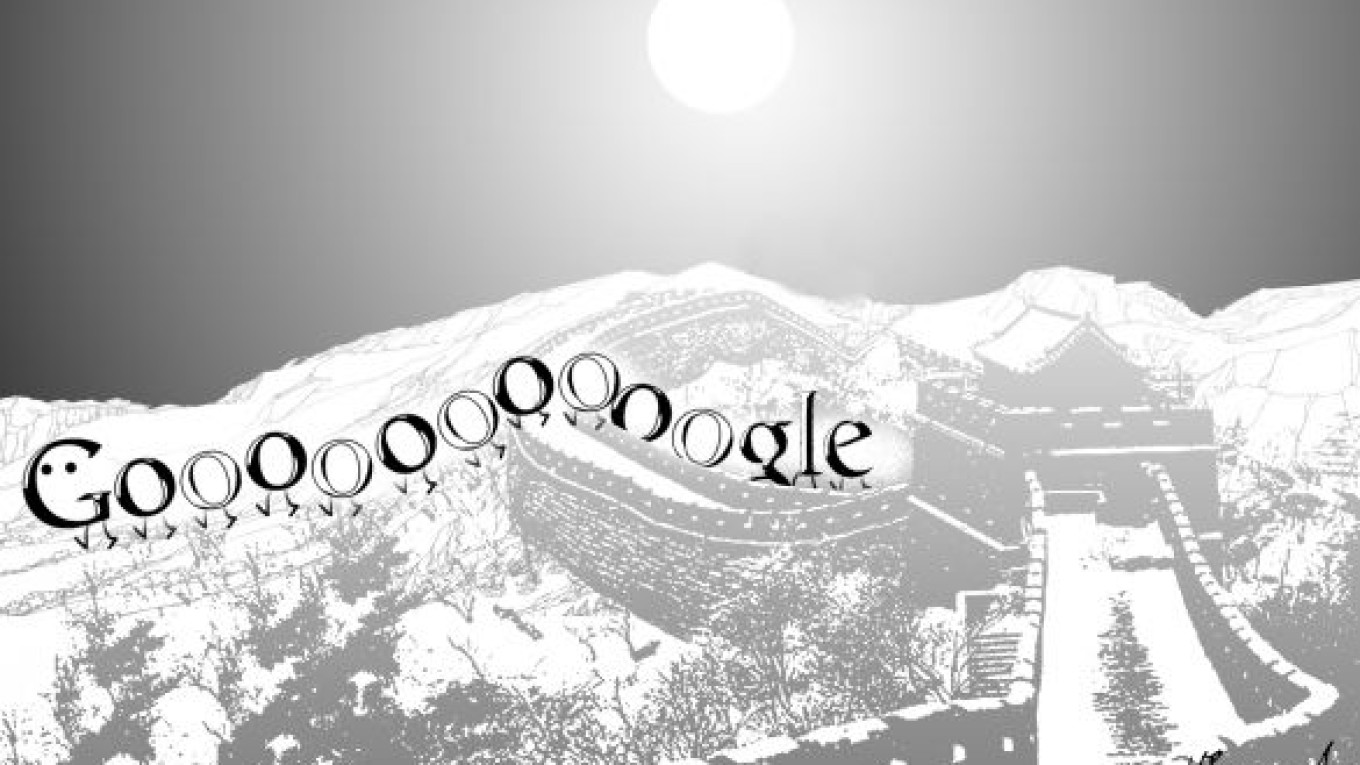
So why has Google made a fuss and threatened to walk out of China? The answer probably stems from a combination of — or a changing calculus around — business interests and values. The censorship issue has long grated at Google. Brin, who spent his early childhood in the Soviet Union before emigrating to the United States, is reported to be especially hostile to censorship, but the company could argue that transparency about censorship was better than not serving China at all.
The censorship, however, has been getting worse. To be sure, many Chinese support government censorship because they see it as a way to maintain civility and order. They know that their government is fragile, and they consider criticism harmful rather than cleansing. They trust their government to deal with problems over time.
At the same time, while China represents a huge market in the ever-receding future, it has not been an especially lucrative market for Google so far. Baidu, the indigenous Chinese rival to Google, benefits in many ways both from government support and from home-team nationalism among users.
More generally, China probably looks less appealing to investors now than it did a few years ago — not so much because of the Chinese economy as a whole, but because of constraints on the ability of any foreign entity to make serious long-term profits.
This growing disillusion was already present when a wave of cyber-attacks on Google (and other companies) forced the company to reassess its entire China strategy. There are certainly other ways that Google could have handled the issue — for example, by capitulating to the Chinese government’s various requests. That would certainly not have comported with Google’s public values, and it would probably have been a bad business decision as well.
When you fall into a situation like this, you always have one option — to walk away. But you must be ready to exercise it. That is exactly what Google has done in China, where its move is irrevocable. The company can’t go back to the old situation. Nor is China likely to say, “We weren’t hacking you, and we promise never to do it again.”
So while Google is unlikely to re-enter China for the foreseeable future, the company has improved its negotiating position in whatever other disputes it might have in the future, and it has won support from the U.S. government.
What can Google do now? It could support Hotspot Shield, a publicly accessible virtual private network offered by AnchorFree, a company that I have invested in and advise — another of my disclosures. Hotspot Shield allows users to keep their browsing private, whether they are concerned about thieves stealing their banking details or about governments monitoring where they surf. It has about 1 million users monthly in China (out of 7 million worldwide). Hotspot Shield is one of the best ways of “scaling the wall” to peer outside the locked-down Chinese Internet and use sites such as Twitter, Facebook and, of course, Google.com (as opposed to Google.cn).
Like Google in the past, AnchorFree may operate more effectively by being discreet, without loud support from Google or other “foreign interests.” Its web site is often blocked in China and many countries in the Middle East, but there are usually other ways to obtain the software. Google, too, may be blocked, but there are ways to get to it for those who are determined. The next steps are up to the Chinese users themselves.
In the end, China knows very well that it can’t make the Internet completely airtight. So someone in the Chinese government is probably having regrets.
It’s tempting to predict how this will end. But I think that it won’t end. As within Google, so within China: Decisions are made, but not everyone agrees with them. There’s a conflict between business interests and moral values. The tug of war will continue for the foreseeable future. But in this little battle of a long war, transparency has won a victory.
Esther Dyson, chairman of EDventure Holdings, is an active investor in a variety of startups around the world. © Project Syndicate
A Message from The Moscow Times:
Dear readers,
We are facing unprecedented challenges. Russia's Prosecutor General's Office has designated The Moscow Times as an "undesirable" organization, criminalizing our work and putting our staff at risk of prosecution. This follows our earlier unjust labeling as a "foreign agent."
These actions are direct attempts to silence independent journalism in Russia. The authorities claim our work "discredits the decisions of the Russian leadership." We see things differently: we strive to provide accurate, unbiased reporting on Russia.
We, the journalists of The Moscow Times, refuse to be silenced. But to continue our work, we need your help.
Your support, no matter how small, makes a world of difference. If you can, please support us monthly starting from just $2. It's quick to set up, and every contribution makes a significant impact.
By supporting The Moscow Times, you're defending open, independent journalism in the face of repression. Thank you for standing with us.

Remind me later.