

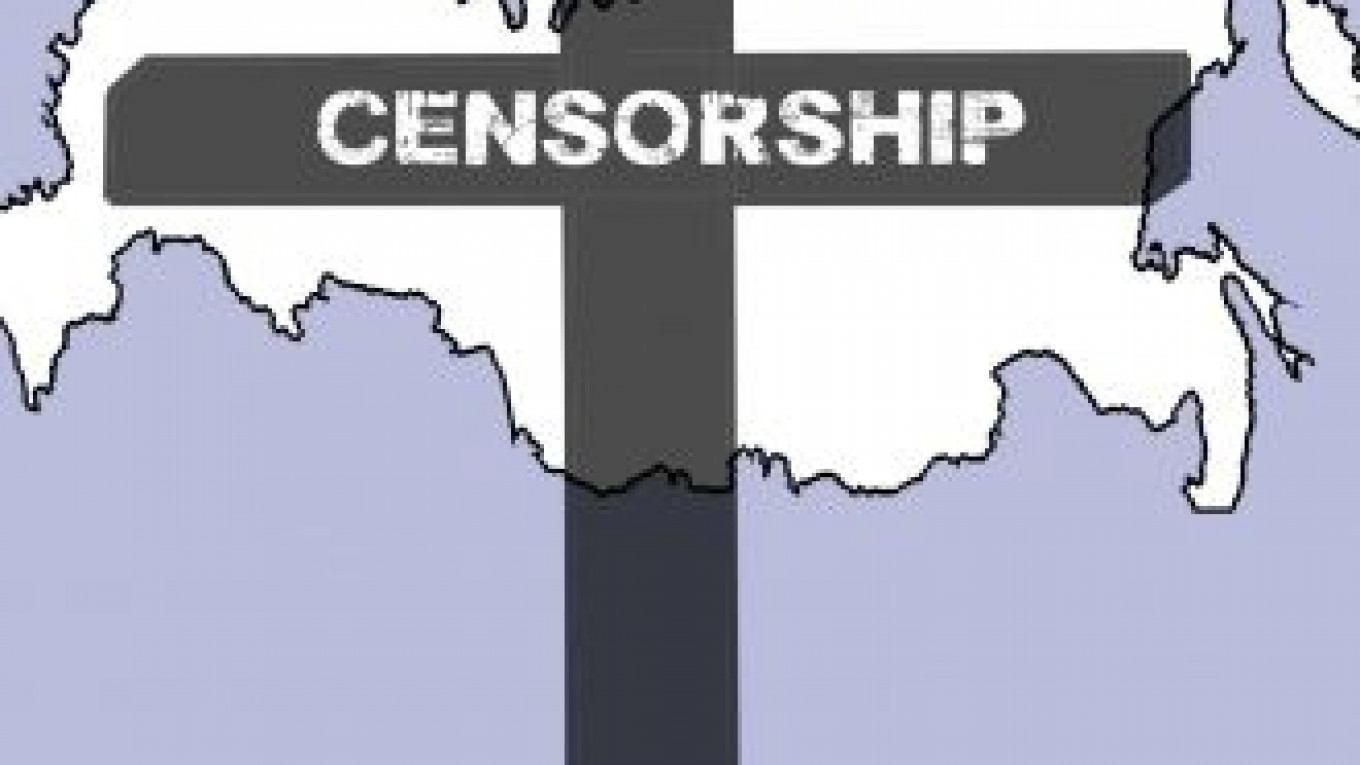
On Tuesday, members of the four parties represented in the State Duma introduced a bill that would carry a three-year prison sentence for "insulting the religious feelings of others." Given the bill's widespread support in the Kremlin and Russian Orthodox Church, it is all but assured of becoming law. This would take Russia another step closer to becoming like Iran and other Muslim theocracies, where "insulting Islam" is also punishable by severe prison sentences.
This is a disturbing and dangerous trend for Russia, particularly given that it wants to modernize. In its frenzy to punish blasphemers, the country's much-acclaimed drive to innovate and develop is bound to suffer.
The problem, of course, is that blasphemy and "insulting religious feelings" are highly subjective notions. Who would determine what is blasphemous or insulting? The state? The Russian Orthodox Church? This issue essentially boils down to a question of good or bad taste.
Already, a group of Orthodox believers have said they would sue a blogger for writing the word God with a lower-case "g." Works defending Darwinism are also offensive to many believers. So are short skirts.
What if someone doesn't cross himself "correctly" or doesn't dress "appropriately" in church? Notably, the three Pussy Riot punk rockers were found guilty of these church violations in their criminal case last month.
This is precisely why these types of slopes are so slippery. Once a state starts prohibiting literature or art for being "offensive," the list will never stop.
Although this bill is packaged as a protection against insults to all religions, it is doubtful that it would used to prosecute Orthodox fundamentalists, who are fond of offending the religious feelings — and sometimes even destroying the property — of other denominations, including Protestants and Jehovah's Witnesses.
In the end, the legislation looks more like an attempt to protect the Orthodox church against criticism. It may cause some journalists to think twice about writing another story of a drunk Orthodox priest who caused an accident in his Mercedes.
Another logistic problem is whether the prison system has enough room to jail all those willing to "insult" the Orthodox church by criticizing it.
During the Pussy Riot trial, we witnessed the inherent difficulties of trying to establish a legal basis to prosecute performance art that insulted someone's beliefs, particularly when there was no violence or vandalism. In a weak attempt to introduce legitimacy to the trial, pseudo linguistic experts were called in to testify on the blasphemous nature of the phrase "holy crap," which the Pussy Riot women yelled during their stunt in Moscow's main cathedral. Pseudo psychologists also testified on the trauma that church personnel supposedly suffered after witnessing the stunt, including loss of sleep.
Prosecuting blasphemy and insults inevitably turns into a campaign to legislate morality — something Russians over 30 know all too well from their own experience. During the Soviet period, criticizing the Communist Party was tantamount to blasphemy, as was displaying nonconformist art. If left uncontrolled, modern-day Russia could use the same highly subjective and arbitrary pseudo-legal reasoning to prosecute those who insult the church, Russian state, ruling party or President Vladimir Putin.
Tasteless, insulting, vulgar or even heretical art should not be made illegal in a secular country that claims to uphold Western values and principles. Although the United States may seem fanatical in its own way about protecting First Amendment rights, it is correct on one main point: Public opinion, not the state, should be the final arbiter of what is good or bad art.
U.S. President Barack Obama put it well during his address to the United Nations General Assembly on Tuesday: "The strongest weapon against hateful speech is not repression; it is more speech." That is why the U.S. First Amendment protects the crude and offensive video "Innocence of Muslims" in the same way it protected "Last Temptation of Christ," the 1988 U.S. film that offended many Christians.
Notably, the presidents of Egypt and Yemen both rejected Obama's defense of free speech on Wednesday from the same UN podium, saying blasphemy should not be protected speech. Meanwhile, Pakistan's president reiterated during his speech at the UN that blasphemy should be punishable by prison, thus lending support to the Duma bill.
For Russia, though, the issue is much deeper than allowing this or that controversial art exhibit or performance. There is a correlation between the level of a country's freedom of speech and its degree of innovation and economic development. In the United States, which has maximum free speech rights, the level of innovation is high and so is its per capita gross domestic product: $48,000. In Egypt, where freedom of speech is limited, the per capita GDP is only $3,000. Even in oil-rich, but freedom-sparse Libya and Iran, it is only $5,700 and $6,300, respectively. In contrast, Turkey, although 98 percent Muslim, is a secular country and has a relatively higher degree of freedom of speech; not surprisingly, it also has a much higher per capita GDP at $10,500.
In Russia, which is somewhere between the United States and Iran in terms of freedom of speech, the per capita GDP is also somewhere in the middle: $13,000. Yet, the more fervently Russia clamps down on freedom of speech, the more likely it will be stuck at the $13,000 level, or perhaps even drop.
Russia needs to choose which course it wants to take: anti-Western and theocratic or liberal-?democratic. It is basically a choice between a closed and open society. Yet it would seem that the Kremlin has already made that choice as it attempts to develop a quasi-theocratic state.
Protecting freedom of speech is just as sacred to democracy purists in the West as protecting Orthodox religious values is to the church and the Kremlin. In many respects, both are fanatical in their beliefs. The only difference is the West's fanatic belief in freedom of speech leads to economic growth and development — notwithstanding the current economic crisis — while religious fanaticism on a state level leads to chronic economic stagnation, decline and high poverty rates.
But, then again, there are other ways to measure Russia's strength than by economic indicators. After all, it was religious philosopher and writer Fyodor Dostoevsky who believed that the strength of Russians is, above all, in their strong spirituality. Apart from the Orthodox church, though, it is doubtful most Russians today would want to live according to Dostoevsky's 19th-century distorted world vision.
Michael Bohm is opinion page editor of The Moscow Times.
Related articles:
A Message from The Moscow Times:
Dear readers,
We are facing unprecedented challenges. Russia's Prosecutor General's Office has designated The Moscow Times as an "undesirable" organization, criminalizing our work and putting our staff at risk of prosecution. This follows our earlier unjust labeling as a "foreign agent."
These actions are direct attempts to silence independent journalism in Russia. The authorities claim our work "discredits the decisions of the Russian leadership." We see things differently: we strive to provide accurate, unbiased reporting on Russia.
We, the journalists of The Moscow Times, refuse to be silenced. But to continue our work, we need your help.
Your support, no matter how small, makes a world of difference. If you can, please support us monthly starting from just $2. It's quick to set up, and every contribution makes a significant impact.
By supporting The Moscow Times, you're defending open, independent journalism in the face of repression. Thank you for standing with us.

Remind me later.