

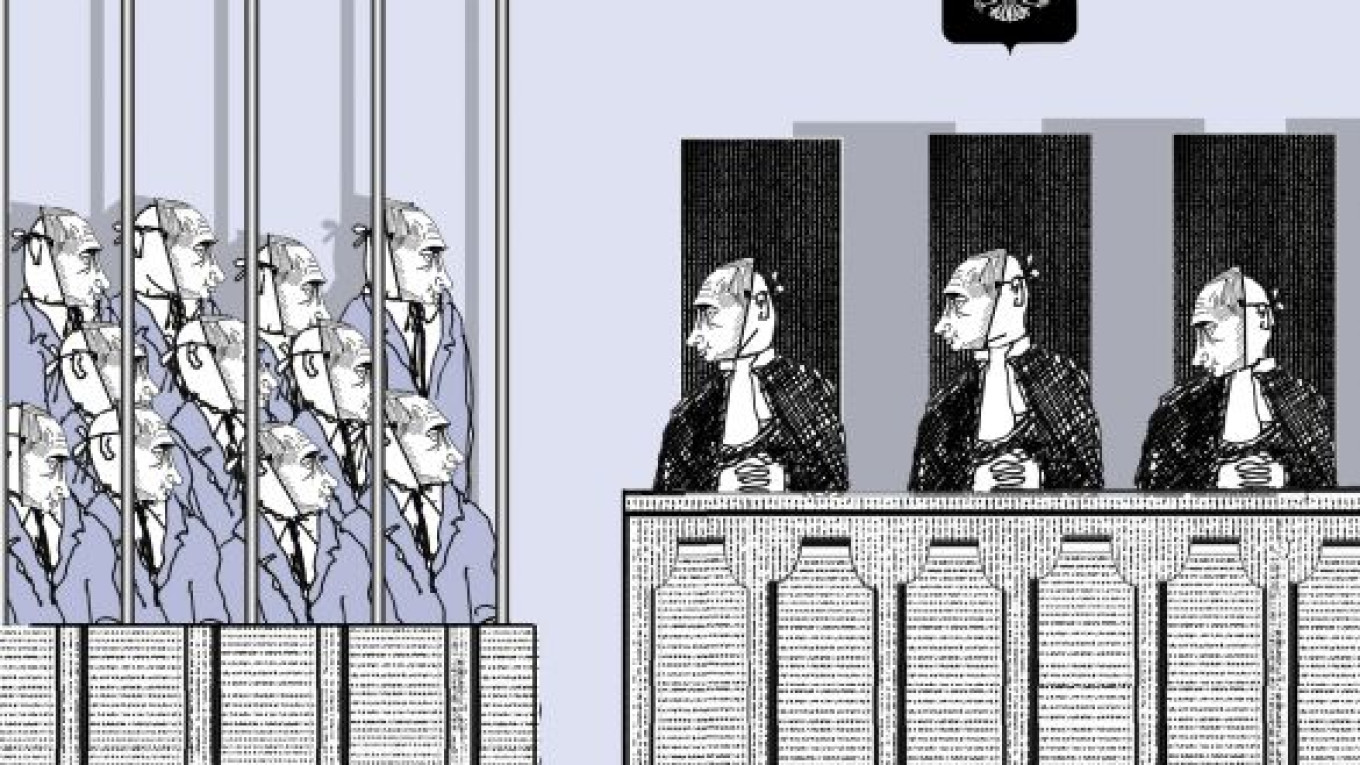
Russia’s greatest curse is not its natural resources, as many believe, but its weak and ineffective institutions. According to the 2010-11 Global Competitiveness Report published by the World Economic Forum, Russia ranks 63rd among the 139 countries listed, primarily because of the low quality of its state institutions.
The poor quality of government institutions, large-scale corruption, excessive government intervention in the economy and corrupt courts that take their orders from state officials all create a terrible business climate and low levels of both domestic and foreign investment. ?
The two criminal cases against former Yukos CEO Mikhail Khodorkovsky and his business partner Platon Lebedev are only the top of the iceberg, the most publicized example of the country’s corrupt and biased court system. According to data reported at the 2010 Krasnoyarsk economic forum, about 300,000 businesspeople are serving prison sentences as a result of fabricated charges or illegal seizures by competitors or officials from law enforcement agencies. Only 1 percent of cases against businesspeople end in acquittals.
Manipulating and abusing the law by bureaucrats against businessmen is used to expropriate their private property and eliminate competition. The same approach is applied in the political sphere as well. The Federal Security Service, police, prosecutors, investigators and courts serve the interests of authorities at all levels who want to avoid transparency and accountability and maintain their monopoly control of the country’s political institutions.
A case in point is the recent decision by Moscow’s Savyolovsky District Court in response to slander charges brought against Prime Minister Vladimir Putin by myself and opposition leaders Vladimir Milov and Boris Nemtsov. During his annual televised call-in show on Dec. 16, Putin claimed that in the 1990s we embezzled billions of dollars along with billionaire Boris Berezovsky.
According to Article 152 of the Civil Code, the defendant in a defamation case — Putin — is required to prove that the claims he made are based on fact. But this is impossible to do because the charges he made against Milov, Nemtsov and myself were completely false. In accordance with standard judicial practices, Judge Tatyana Adamova had to offer an official explanation of why she ruled in favor of Putin. All she could come up with were ludicrous clams that she dug up from several questionable web sites, including those run by nationalist organizations.
Adamova fully sided with Putin’s lawyers, writing in her decision that he was not referring directly to the plaintiffs. The names Milov, Ryzhkov and Nemtsov were apparently used in a “general sense” only to represent a “certain class of public officials” who embezzled huge sums of money in the 1990s. Thus, the judge concluded, Putin is not required to prove that the three specific individuals whom he named stole anything. In this way, Putin was able to make blatantly slanderous statements on live television while avoiding completely legal responsibility for his defamation.
The same cannot be said of those who criticize the authorities. Kazan journalist and politician Irek Murtazin received 21 months in prison for speculating on his blog that the Tatarstan president might be dead. In Gorno-Altai, a criminal case is proceeding against journalist and politician Sergei Mikhailov for accusing Altai region Governor Alexander Berdnikov of alcoholism and doing a bad job of managing the regional government. In addition, a court ordered the closure of the
Ingushetia.ru opposition web site, organizers of the controversial Forbidden Art exhibition were convicted, and criminal proceedings have began against artist Artyom Loskutov and members of the Voina art group.
Putin subscribes wholeheartedly to the slogan attributed to Spanish strong-arm leader Francisco Franco: “My friends get everything; my enemies get the law!”
Imagine if a member of the opposition states clearly on television that Putin is guilty of embezzlement and Putin decides to file slander charges in the same Savyolovsky court to protect his honor and dignity. As a hypothetical exercise to test the court’s consistency, imagine if the defendant tried to use Putin’s tactic by claiming that Putin’s name was invoked only in a “general sense” to represent a “certain class of public officials.” Would the judge also rule in the defendant’s favor?
Vladimir Ryzhkov, a State Duma deputy from 1993 to 2007, hosts a political talk show on Ekho Moskvy radio.
A Message from The Moscow Times:
Dear readers,
We are facing unprecedented challenges. Russia's Prosecutor General's Office has designated The Moscow Times as an "undesirable" organization, criminalizing our work and putting our staff at risk of prosecution. This follows our earlier unjust labeling as a "foreign agent."
These actions are direct attempts to silence independent journalism in Russia. The authorities claim our work "discredits the decisions of the Russian leadership." We see things differently: we strive to provide accurate, unbiased reporting on Russia.
We, the journalists of The Moscow Times, refuse to be silenced. But to continue our work, we need your help.
Your support, no matter how small, makes a world of difference. If you can, please support us monthly starting from just $2. It's quick to set up, and every contribution makes a significant impact.
By supporting The Moscow Times, you're defending open, independent journalism in the face of repression. Thank you for standing with us.

Remind me later.