

The campaign rhetoric in Russia's presidential election has grown increasingly harsh. This happens in many countries, but the difference with Russia is that "external factors" play a disproportionately greater role in the political process. In most other countries, voters evaluate candidates based on their domestic policies or track records, especially with regard to the economy.
It would be difficult to find any country in the modern world besides Russia where an ordinary meeting between opposition leaders and the U.S. ambassador would elicit any particular reaction. The hyped reaction caused by that meeting at the U.S. Embassy on Jan. 17 is proof that the paranoid fears Josef Stalin inculcated in the Soviet Union, which continued throughout the Cold War, are still alive and well in today's Russia.
Does Russia still feel so insecure and vulnerable that it has to build its entire policy on opposition to the West, and particularly to the United States? Is Russia only capable of formulating reactive, rather than proactive policies?
Russian leaders — especially during an election campaign — like to play the anti-West and anti-U.S. card as part of the political struggle. But that tactic only creates the impression that Russia's inferiority complex has a direct impact on how it formulates its policies.
At the same time, beyond the occasional rhetorical outburst, Vladimir Putin, as both president and prime minister, has never turned these aggressive words against the United States into concrete actions. On the contrary, Moscow cooperates with Washington on many trade issues and in several crucial areas affecting global security.
When Russia sharply criticizes the United States, it does so for two main reasons.
First, Putin occasionally sees the political need to boost his image as a strong leader who is capable of standing virtually alone against the West and the United States. That was why, for example, President Dmitry Medvedev explained that Russia's actions in the Russia-Georgia war of August 2008 had been intended not so much to protect Russian peacekeeping forces in the area as to stop NATO forces from advancing toward Russia.
The same logic motivates Russia's current policy regarding Syria. Apparently, the Kremlin is gambling that the political payoff for Putin when he stands alone against the whole world — with China following the Kremlin's lead — outweighs the risks involved in opposing the entire Arab world, Europe, the United States and the other two BRIC countries of Brazil and India.
The second main reason the two countries disagree is when Russia's national interests are clearly at odds with those of the United States. But this is perfectly normal and affects such issues as Iran or conflicting interests over the routes of oil and gas pipelines. Few U.S. politicians would interpret these differences as reflecting a deliberate anti-U.S. policy from the Kremlin. In fact, the United States understands better than anyone that a country the size and weight of Russia needs to protect its legitimate national interests.
While Putin is not an anti-U.S. politician, neither is he particularly pro-U.S. Rather, he is a realist. What's more, he has even said he admires the internal U.S. political structure. He especially likes the political diversity at the local and state levels, a diversity that is reduced to the competition between two major political parties at the federal level. And Putin recently admitted that he likes the fact that the U.S. president, not a prime minister or vice president, controls the Cabinet.
As far as most of Washington and Wall Street is concerned, they would probably pick Putin over any of his opponents as their candidate of choice.
Russian history is often described as a constant race to catch up with the level of development in the West. Almost all of Russia's major reforms and occasional efforts at modernization have been inspired by a desire to close that gap with the West. But this creates the impression that Russians themselves lack the interest, motivation or ability to fully develop their own country.
According to this line of reason, the only way to accomplish periodic attempts at modernization is to rally the people against an outside enemy. In my opinion, convincing people that the country's development — or even survival — depends on defeating an imaginary outside threat is a deeply flawed ideology.
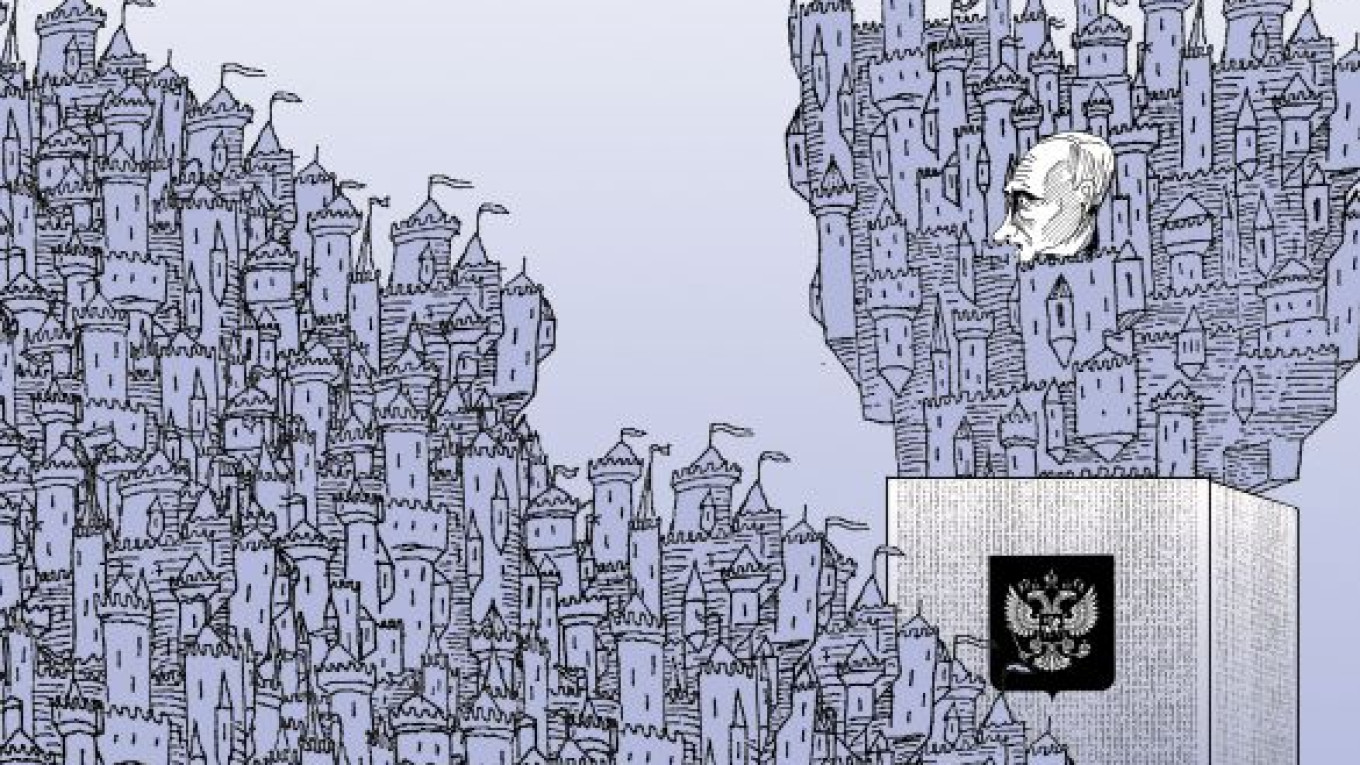
It is particularly cynical to create a besieged-fortress mentality in the minds of the people, while at the same time reproaching them for lagging so far behind global trends.
Nikolai Zlobin is director of the Russian and Asian programs at the World Security Institute in Washington. This comment appeared in Vedomosti.
A Message from The Moscow Times:
Dear readers,
We are facing unprecedented challenges. Russia's Prosecutor General's Office has designated The Moscow Times as an "undesirable" organization, criminalizing our work and putting our staff at risk of prosecution. This follows our earlier unjust labeling as a "foreign agent."
These actions are direct attempts to silence independent journalism in Russia. The authorities claim our work "discredits the decisions of the Russian leadership." We see things differently: we strive to provide accurate, unbiased reporting on Russia.
We, the journalists of The Moscow Times, refuse to be silenced. But to continue our work, we need your help.
Your support, no matter how small, makes a world of difference. If you can, please support us monthly starting from just $2. It's quick to set up, and every contribution makes a significant impact.
By supporting The Moscow Times, you're defending open, independent journalism in the face of repression. Thank you for standing with us.

Remind me later.