

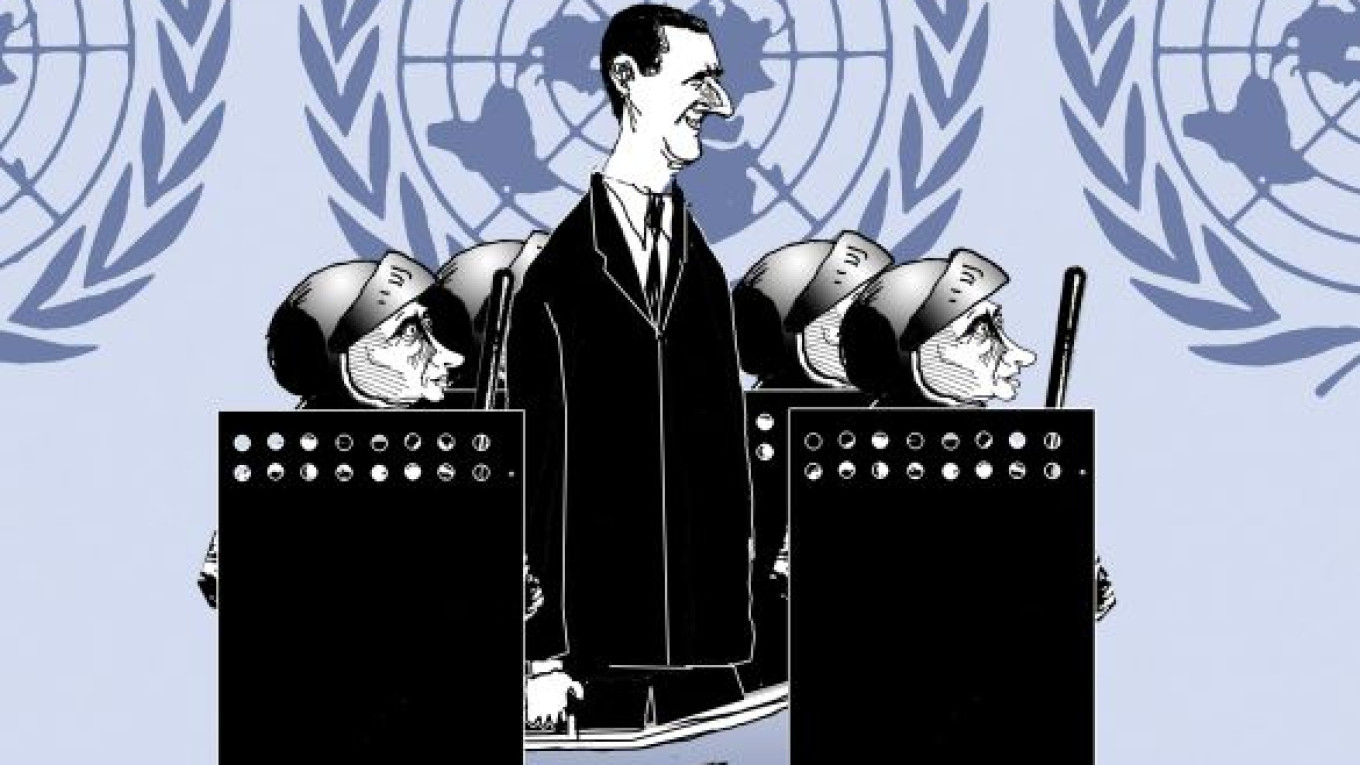
After United Nations Security Council Resolution 1973 allowed the United States and its allies to use military force in Libya last year, the Kremlin adopted a policy opposing such humanitarian interventions as a matter of principle.
Moscow has taken the same stance with Syria as Western nations are considering various options for humanitarian intervention to stop the killing of civilians and to prevent a full-scale civil war.
Articulating his anti-?intervention policy, President Vladimir Putin wrote in his Feb. 27 Moskovskiye Novosti article that the global community should not pick sides in the Syrian conflict and that the problem should be solved "without foreign intervention and should respect [Syria's] sovereignty. … We are against accepting Security Council resolutions that would be interpreted as a green light toward military intervention in internal Syrian affairs." What's more, in his May 7 foreign policy decree, Putin wrote that Russia "will oppose attempts to use the concept of human rights as an instrument of political pressure and to intervene in the internal affairs of other countries."
The problem with this policy is that it directly contradicts one of the basic founding principles of the UN — that no nation has the right to kill its own citizens and hide behind the archaic argument that it has a "sovereign right" to handle its own internal matters as it sees fits, including the wanton killing of thousands of civilians.
There are no such rights in the post-World War II era, and this is precisely why the UN included Chapter VII in its charter, which was later expanded under the Responsibility to Protect principle in 2005 in the wake of the Rwanda genocide. These two principles give the UN Security Council the right to approve intervention in another country ?€” including the use o f military force ?€” to prevent genocide, mass killing of civilians and war crimes.
There are no clear, objective guidelines when Chapter VII or the Responsibility to Protect norm should be invoked. In Libya, the tipping point was after several thousand civilians were killed by government forces. In Rwanda, it unfortunately required 800,000 civilian deaths. In Syria, the number has already exceeded 10,000 and is growing. On Wednesday, opposition groups claimed that government troops and security forces killed about 100 villagers in Qubeir and Heffe. If confirmed by UN monitors, this would be Syria's fourth massacre of civilians in two weeks.
The Security Council has invoked Chapter VII of the UN Charter 15 times, approving military intervention in sovereign countries. The first invocation was Security Council Resolution 82, which the Soviet Union boycotted, at the start of the Korean War in 1950, and the most recent invocation was Resolution 1973, authorizing military force against Libya last year, from which Russia abstained.
What Putin's position on humanitarian intervention fails to recognize is that the global, collective responsibility to prevent the mass killing of civilians by government forces ??€” a concept that was developed after the horrors of World War II and the Holocaust ?€” provides a fundamental UN framework for global order and security.
Thus, the gross abuse of human rights committed by Syria's government troops and security forces cannot be dismissed as an "internal matter" for Syrian President Bashar Assad to sort out himself, as the Kremlin maintains. It has now become an international issue by definition.
In the end, Russia has taken a strange, contradictory position on the Security Council. On the one hand, the Kremlin has always praised the council ?€” and the UN as a whole ?€” as the basis for multilateral peacekeeping and a valuable mechanism to oppose what it views as U.S. unilateralism and its aggressive, expansionist foreign policy. In addition, permanent membership in the Security Council has always been a source of pride for Russia. Along with its large nuclear arsenal, permanent membership allows Russia to maintain its superpower status. At the same time, however, Russia has questioned the right and duty of the UN Security Council to use military force when necessary to stop a dictator from killing its own citizens.
To be sure, the exact form of humanitarian intervention in Syria is a point of heated debate, particularly given the stark differences between Syria and Libya. Some nations propose an arms embargo, while others are pushing for a proposal to arm certain rebel groups. Still others suggest creating an international coalition to enforce a no-fly and no-tank zone in civilian sectors.
In any case, Russia needs to change its fundamental ideological position opposing UN-?sanctioned humanitarian interventions, or what the Kremlin scornfully calls "Western neointerventionism." Russia needs to join the post-World War II era by rejecting its primitive, cynical notion of "sovereign democracy" ?€” not only within its borders but for other countries as well.
Most of the world's nations have adopted the Responsibility to Protect norm as a guiding principle for global order and security. It is time for Russia to take this responsibility as well.
Michael Bohm is opinion page editor of The Moscow Times.
A Message from The Moscow Times:
Dear readers,
We are facing unprecedented challenges. Russia's Prosecutor General's Office has designated The Moscow Times as an "undesirable" organization, criminalizing our work and putting our staff at risk of prosecution. This follows our earlier unjust labeling as a "foreign agent."
These actions are direct attempts to silence independent journalism in Russia. The authorities claim our work "discredits the decisions of the Russian leadership." We see things differently: we strive to provide accurate, unbiased reporting on Russia.
We, the journalists of The Moscow Times, refuse to be silenced. But to continue our work, we need your help.
Your support, no matter how small, makes a world of difference. If you can, please support us monthly starting from just $2. It's quick to set up, and every contribution makes a significant impact.
By supporting The Moscow Times, you're defending open, independent journalism in the face of repression. Thank you for standing with us.

Remind me later.