

A vivid example of how detached from reality Yury Luzhkov became in his last weeks in office was when he gave an interview to Ren-TV’s “Nedelya” program on Sept. 18. He was asked what percentage of City Hall’s contracts were fulfilled by Inteko, the construction company owned by Yelena Baturina, his billionaire wife.
“Only 2 percent,” Luzhkov answered.
By all basic standards and definitions of conflict of interest, that is 2 percent too much.
Amazingly, Baturina appeared to contradict her husband a week later when she told The New Times magazine that Inteko had won only one city building tender — and had been forced to abandon it when local authorities failed to meet their obligations.
Apparently, they can’t seem to get their stories straight. The seeming contradiction between Luzhkov’s and Baturina’s statements raises new questions about Luzhkov’s activities as mayor for the past 18 years.
One of Moscow’s largest contracts — the restoration of sculptor Vera Mukhina’s classic “The Worker and Collective Farm Girl” statue — is a good example of how city contracts are awarded to companies owned by immediate relatives in “tenders.” Opposition leader Boris Nemtsov wrote in his investigative booklet “Luzhkov. Results” that there were two companies that bidded in the February 2009 tender: Oryol and Strategia, which is controlled by Inteko. After Oryol was disqualified based on “improper documents,” Strategia was declared the winner. The original tender was in the amount of 2.395 billion rubles ($78.4 million), but after the contract was signed the amount was increased by 500 million rubles ($16.4 million) to 2.905 billion rubles ($95 million), Nemtsov wrote.
Other than Nemtsov, few are talking about arresting and trying Luzhkov on corruption charges. Of course, the constitutional right of presumption of innocence applies to Luzhkov as it does to any citizen. But only one of the dozens of corruption allegations that Nemtsov laid out in detail in “Luzhkov. Results” should be enough justification for prosecutors to open an investigation and file criminal charges against Luzhkov.
In the United States, defense attorneys joke that it is so easy for prosecutors to get a grand jury to approve a criminal indictment that they could indict a ham sandwich if they wanted. But in Russia, the exact opposite is true when the target is a political heavyweight the size of Luzhkov.
Nemtsov has been trying for a year to convince the Prosecutor General’s Office to open a criminal case, but all of his requests have been rejected over what prosecutors claimed was a “lack of grounds.” Luzhkov, meanwhile, sued Nemtsov for defamation over allegations he made in the booklet as well as in an interview with Kommersant. In November, the Zamoskvoretsky District Court partially upheld Luzhkov’s claim and ordered Nemtsov and Kommersant to pay 500,000 rubles (about $17,000) in damages and to refute several points. Both are appealing to the European Court of Human Rights.
Pursuing a criminal case against Luzhkov while he was mayor would have been senseless. He and Baturina almost never lost the defamation lawsuits they repeatedly filed against anyone who accused them of corruption.
Last October, Liberal Democratic Party leader Vladimir Zhirinovsky publicly called Luzhkov and his top aides the ringleaders of “the Moscow mafia.” He repeated this charge in April from behind the podium in the State Duma. Luzhkov sued for defamation and won 500,000 rubles in damages, a ruling upheld by the Moscow City Court in July.
Defamation or not, Zhirinovsky was correct about one thing: To survive and prosper in a criminal world, you must be willing to give a “fair share” of your proceeds to your krysha (protectors). This may explain in part why Luzhkov’s business and political relationship with the Kremlin elite was so close throughout the 2000s.
But even the closest relationships are subject to irreconcilable differences, particularly when they involve large competing egos, huge sums of money and control over Moscow’s economy. It is clear that the reasons for the Kremlin-Luzhkov fallout were much more serious than Luzhkov’s tame criticism of President Dmitry Medvedev in a recent Rossiiskaya Gazeta interview, which many observers singled out as the casus belli. The Luzhkov affair smacks much more of an economic turf battle than a political one.
Luzhkov’s leadership as mayor proved largely successful. He enjoyed broad support from Muscovites and, for much of the past decade, from United Russia members and Putin himself.
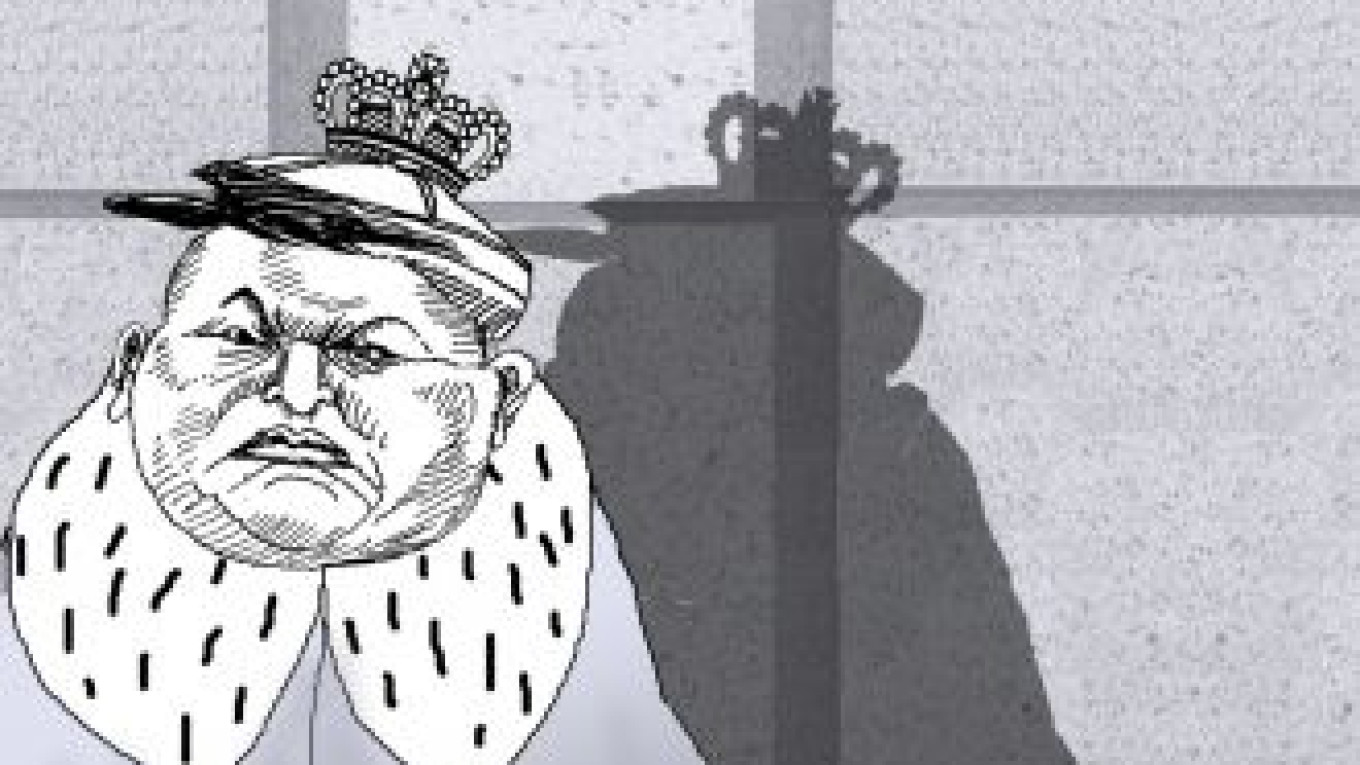
But several years ago, the dizziness of being the king of Moscow seemed to have gotten the best of him, and the natural side effects of hubris and megalomania set in. As a result, he lost touch with Muscovites and even more so with Medvedev, with whom he had never gotten along. More important, however, he alienated himself from his biggest patron — Putin. It was critical that Putin replace Luzhkov with a less ambitious and controllable mayor. This may be why Putin’s ally Vladimir Kozhin, who heads the Office of Presidential Affairs, is considered a frontrunner to replace Luzhkov.
Now that Luzhkov has been sacked, many are wondering what will happen to him. Just before Luzhkov left for vacation in Austria two weeks ago, he was reportedly summoned to the Kremlin and offered an attractive package if he agreed to resign. One option that was supposedly discussed was a sinecure in the Federation Council — where senators enjoy immunity from criminal prosecution. But after Luzhkov announced on Monday that he would not step down, this became a nonissue. Alternatively, Luzhkov could form a new opposition movement to fight for the return of direct gubernatorial elections, as one City Hall official said he was considering. (But if he wants to hold an opposition rally in Moscow, he may have trouble getting approval from the new administration in City Hall.)
In the end, Luzhkov’s fatal mistake was that he got too big for his britches. Putin doesn’t tolerate governors — or anyone else under his patronage for that matter — who are overly ambitious. What he really likes are loyal yes-men. Blind loyalty is the foundation on which his vertical power structure is based. This is a main reason why, in 2004, then-President Putin gave himself the power to appoint governors and fire them if they ever get out of line.
The biggest winners in Luzhkov’s sacking are Putin and his vertical power structure. It is now highly unlikely that regional leaders or other political appointees will risk criticizing or butting heads with Putin or Medvedev. “Operation Luzhkov” will have the same chilling effect on politicians that “Operation Khodorkovsky” had on oligarchs.
After Luzhkov was fired, Putin’s vertical power structure became even more vertical and more powerful. Putin once again showed who’s the boss.
Michael Bohm is the opinion page editor at The Moscow Times.
A Message from The Moscow Times:
Dear readers,
We are facing unprecedented challenges. Russia's Prosecutor General's Office has designated The Moscow Times as an "undesirable" organization, criminalizing our work and putting our staff at risk of prosecution. This follows our earlier unjust labeling as a "foreign agent."
These actions are direct attempts to silence independent journalism in Russia. The authorities claim our work "discredits the decisions of the Russian leadership." We see things differently: we strive to provide accurate, unbiased reporting on Russia.
We, the journalists of The Moscow Times, refuse to be silenced. But to continue our work, we need your help.
Your support, no matter how small, makes a world of difference. If you can, please support us monthly starting from just $2. It's quick to set up, and every contribution makes a significant impact.
By supporting The Moscow Times, you're defending open, independent journalism in the face of repression. Thank you for standing with us.

Remind me later.