

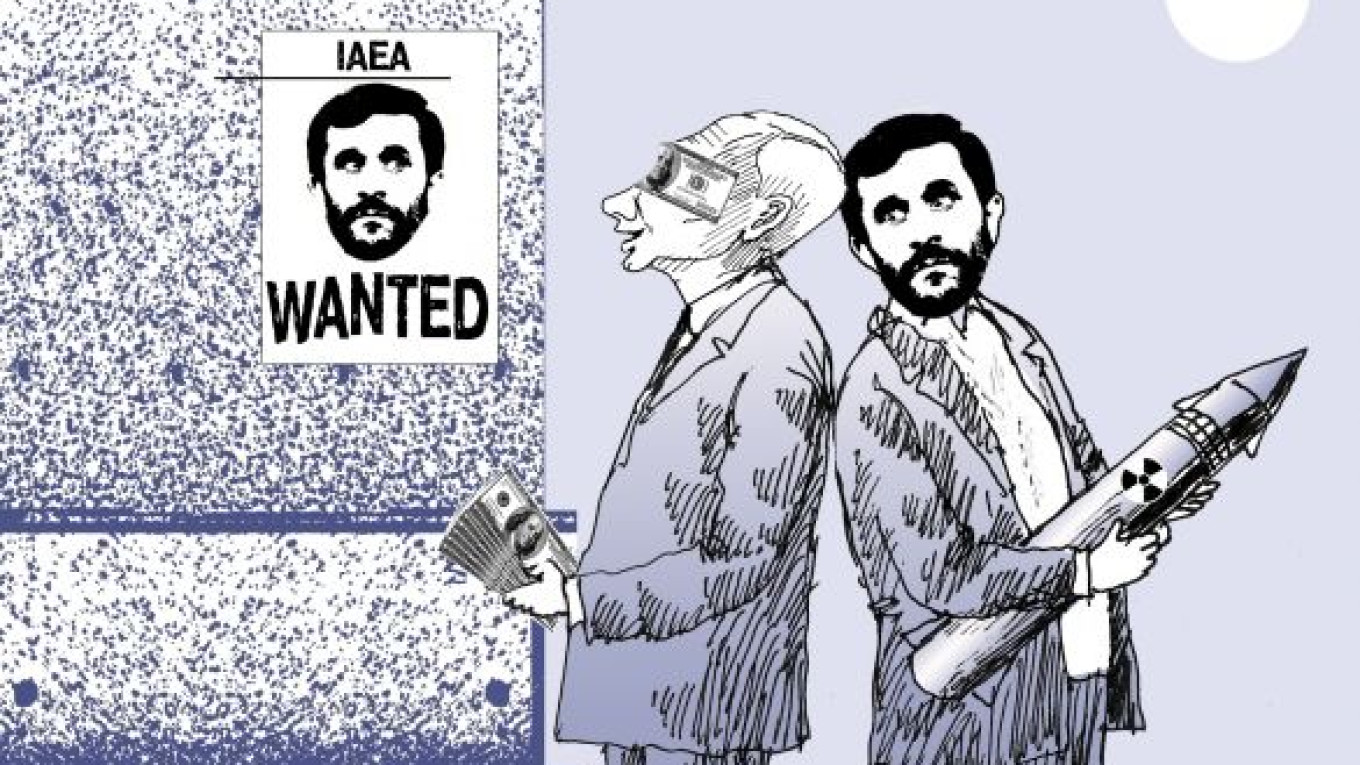
The International Atomic Energy Agency’s latest report on Iran’s nuclear program has refocused world attention on the Iranian regime’s relentless pursuit of the bomb and on the global failure thus far to derail it. But a multilateral solution to the Islamic republic’s nuclear ambitions appears to be as elusive as ever, due in no small measure to the stances of its enablers — Russia among them. In recent days, Moscow has publicly rejected the new IAEA findings and argued for renewed diplomacy in response to Iran’s nuclear transgressions.
This obstructionism is unfortunate, but understandable. The strategic relationship that has emerged between Moscow and Tehran since the late 1980s is deep and enduring. It includes vibrant defense and industrial trade, including nuclear technology and assistance from Russia; a quiet understanding that Iran will steer clear of spreading its brand of radical Islam in Russia’s turbulent southern regions; and a shared opposition to a range of U.S. foreign policy efforts.
The results have been noteworthy. Russia’s arms sector, which two decades ago was on the verge of collapse, is now booming, thanks in large part to Iran. The Iranian regime itself has proven to be a reliable (and lucrative) arms client in recent years, while deepening international concerns over Iran’s nuclear program have led to an upsurge in military investments among countries in the already-volatile Middle East — a trend that Russia’s industrial sector has exploited. Iran’s nuclear program, in other words, has proven to be very good for Russian business.
Russia’s nuclear trade has also benefited greatly. The years since Iran’s nuclear program broke into the open have seen an explosion of interest in the atom in the Greater Middle East. Today, 14 countries throughout the Middle East and North Africa have openly begun to pursue some level of nuclear capability. And Russia, the world’s leading exporter of nuclear technology, has capitalized on this trend, inking nuclear cooperation deals with a range of nations, from Algeria to Jordan.
Notably, however, support for the Russian-Iranian entente is far from universal at home. The past decade has seen the emergence of a significant minority view, articulated by a number of prominent Russian officials and experts, that their government’s partnership with Iran could turn out to be a double-edged sword. Nevertheless, the dominant approach adopted by the Kremlin remains one that views Iran as a key partner and favors the expansion of strategic cooperation with the regime in Tehran.
So it is perhaps not surprising that Russia remains resistant to real, substantive alterations to the strategic status quo. Indeed, its cool response to the latest IAEA revelations suggests that — despite nearly incontrovertible evidence of Iran’s quest for the bomb — Moscow still sees partnership with Tehran as a net benefit.
But this may not continue for much longer. Iran’s nuclear advances have been mirrored by an increasingly aggressive, revisionist foreign policy line on the part of the Islamic republic. For the moment, these provocations appear localized to the Arab Spring countries of Bahrain, Yemen and Syria, where Tehran has meddled in the popular uprisings. Iran was also involved in ill-conceived terrorist plots on U.S. soil, such as the foiled scheme last month to assassinate Saudi Arabia’s envoy at a posh Washington eatery.
Armed with nuclear weapons, however, Iran could prove considerably bolder. The Islamic republic, after all, possesses vital strategic and economic interests in Central Asia and both the North and South Caucasus. Historically, those interests have taken a backseat to Iran’s flourishing partnership with Russia. But armed with nuclear weapons, an emboldened Iran will certainly become a more assertive player in the region, perhaps even going so far as to revise regional arrangements in its favor at the expense of Moscow’s geopolitical position.
Iran’s strategic advances also pose a distinct challenge. As far back as 2003, PIR Center, a respected Moscow-based think tank, was already estimating that 20 million Russians were within range of Iran’s ballistic missiles. Today, thanks to Iran’s concerted work on its nuclear capabilities and associated delivery systems since then, the number of potential victims of an Iranian attack has increased. Iran is therefore first and foremost a growing potential menace to the security of Russia itself.
For years, conventional wisdom in the Kremlin has ignored this shifting balance and posited its partnership with Tehran as a geopolitical asset rather than a strategic liability. As Iran approaches the nuclear Rubicon, however, this calculus is likely to rub up against a sobering reality: Time is working against Moscow and in favor of Iran.
The Kremlin’s Iran policy, in other words, is ripe for a rethink. For Russian leaders, such a reconception should make sound strategic sense, too, because cooperation on pressuring Iran is one of the few areas of strategic importance where Russia and the United States can collaborate constructively. If that happens, it would represent a true “reset” in U.S.-Russian relations, as well as a much-needed shot in the arm for the international effort to derail Iran’s nuclear drive.
Ilan Berman is vice president of the American Foreign Policy Council in Washington.
A Message from The Moscow Times:
Dear readers,
We are facing unprecedented challenges. Russia's Prosecutor General's Office has designated The Moscow Times as an "undesirable" organization, criminalizing our work and putting our staff at risk of prosecution. This follows our earlier unjust labeling as a "foreign agent."
These actions are direct attempts to silence independent journalism in Russia. The authorities claim our work "discredits the decisions of the Russian leadership." We see things differently: we strive to provide accurate, unbiased reporting on Russia.
We, the journalists of The Moscow Times, refuse to be silenced. But to continue our work, we need your help.
Your support, no matter how small, makes a world of difference. If you can, please support us monthly starting from just $2. It's quick to set up, and every contribution makes a significant impact.
By supporting The Moscow Times, you're defending open, independent journalism in the face of repression. Thank you for standing with us.

Remind me later.