

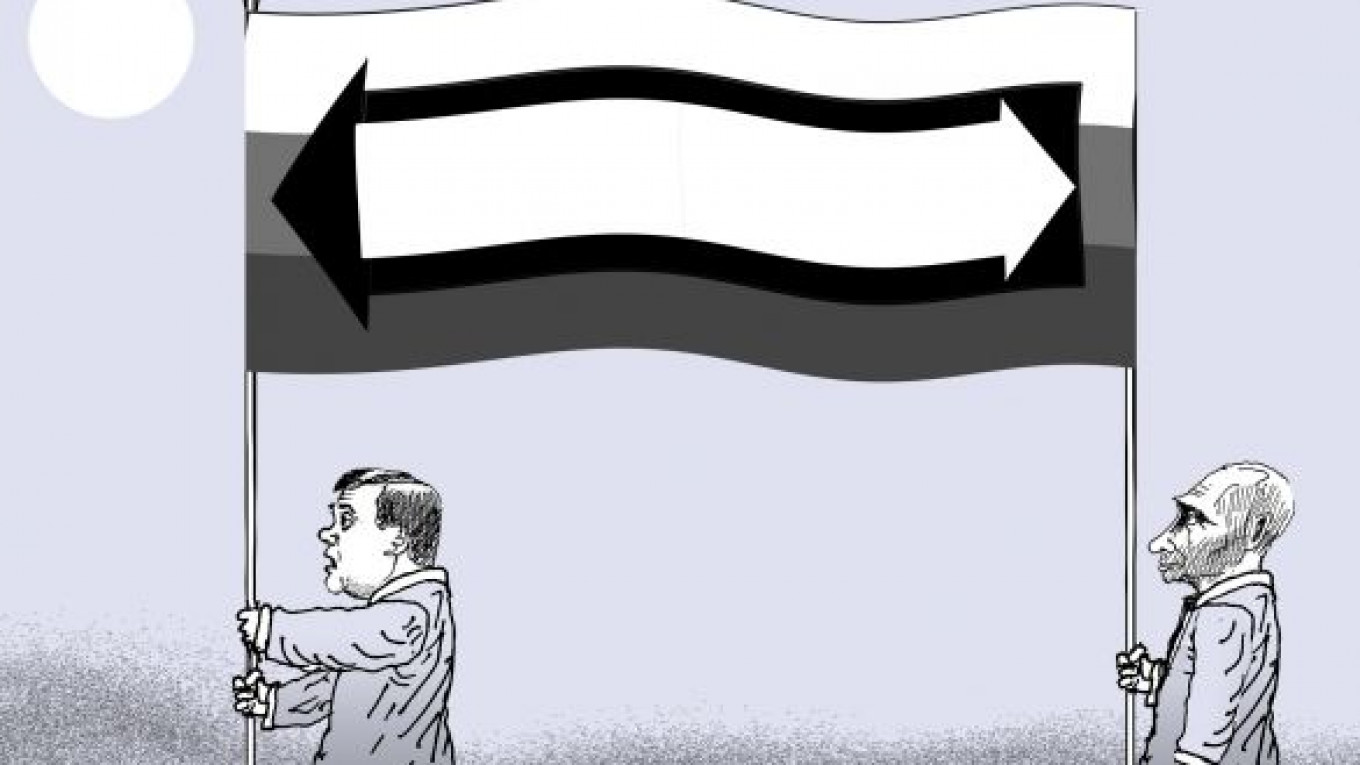
President Dmitry Medvedev gave a video address last week and, according to tradition, sounded a liberal note in advance of his annual state-of-the-nation address. Last year his message — laid out in the article “Go, Russia!” — sounded like a manifesto calling for change, but now that the midpoint of his term in office has already passed, the message was more like a progress report on what has already been achieved.
Surprisingly, the simple marketing trick of describing Russia’s modest technological advances with glowing, ultra-liberal rhetoric and shamelessly presenting that to the West as progress, once again, continues to work for Moscow — time and time again.
If we’re going to take the president’s message seriously — something I would not advise to the uninitiated reader — it creates an impression of political schizophrenia. In the first part of the speech, Medvedev levels fervent accusations and warnings from on high about the danger of stagnation and calls for strengthened political competition. But in the second part of the speech, he reverts to the language of a typical corporate lawyer who, almost from thin air, paints a picture of major achievements.
Let’s take a look, then, at how Russia, in the president’s words, has made “decent progress” improving its political system.
“The first thing we did was minimize the risks of election manipulation,” Medvedev says. But aside from several minor improvements to the actual voting process, the powerful electoral machine continues to be completely contained within the government’s power vertical and impervious to outside influence.
“Second,” he tells us, “all parties are now guaranteed equal access to state-run media.” But that is not the case when the entire state machinery consists of a single party that maintains its hold on power through rigged elections, and when only seven Kremlin-approved parties are even allowed to participate in elections. When the “head chef” controls which items make it onto the electoral menu, there’s no need for leaders to worry about whether voters pick the special of the day, since everything’s coming from the same kitchen.
“Third,” the president continues, “parties that win a majority in regional parliaments now have the exclusive right to propose candidates for governors.” That point sounds particularly ridiculous following the scandalous dismissal of Mayor Yury Luzhkov. The federal center continues, as before, to choose governors in consultation with United Russia’s central bureaucracy. What’s more, the Kremlin has been appointing an increasing number of governors from outside the regions they’re sent to serve.
“Fourth,” Medvedev tells us, “a number of measures to protect minority rights have been taken” and “the number of signatures of party supporters required for registering to participate in elections has been reduced.” Here, the situation has only worsened lately. With increasing frequency, political parties that are not already represented in the State Duma — along with their candidates — have been denied the right to register or pulled from electoral lists. And by eliminating the right to register through the payment of a monetary deposit, control over who may participate in elections has become absolute.
As for the president’s fifth point, that Russia has achieved a proportional balance in the number of deputies in regional legislative assemblies, that’s not a responsibility of the central authorities in a federated state, and it does nothing to serve the goal of modernization.
To complete the list of “achievements,” I would also add the elimination of direct mayoral elections and further limitations on voter representation in municipal elections, where the share of proportional systems is growing and public groups have lost the ability to put forward their own candidates.
The result is that there has been no political modernization under Medvedev. Russia has been either treading water or regressing.
This seems entirely natural when the country’s real leader does not currently occupy the highest position of power and therefore blocks any changes to the system that he perceives as a potential threat to his personal authority.
There are changes to be made down the road, however. The period of regency will end in 2012 regardless: Either the regent will return to the throne or Medvedev will retain the presidency. Either outcome will inevitably lead to a restructuring of the entire system.
Thus, we can expect to see a lessening of the gap between the nominal and real centers of power. Accordingly, the government will be more willing to embrace modernization – not for the sake of improvements, but as the only path to political survival.
The current system is far too primitive for the increasingly complex situation.
Reforms to the political system are therefore inevitable. The only question remaining is how they will take shape. After the presidential elections in 2012, shortages of cash will most likely force the government to make significant reductions to social spending, creating unfavorable conditions for any attempt at liberal modernization.
Nikolai Petrov is a scholar in residence at the Carnegie Moscow Center.
A Message from The Moscow Times:
Dear readers,
We are facing unprecedented challenges. Russia's Prosecutor General's Office has designated The Moscow Times as an "undesirable" organization, criminalizing our work and putting our staff at risk of prosecution. This follows our earlier unjust labeling as a "foreign agent."
These actions are direct attempts to silence independent journalism in Russia. The authorities claim our work "discredits the decisions of the Russian leadership." We see things differently: we strive to provide accurate, unbiased reporting on Russia.
We, the journalists of The Moscow Times, refuse to be silenced. But to continue our work, we need your help.
Your support, no matter how small, makes a world of difference. If you can, please support us monthly starting from just $2. It's quick to set up, and every contribution makes a significant impact.
By supporting The Moscow Times, you're defending open, independent journalism in the face of repression. Thank you for standing with us.

Remind me later.