

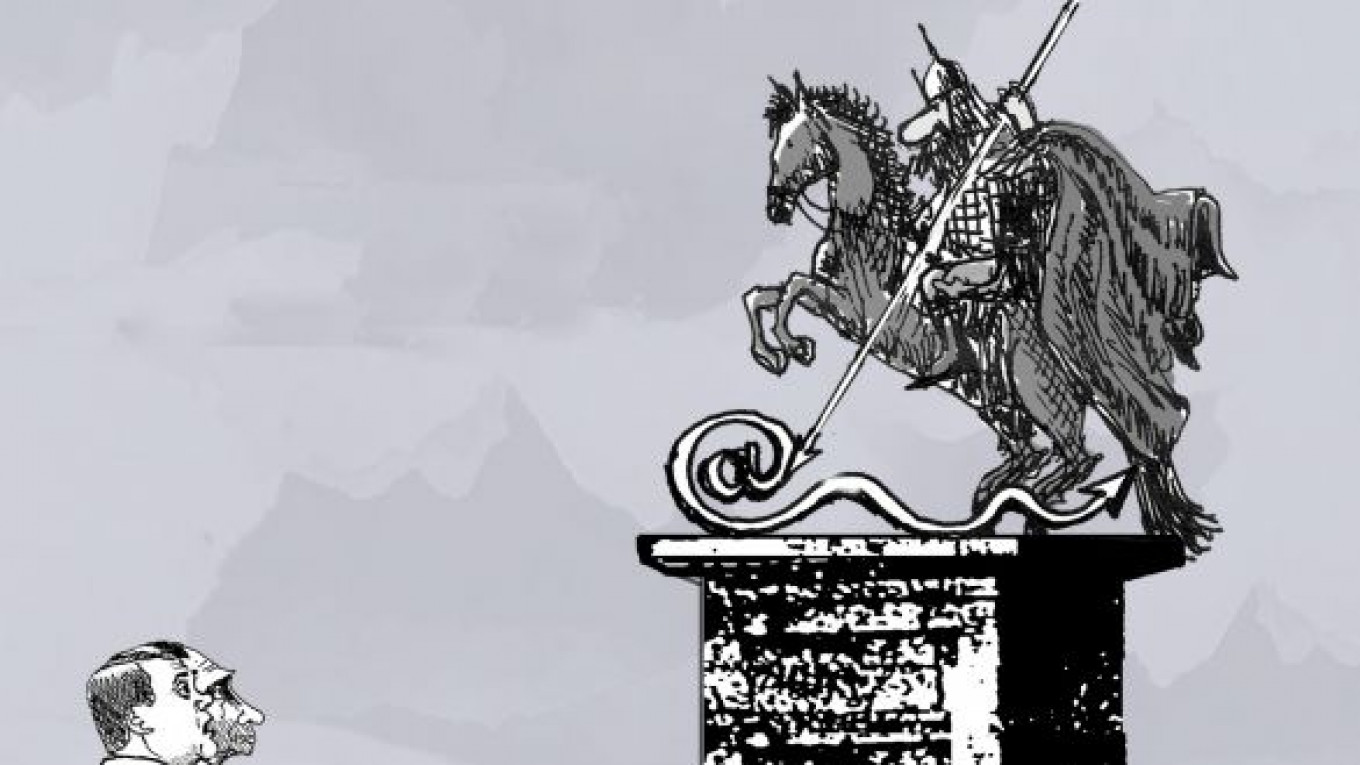
Recent events in the Arab world have sparked renewed optimism with online social networks. Many in the West are now convinced that Internet technology can create something previously impossible under authoritarian states — a strong opposition that can seize power through either elections or street demonstrations.
But how directly the Internet influenced these events is highly debatable. Many of the Western politicians who hold Twitter in high esteem are, in fact, captives of Cold War thinking, sociologist Evgeny Morozov argues in his recently released book “Net Delusion.” These politicians continue to believe that democracy will prevail whenever the people beyond the Iron Curtain gain access to free information. They point out that the Soviet Union collapsed soon after copiers and faxes appeared and information began freely circulating here.
The problem, however, is that nobody has proved a cause-effect correlation between fax machines and the Soviet collapse.
For 20 years now the global democratization process has stalled, and the West has feverishly sought a new technological gadget — a new fax machine — to free the citizens of authoritarian states. The flaw in this thinking is that many authoritarian states no longer prohibit their citizens from traveling abroad, and people who want uncensored information can usually find ways to obtain it.
Nonetheless, leading Western media outlets can’t stop glorifying the Internet and social networks as the new tools for empowering grassroots resistance movements. This point is not lost on the notoriously suspicious Kremlin, which is convinced that the West has found a new means for advancing its interests after the color revolutions of the mid-2000s. Since then, the argument goes, the opposition is much more capable of orchestrating a regime change thanks to Twitter technology.
What’s more, even weak or poorly organized opposition forces are capable of effecting regime change if their arsenals include Twitter and Facebook. As President Dmitry Medvedev said last week in Vladikavkaz: “Let’s face the? truth. They have been preparing such a? scenario for? us, and? now they will try even harder to? implement it.”
Medvedev’s reaction shows that the Kremlin is taking the threat very seriously. The question now is how the authorities will respond if similar protests erupt in Russia. The siloviki and the presidential administration are the two agencies capable of responding to any Internet-based threat of revolution.
The Federal Security Service and Interior Ministry have demonstrated several times in recent years which approach they believe is best — registering every single Internet user to identify “extremists” and bring criminal charges against them.
That is precisely how the FSB and Interior Ministry reacted to the revolutions in Tunisia and Egypt — by proposing Criminal Code amendments that would have made the owners of online social networks responsible for all content posted on their sites. Apparently, the idea is not to incriminate the owners of Facebook and Vkontakte of extremism personally, but to force them to pass responsibility on to individual users by requiring each to sign a contract that includes their passport information.
At the same time, the siloviki do not want to run special Internet-based operations in fear of leaving a trail. For example, when Russian nationalist hackers attacked Estonian government web sites in 2007, they left no evidence that might incriminate the Kremlin in the affair, forcing the Estonians to disavow their accusations of state involvement. Regarding computer attacks, it is preferable to maintain a safe distance from the scene of the crime.
Meanwhile, the presidential administration has traditionally preferred more adventurous methods. A couple years ago, the Kremlin opened its own “school of bloggers,” and although the school was supposedly later shut down, the same initiative was taken up by the regions.
This project was organized by the Foundation for Effective Policy, a think tank run by Kremlin-friendly political analyst Gleb Pavlovsky. Judging by the courses it offers — such as “Velvet Revolutions: A Warning” — the group is charged with a single overriding task: to resist the “subversive activity” of the West.
The head of United Russia’s political department, Alexei Chadayev, controls funding to the Kremlin school of bloggers. In February, he published an article in the Nezavisimaya Gazeta in which he wrote that “the 2011 State Duma elections will be the first in the history of our country in which the Internet-based campaign will be of equal or greater importance than the campaign in the traditional mass media.”
As mass unrest continues to shake authoritarian states in North Africa and the Middle East, the siloviki are pushing for the registration of social network users and waiting to pounce on anyone posting an extremist message and the Kremlin is funding pro-government bloggers. This will inevitably be interpreted by analysts as a new political battle between the government against the opposition.
Meanwhile, Russia’s 40 million Internet users — the country’s middle class and most active segment of the population — have shown remarkably little interest in this political struggle. This means that the Kremlin’s battle to prevent an imminent Facebook revolution will remain largely virtual.
Andrei Soldatov is an intelligence analyst at? Agentura.ru? and co-author of “The New Nobility: The Restoration of Russia’s Security State” and “The Enduring Legacy of the KGB.”
A Message from The Moscow Times:
Dear readers,
We are facing unprecedented challenges. Russia's Prosecutor General's Office has designated The Moscow Times as an "undesirable" organization, criminalizing our work and putting our staff at risk of prosecution. This follows our earlier unjust labeling as a "foreign agent."
These actions are direct attempts to silence independent journalism in Russia. The authorities claim our work "discredits the decisions of the Russian leadership." We see things differently: we strive to provide accurate, unbiased reporting on Russia.
We, the journalists of The Moscow Times, refuse to be silenced. But to continue our work, we need your help.
Your support, no matter how small, makes a world of difference. If you can, please support us monthly starting from just $2. It's quick to set up, and every contribution makes a significant impact.
By supporting The Moscow Times, you're defending open, independent journalism in the face of repression. Thank you for standing with us.

Remind me later.