

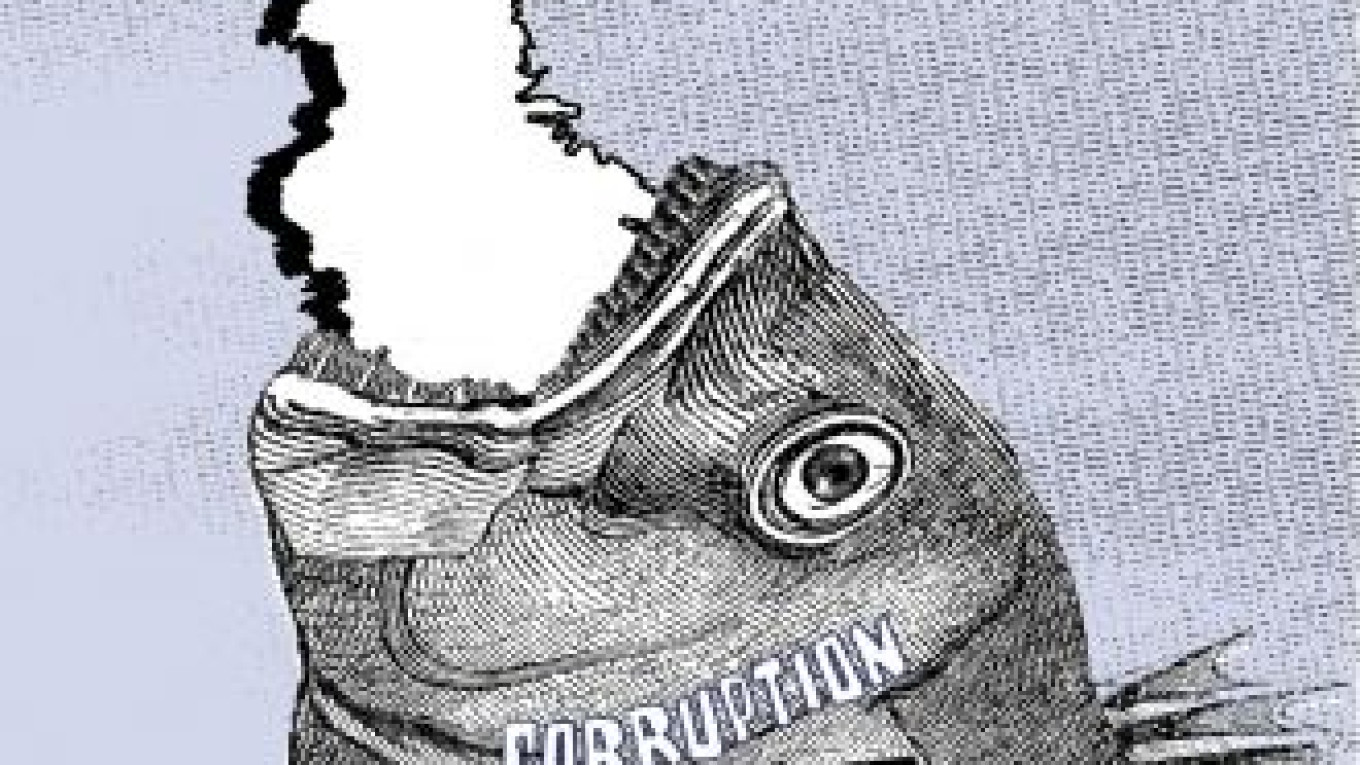
We all agree. Russia needs to be rebuilt. Ample material is available: talented human capital, lots of cash and plenty of raw materials. But how should it be done? The downside is that Russia's two biggest problems of corruption and authoritarianism are crippling the country.
Each fall, I teach a graduate course at Georgetown University on post-Communist economic transformation. A favorite essay among my students is how to fight corruption in Russia. Corruption is usually defined as "the misuse of public power for private gain."
Let's face it, the aim of Vladimir Putin's regime and most other authoritarian regimes in the former Soviet Union is to maximize corruption for the enrichment of themselves and a broader elite. That is the reason for their authoritarian rule.
Therefore, the main goal of both anti-corruption endeavors and democratization is to break the power of the corrupt elite. With few exceptions, authoritarian rule means corruption, not order. Everything follows from this elementary insight.
Since Russia is pervasively corrupt, especially at the top, any battle against corruption will be extremely difficult. Any knight on a white horse is likely to be corrupted over time, if he was not at the outset, as Ukraine's Orange Revolution so richly illustrated.
Paradoxically, when fighting corruption, the best government to have is an unstable one. Indeed, the governments that fought corruption the best in the 1990s in Eastern Europe were in Poland and the Baltic states, because they were ousted every year. If fighting corruption is the main goal, government instability is actually desirable.
Consequently, it is not by chance that the most democratic and least corrupt governments among former Communist countries are parliamentary republics that can oust any government easily. Presidents who serve too long have too much discretionary power and are not sufficiently transparent. Russia is not likely to become democratic and be in a position to control corruption until it abandons its current Constitution that gives too much power to the president. All the post-Communist regimes in Central and Eastern Europe have become parliamentary and democratic over time, while all the dysfunctional dictatorships in the former Soviet Union are presidential states.
Any true democracy needs free media and transparency. Russia has a healthy and vibrant Internet media, many professional journalists and narrow print media, but the main media are far from free or independent, which is an absolute precondition for democracy.
One idea to help Russia battle corruption is to adopt a law that would provide maximum public access to information. This would go a long way toward improving transparency in government affairs. Sweden adopted such a law in 1766, according to which all state information is available to the public. The only exceptions are information concerning national security or information of a strictly personal nature, such as medical records. This law extended to the Grand Duchy of Finland when it was part of the Russian Empire and stayed in effect until the Bolshevik Revolution. If a Russian tsar was comfortable with this high level of government transparency, Russia's current leaders should be as well.
No democracy can be ruled by the secret police. In fall 1991, President Boris Yeltsin reduced the size and strength of the old KGB, but Putin has largely reassembled it as the FSB. The first task of any new democratic government in Russia must be to abolish the FSB in its current form, as well as the other "law enforcement" agencies that spy on its own people.
As Igor Yurgens and his colleagues from the Institute of Contemporary Development have pointed out, Russia had better abolish not only the FSB but also the Interior Ministry because these two organizations function largely as authorized organized crime institutions. Instead, Russia should follow the example of the United States when it created the FBI to make its internal investigative capabilities cleaner and more effective.
A decade ago, Russia undertook a seemingly serious judicial reform, but it turned out to do little more than transfer power over the courts from the regional leaders to the presidential administration. This time, the courts should be made truly professional and independent. International control through the Council of Europe could help.
The biggest source of corruption in Russia are large state corporations. It came as quite a surprise when Putin himself threatened his favorite companies, such as Gazprom, Transneft, Russian Railways, Sovcomflot, Vneshekonombank, VTB and Rosatom, with a thorough review of their corrupt schemes and repercussions, as The Moscow Times reported on Dec. 20. This alone underscores how much Putin feels popular pressure to curb corruption. He should start by insisting that the management boards of these companies should be sacked instantly. Even Putin has acknowledged that corruption among these board members is a big problem.
Since 1997, Russia has failed to expand its road network because of ever-rising corruption. With surprising honesty, Putin said at a VTB Capital investment conference on Oct. 6, "We will strive to reduce all kinds of unnecessary construction projects and the like where corruption is rampant." Thus, he effectively acknowledged that Russia is too corrupt to build roads and that he has no intention of cleaning up this corruption.
The only information missing was who benefits from this corruption, but, thanks to the Internet, we have a pretty good idea. What Russia needs is a small group of honest men and women who are legally entitled to organize competitive tenders for major public projects.
Lower down in the hierarchy, many reforms have still not been instituted, such as abolishing all nontransparent benefits in kind for top officials and cleaning out petty tutelage. Russia could ask for technical assistance from Estonia or Georgia if the authorities were to get serious about how to accomplish this.
Russian web sites are full of information implicating law enforcement officials at the highest levels in organized crime. In a law-abiding state, this evidence would be investigated and the key culprits would be jailed if found guilty in court.
One of Putin's international friends, former French President Jacques Chirac, has just been given a suspended two-year prison sentence, and his closest foreign friend, Silvio Berlusconi, is being investigated on numerous charges despite all of his wealth and power. Nobody will take law enforcement in Russia seriously until it goes after corrupt public officials, starting at the top.
Anders Aslund is a senior fellow at the Peterson Institute for International Economics.
A Message from The Moscow Times:
Dear readers,
We are facing unprecedented challenges. Russia's Prosecutor General's Office has designated The Moscow Times as an "undesirable" organization, criminalizing our work and putting our staff at risk of prosecution. This follows our earlier unjust labeling as a "foreign agent."
These actions are direct attempts to silence independent journalism in Russia. The authorities claim our work "discredits the decisions of the Russian leadership." We see things differently: we strive to provide accurate, unbiased reporting on Russia.
We, the journalists of The Moscow Times, refuse to be silenced. But to continue our work, we need your help.
Your support, no matter how small, makes a world of difference. If you can, please support us monthly starting from just $2. It's quick to set up, and every contribution makes a significant impact.
By supporting The Moscow Times, you're defending open, independent journalism in the face of repression. Thank you for standing with us.

Remind me later.