

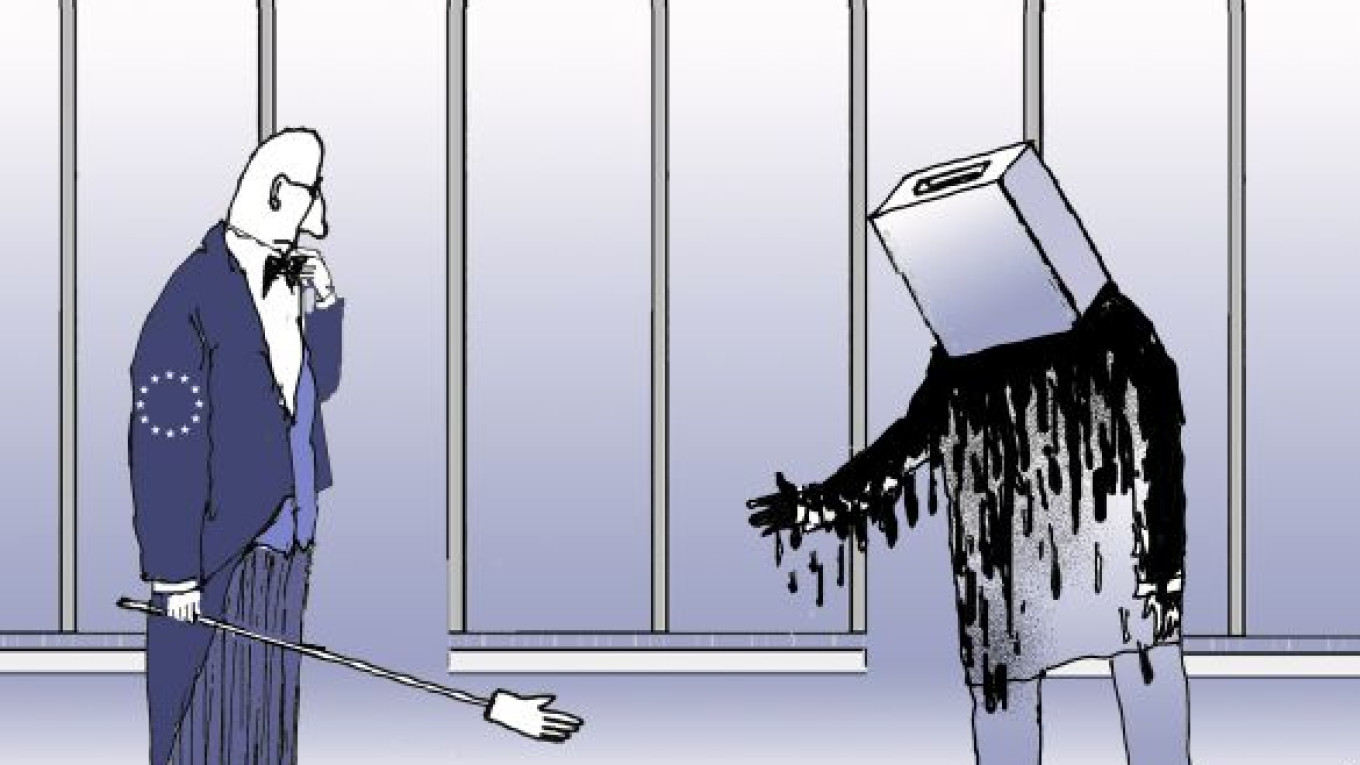
On Dec. 4, Russia will hold the dirtiest, most fraudulent and dishonest “elections” of its entire post-Soviet history.
For the first time in the past decade, State Duma elections will be held against a backdrop of widespread discontent and frustration with the authorities — especially in the country’s large cities, where voters are best informed about the abuses and corrupt practices of the regime. Every survey reveals a plummeting level of faith in and support for President Dmitry Medvedev, Prime Minister Vladimir Putin and their United Russia party — commonly referred to as “the party of crooks and thieves.”
United Russia leaders have issued instructions to regional offices to obtain election results ranging from 60 percent to 65 percent of the vote. The party is employing all of its infamous tricks toward that end, using administrative pressure and bribes to a range of fraudulent practices that it has perfected over the years. They are even applying pressure to international election monitors from the Organization for Security and Cooperation in Europe. As a result, it will be impossible to recognize the upcoming elections as legitimate, free or fair by any internationally recognized standards.
And how will the West react to this pathetic charade? What position will the European Union adopt after the elections? Will the popularly elected leaders of democratic European states send congratulatory telegrams to Putin and Medvedev as the so-called winners in the so-called elections? And will they embrace, shake hands and give flowers to Russian rulers who prohibited the opposition from taking part in the elections and falsified the election results? ?
How will these elections influence the next EU-Russia summit on Dec. 15? Will it be another routine meeting of two “strategic partners” pledging once again to uphold “common values”? Will EU officials pretend that nothing unusual occurred in Russia on Dec. 4 and that Moscow is actually fulfilling its basic democratic obligations to free and fair elections as a Council of Europe and OSCE member?
If the EU, OSCE and Council of Europe officially recognize the results of the Duma elections, the West will add legitimacy to a regime that is increasingly losing legitimacy within Russia itself. If European politicians recognize the election results and the new Duma, they will be sacrificing European values and Europe’s moral authority for the sake of their pragmatic and cynical short-term political interests. In fact, former German Foreign Minister Frank-Walter Steinmeier and political analyst Alexander Rahr propose that Brussels base its Russia policy exclusively on such “pragmatic interests,” even if they fall a long way short of European values. Steinmeier was completely direct in his message when he said, “It would be wrong today to pursue a Russia policy based on Western values.”
But European politicians who claim that they “do not have any leverage concerning the internal situation in Russia” are not telling the whole truth. They could implement a wide range of measures that would reinforce the authority of the European Union and Council of Europe as steadfast supporters of democratic values. And such measures would aid Russia’s transition to democracy.
First, European organizations should not recognize the legitimacy of the newly elected Duma and thus should not recognize the legitimacy of the Russian delegation to the Parliamentary Assembly of the Council of Europe.
Second, the new EU-Russia agreement that diplomats are currently hammering out should include a full section devoted to democracy and human rights that would carry legal obligations and a mechanism for mutual monitoring of compliance with those obligations.
Third, the EU-Russia summit next month should be postponed. That would send a clear signal to the Russian authorities that they have not upheld their obligations as OSCE and Council of Europe members. If the summit is held as scheduled, a question should be added to the agenda calling for an open discussion of the illegitimacy of the Duma elections.
Fourth, democracy and human rights should become an ongoing agenda question for all meetings and summits held as part of the regular EU-Russia political dialogue.
Fifth, the Council of Europe should fully monitor the Russian authorities’ compliance with the European conventions it ratified as part of its membership in that organization, paying special attention to their compliance with rulings made by the European Court of Human Rights.
Sixth, Europe should introduce permanent visa and economic sanctions against Russian officials and law enforcement officers who commit or allow human rights violations. At the same time, the EU visa procedure for ordinary Russian citizens should be simplified and eliminated completely in the near future.
Such a program would have a chilling effect on corrupt Russian officials accustomed to breaking the law with impunity and would deprive the regime of any legitimacy in the West. It would enable millions of Russians to view a united Europe as a true ally committed to democratic values and not a cynical business partner interested only in obtaining the most advantageous deal from corrupt politicians and captains of big business.
Of course, the ultimate responsibility for building democratic institutions rests with the Russian people. But European politicians should do their part by taking a firm position based on clear democratic principles — and then acting in accordance with those principles.
Vladimir Ryzhkov, a State Duma deputy from 1993 to 2007, hosts a political talk show on Ekho Moskvy radio and is a co-founder of the opposition Party of People’s Freedom.
A Message from The Moscow Times:
Dear readers,
We are facing unprecedented challenges. Russia's Prosecutor General's Office has designated The Moscow Times as an "undesirable" organization, criminalizing our work and putting our staff at risk of prosecution. This follows our earlier unjust labeling as a "foreign agent."
These actions are direct attempts to silence independent journalism in Russia. The authorities claim our work "discredits the decisions of the Russian leadership." We see things differently: we strive to provide accurate, unbiased reporting on Russia.
We, the journalists of The Moscow Times, refuse to be silenced. But to continue our work, we need your help.
Your support, no matter how small, makes a world of difference. If you can, please support us monthly starting from just $2. It's quick to set up, and every contribution makes a significant impact.
By supporting The Moscow Times, you're defending open, independent journalism in the face of repression. Thank you for standing with us.

Remind me later.