

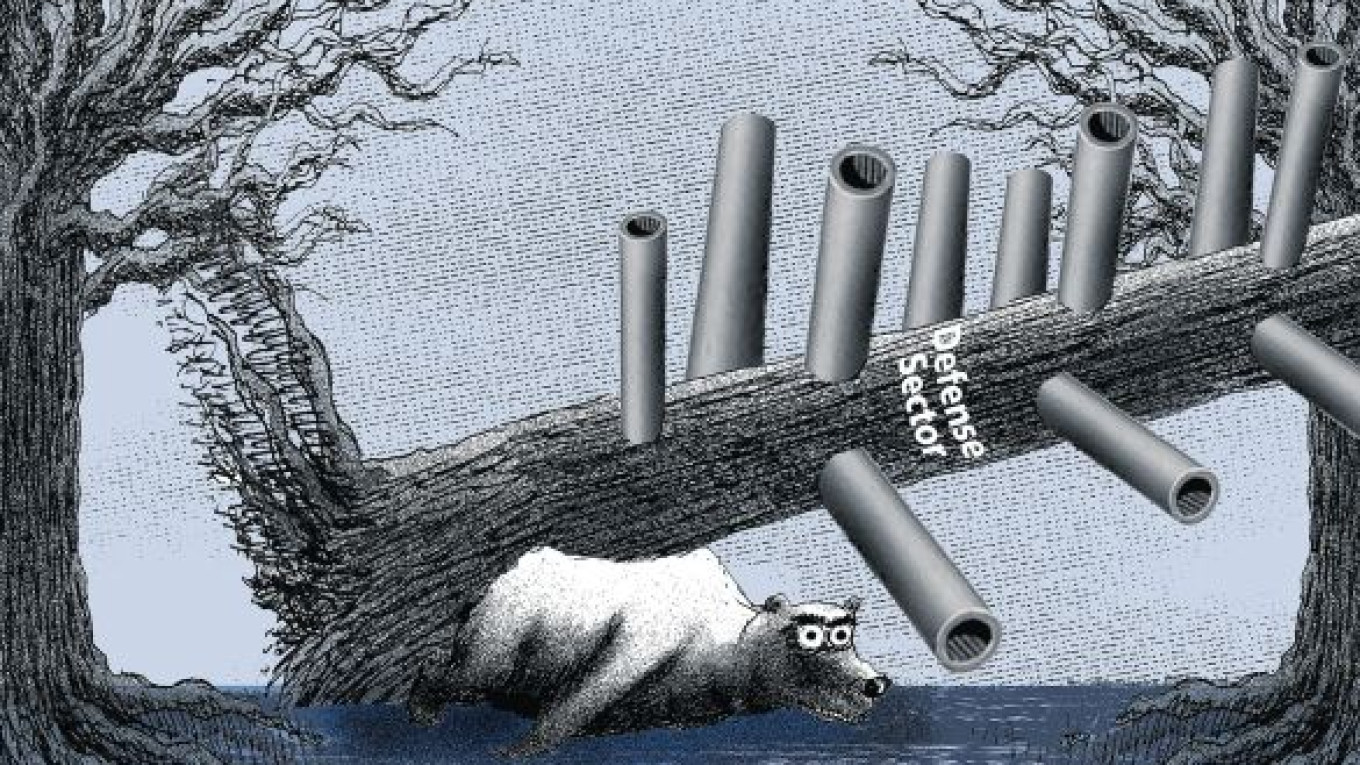
As a member of the Moscow-based Council on Foreign and Defense Policy, I found it interesting to witness a dispute between two prominent members of President Vladimir Putin's elite concerning different approaches to modernizing Russia's armed forces.
It is especially interesting because it has become such a rarity in recent times to see an open discussion or debate between Putin's close associates. The participants were Deputy Prime Minister Dmitry Rogozin, who oversees the country's military-industrial complex, and former Finance Minister Alexei Kudrin, leader of the oppositional Civil Initiatives Committee.
Kudrin said in a recent interview with Der Spiegel that the militarization of Russia would stifle economic growth, and he reminded us that a similar policy contributed to the collapse of the Soviet Union. Rogozin countered that an increase in defense orders would stimulate domestic investment and demand.
The military-industrial complex occupied a special place in the Soviet economy, where it increased domestic demand and stimulated development of the civilian sector. That trend continued right up to the mid-1980s. The trend reversed only in the late 1980s, when defense spending for the war in Afghanistan and the "Star Wars" arms race with the U.S. became disproportionately high.
In the 1990s, Russia's defense sector became little more than a consumer resource. There was practically no domestic demand for its products, and monetarists under President Boris Yeltsin used budget subsidies to administer what amounted to life support to the dying industry. The situation became worse when a nationwide tax provided most companies in the defense sector with too little money to develop but just enough to avoid collapsing altogether. The result was that the best technical specialists and engineers from this sector left Russia, weakening defense companies even more and causing others to go belly-up.
To this day, Kudrin continues to preach that military enterprises are an excessive burden on the economy and that military personnel are an annoying problem that must be factored into calculations for pensions and other government subsidies.
We have come to the point where a simple increase in funding has no tangible impact. With only a few exceptions, the defense sector has consistently deteriorated over the past 20 years. What's more, expenses have skyrocketed in recent years, even while production has remained stable. The same bullet that yesterday cost just one ruble to manufacture now costs 10 rubles. Continued increases in military spending without major structural changes to the defense sector will produce nothing but an additional burden on the economy.
To modernize its armed forces, Russia needs to create innovative, high-tech companies to become key components of the defense sector. Only then would the money lead to increased production and spur economic growth instead of simply ending up in the pockets of modern-day "red directors," the notoriously corrupt factory heads of the Soviet era.
The lack of real transformation in the defense sector over the past 20 years has put Russia in a unique position. It is now the world's only leading economy in which there is no direct connection between its scientific and innovative sector, the volume of military orders and its overall economic growth. The enormous increase in military spending in recent years has not resulted in better equipment for the army or improved conditions for soldiers. If anything, it has had only a negative effect on the economy, particularly when the government increased taxes on private businesses to help provide funds for increased defense expenditures.
To be fair, Rogozin has taken a number of steps that could lead to structural changes and more innovation in the defense sector. One example is the creation of the Applied Research Foundation. But this was done in isolation not only from the private manufacturers of high-tech products but also from other government modernization initiatives such as the Skolkovo technology park and Rosnano. This approach confirms that the government is still driven by the same neoliberal approach in which it tries to solve economic problems by simply throwing money at them, a tactic that is fundamentally flawed under current circumstances.
We should closely study the U.S. approach to defense modernization. One of President Barack Obama's first acts when coming into office was the creation of the position of national chief technology officer, who answers directly to the president. That officer coordinates all state orders for new technologies needed in both military and civilian sectors, relying primarily on businesses offering the most advanced technologies. Thanks to that approach, a clear majority of U.S. businesses and the American people have positive opinions of the U.S. military and support increased spending for the defense sector. This is something Russia needs to emulate.
Ilya Ponomaryov is a State Duma deputy for the Just Russia party.
Related articles:
A Message from The Moscow Times:
Dear readers,
We are facing unprecedented challenges. Russia's Prosecutor General's Office has designated The Moscow Times as an "undesirable" organization, criminalizing our work and putting our staff at risk of prosecution. This follows our earlier unjust labeling as a "foreign agent."
These actions are direct attempts to silence independent journalism in Russia. The authorities claim our work "discredits the decisions of the Russian leadership." We see things differently: we strive to provide accurate, unbiased reporting on Russia.
We, the journalists of The Moscow Times, refuse to be silenced. But to continue our work, we need your help.
Your support, no matter how small, makes a world of difference. If you can, please support us monthly starting from just $2. It's quick to set up, and every contribution makes a significant impact.
By supporting The Moscow Times, you're defending open, independent journalism in the face of repression. Thank you for standing with us.

Remind me later.