

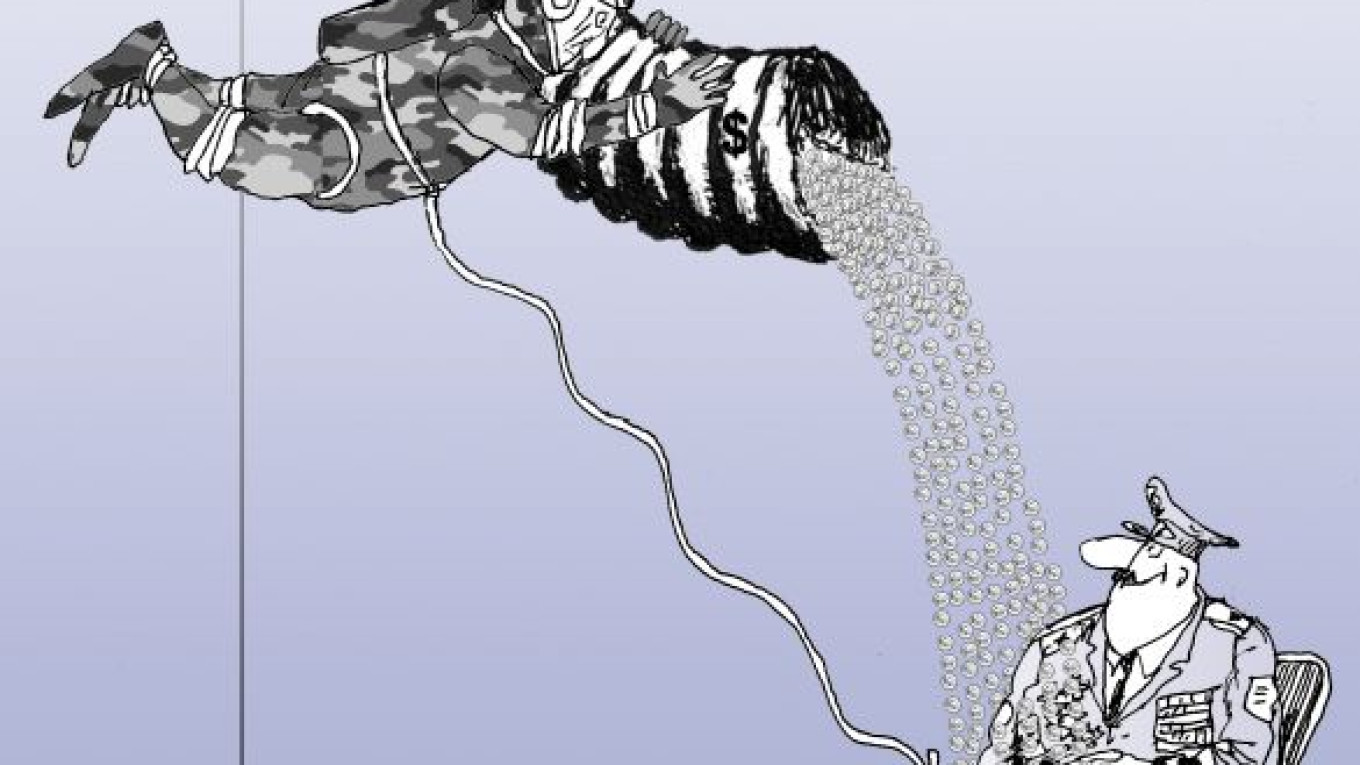
Long ago, I formulated what I humbly call the “Golts Principle” — the more absurd the idea, the more likely it is that the Russian bureaucracy will embrace it. The motive is clear: By adopting impossible goals, bureaucrats can milk the state budget indefinitely.
This axiom was confirmed yet again recently. Lieutenant General Valery Ivanov, head of the Aerospace Defense operational strategic command, announced that a highly sophisticated, integrated air and space defense system has been created in response to an order from President Dmitry Medvedev and that it will be operational by December. Ivanov stated that his command, the former Moscow air defense district, would now include space defense forces as well.
This fairy-tale dream of outdoing the United States in missile defense has been dragging on for four years. In 2007, then-Defense Minister Sergei Ivanov announced his intention to combine air defense and space defense forces to create a unified system of aerospace defense. Specialists were unanimous in ridiculing the idea, citing the laws of physics as proof that the administrators were misguided.
The project’s logic was simple: Since the insidious United States is planning an air and space attack against Russia, the Defense Ministry must therefore counter with an advanced space defense system. That makes it necessary to combine the country’s air and space defense systems.
But there was one little problem that the authors of this grand idea preferred not to mention — the systems are not combinable a priori. Enemy missiles flying through space are subject to one set of laws of physics, while missiles entering the Earth’s atmosphere are subject to another. Thus, shooting down enemy missiles in both air and space require two completely different systems of radar — one for air and one for space — and, correspondingly, two different systems of interceptor missile technology.
But apparently military and civilian bureaucrats, in their relentless attempt to milk billions of dollars in defense allocations, are trying to trump basic laws of physics. In comparison, the United States clearly has a better understanding of the law of physics. It has developed two missile defense systems in air and space separately and hasn’t attempted to achieve the impossible of combining the two systems into one.
The harebrained idea of an integrated air and space defense system is just the latest in a series of ridiculous projects coming out of the Defense Ministry. Take, for example, the “miracle weapon” — the S-500 system allegedly capable of intercepting enemy missiles in Earth’s atmosphere as well as in the lower reaches of space. According to Valery Ivanov, the S-500 will be operational by 2015. But I would not be so optimistic. The S-400 — the precursor to the S-500 — was deployed in 2007. In the four years since, only 32 units have been produced, or enough to equip just two regiments. Ivanov expects to receive shipment of 16 more units by year’s end, enough to equip one more regiment.
Thus, it is unclear on what grounds Ivanov thinks that Russia’s aerospace forces are already capable of defending two-thirds of the country’s territory. What’s more, the history of the S-400’s deployment indicates that the S-500 will fare no better. Almaz-Antei, the Moscow-based defense contractor that produces the S-400 and is supposed to produce the S-500, has yet to begin mass-producing either of the systems.
But Ivanov can fabricate whatever cock-and-bull stories he wants. After all, Russia has used its lack of an integrated air and space defense system as an argument to oppose European plans to improve its own missile defense system. Now that NATO has rejected Moscow’s proposal to create a joint sector-based missile defense system, Russia will defiantly try to create its own super-advanced missile defense system.
Regardless of Russia’s (or any other country’s) technological inability to create such a system, there is another inherent basic problem: Russia is still driven by Cold War-era nuclear deterrence theory. By even threatening to create an integrated air and space defense system, Moscow is tacitly implying that it would want to launch a first strike against the United States and thus needs an advanced defense system to weaken the effectiveness of any U.S. counterstrike. Or, just as ludicrous, it is implying that the United States could launch a nuclear first strike against Russia. Is this 2011 or 1983?
The problem is not simply that senior officials are supporting a pointless idea, but that they are pushing a proposal that has been publicly ridiculed and declared technologically impossible.
There can only be two possible explanations for this. Either the officials have discovered new laws of physics, or, as the Golts Principle asserts, individuals with a vested interest in the program have prevented their superiors from learning that the specialists have already dismissed this kind of aerospace defense system as impossible. The fact that this crazy idea is treated seriously by Russia’s military and civilian bureaucrats calls into question their ability to achieve even the simplest goals of defense and national security.
Alexander Golts is deputy editor of the online newspaper Yezhednevny Zhurnal.
A Message from The Moscow Times:
Dear readers,
We are facing unprecedented challenges. Russia's Prosecutor General's Office has designated The Moscow Times as an "undesirable" organization, criminalizing our work and putting our staff at risk of prosecution. This follows our earlier unjust labeling as a "foreign agent."
These actions are direct attempts to silence independent journalism in Russia. The authorities claim our work "discredits the decisions of the Russian leadership." We see things differently: we strive to provide accurate, unbiased reporting on Russia.
We, the journalists of The Moscow Times, refuse to be silenced. But to continue our work, we need your help.
Your support, no matter how small, makes a world of difference. If you can, please support us monthly starting from just $2. It's quick to set up, and every contribution makes a significant impact.
By supporting The Moscow Times, you're defending open, independent journalism in the face of repression. Thank you for standing with us.

Remind me later.