

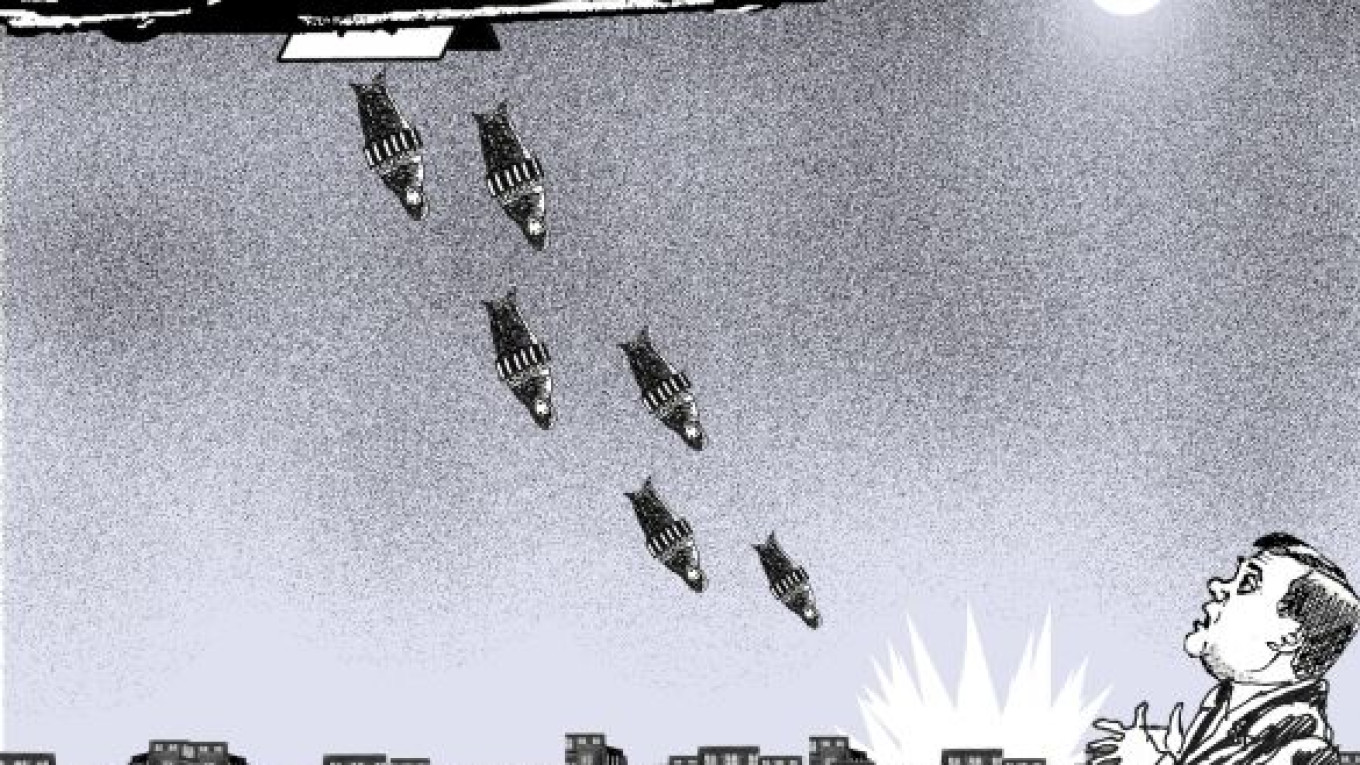
Last week’s horrifying terrorist attack at Domodedovo Airport that killed 35 people should serve as a wake-up call to the public. The suicide bombing reveals the unpreparedness of government officials at all levels to deal with attacks and their inability to mount an appropriate response. President Dmitry Medvedev singled out airport security staff for their inability to avert the disaster, although they were only the last of several agencies that failed to do their jobs. Although airport security could stand to make some straightforward improvements, that is hardly the main problem. The same argument applies to the transportation police, where Medvedev made several high-profile dismissals in the wake of the attack.
The authorities fail to learn the right lessons from their failures like inept generals who stick to the same strategy after losing battles. By requiring everyone entering the airport to pass through a metal detector, the Domodedovo security staff has created a thick crowd in front of the airport. The next explosion could take place there, or in any one of the countless locations in the capital where large throngs of people gather.
Complicating the problem was the conspicuous lack of political leadership following the terrorist attack. Addressing the Federal Security Service, Medvedev sounded more like a mid-level specialist on airport security than the leader of the country — if only nominally so.
Two days after the bombing, Prime Minister Vladimir Putin felt obliged to declare that it probably had no connection with Chechnya. That might be an understandable reaction from someone who claims to have restored peace to war-torn Chechnya, but it was politically irrelevant.
Through it all, FSB chief and head of the National Anti-Terrorist Committee Alexander Bortnikov avoided making a single public statement.
Undoubtedly, the situation in the North Caucasus both directly and indirectly provoked the attack at Domodedovo. Two wars in the past 16 years created and continue to create conditions for increased terrorism in the region itself and in Moscow. Since 1994, hundreds of thousands of Interior Ministry officers and soldiers from across the country have served in Chechnya. While there, they have learned to hate and managed to sow the seeds of hatred throughout the country. They were taught to belittle the value of other people’s lives, and even their own. The recent senseless mass murders in the Krasnodar and Stavropol regions are chilling examples of the lack of respect for life.
Clearly, the problem cannot be solved through the use of force alone. The trouble is that after every major terrorist attack, officials fall hostage to political clans and intelligence agencies that demand greater funding and authority to avert future attacks when they should instead thoroughly discuss what happened in order to identify exactly what went wrong. As such, after the Beslan school siege in 2004, then-President Putin announced a tightening of the political screws, and after the Moscow metro bombing last March, an amendment was passed giving broader powers to the FSB.
No security measures can fully protect a city of more than 10 million people after 16 years of open warfare in the North Caucasus — even if the conflict is officially at a “low simmer” today. Any long neglected disease must be treated at the source and not at the site of the metastasis. Lasting security can only be established when the problems of the North Caucasus are resolved. Those problems have been accumulating for years, even decades, and a serious solution can only be achieved by implementing an effective long-term strategy.
But Russia’s political elite has always looked for quick fixes, seeking to ease tensions in Chechnya before the 2004 presidential election and now again ahead of the 2014 Olympic Games in Sochi.
There was a relatively short period from 2004 to 2007 when the federal authorities tried to modernize the ruling elite in the Caucasus republics with help from Dmitry Kozak, then the presidential envoy to the region. That met with some success. But it was the last serious attempt at nation-building and at tackling the socio-economic problems of the region. The federal government is now placing its bets on the elites of archaic local clans and on completely replacing local siloviki leaders with outsiders who constantly rotate through the region. However, it is painfully obvious that money and police measures alone cannot solve the problem of the North Caucasus.
Societal and political pressures in Russia were escalating even before the Domodedovo attack as evidenced by a wave of ethnic tension that culminated in youth rioting and street clashes in Moscow and other cities in December. Tensions are only bound to escalate ahead of upcoming elections as political campaigns increasingly rally supporters against “foreign enemies.” All of this creates difficult conditions for making sound decisions and tests the maturity and responsibility of the authorities and society. Without relying on leaders, society itself must initiate serious talks about the causes for the current difficulties and find ways to resolve it. People then should formulate their proposals and present their demands to the authorities.
Nikolai Petrov is a scholar in residence at the Carnegie Moscow Center.
A Message from The Moscow Times:
Dear readers,
We are facing unprecedented challenges. Russia's Prosecutor General's Office has designated The Moscow Times as an "undesirable" organization, criminalizing our work and putting our staff at risk of prosecution. This follows our earlier unjust labeling as a "foreign agent."
These actions are direct attempts to silence independent journalism in Russia. The authorities claim our work "discredits the decisions of the Russian leadership." We see things differently: we strive to provide accurate, unbiased reporting on Russia.
We, the journalists of The Moscow Times, refuse to be silenced. But to continue our work, we need your help.
Your support, no matter how small, makes a world of difference. If you can, please support us monthly starting from just $2. It's quick to set up, and every contribution makes a significant impact.
By supporting The Moscow Times, you're defending open, independent journalism in the face of repression. Thank you for standing with us.

Remind me later.