

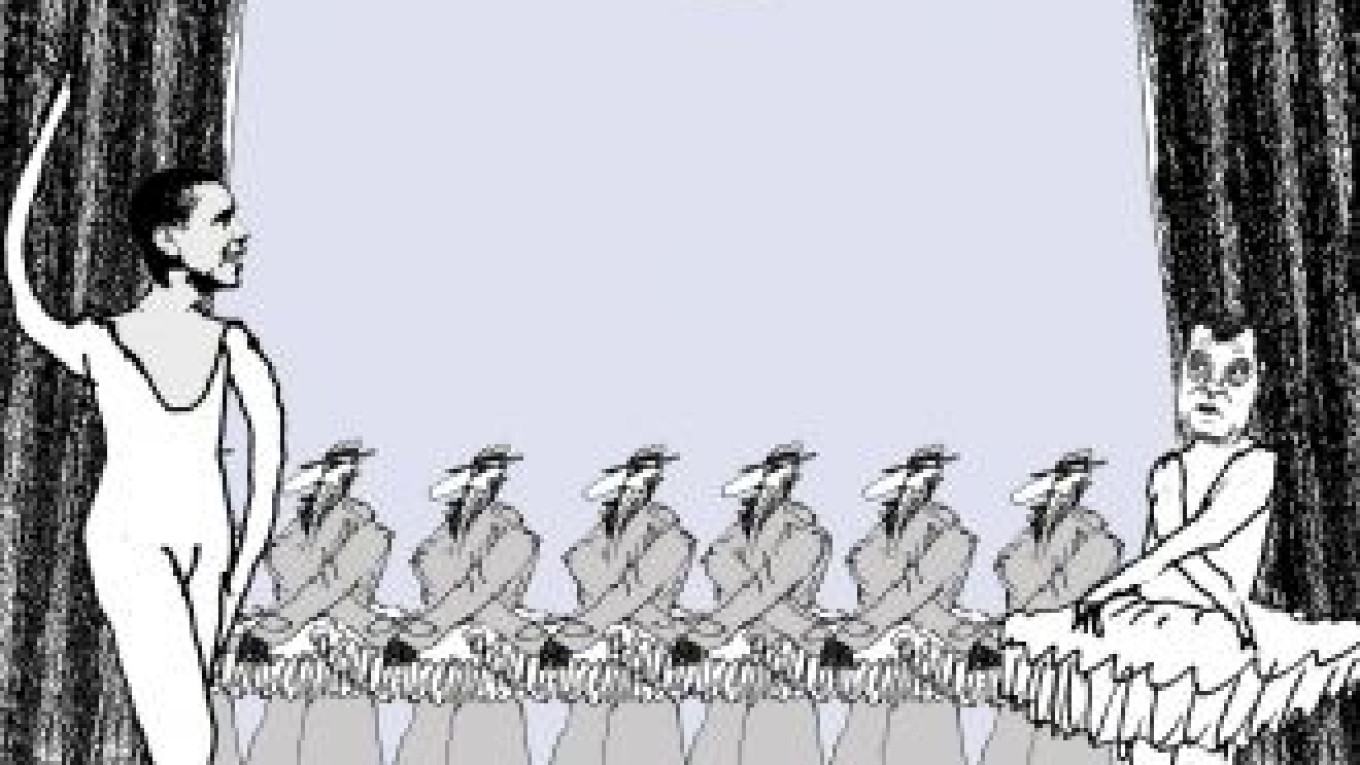
U.S.-Russian relations over the past month have become increasingly similar to the “Ballet de la Merlaison,” created by Louis XIII of France in the 17th century. In this unique ballet, the king authored the work and played the leading role. All the other roles in the ballet were considered extras, who eagerly danced to the tune of the king. As long as the king was still alive, this ballet was considered to be the work of a genius.
In the modern world, the United States plays the role of “king of the world.” It has a military superiority over other nations that is unprecedented in human history. It also has a highly developed economy and an ability to control global finance by dispensing dollars in huge volumes in every corner of the world.
Unfortunately, for the past 20 years Russia has been all too willing to play the role of an “extra” on the U.S.-dominated stage. It wallows in a permanent state of political and economic crises. It lacks a modern army, a developed economy, a convertible currency and a clear vision of its future. Furthermore, Russia is weakened by a growing schism between clans within the ruling elite, rampant corruption, separatist violence and terrorism. At the same time, Russia has a vast territory rich in resources that the West finds very attractive.
In the first act of the “Ballet de la Merlaison,” President Dmitry Medvedev embraces Hamas leader Khaled Mashaal and takes a position on the Middle East crisis that runs counter to the United States. For internal political reasons, Medvedev must show Russians that he is not another weak Kremlin leader, like Mikhail Gorbachev or Boris Yeltsin, and that he can stand up to the West. Unfortunately, this is only a cheap imitation of butting heads with the United States. The following acts in the ballet clearly show his weaknesses and servility to the West.
The second act of the “Ballet de la Merlaison” begins with Russia caving into the U.S. request to vote for United Nations Security Council sanctions against Iran. In so doing, Russia loses its leverage not only in Iran, but also in the Caucasus and Central Asian regions, which are of tremendous strategic importance for Moscow.
Having given in on Iran sanctions, Russia has forced itself into a corner. It will now have to toe the U.S. line on every question pertaining to Iran. Medvedev’s decision on Iran reflects his ideological affinity for the ultraliberalism of Igor Yurgens, chairman of the management board of the Institute of Contemporary Development think tank, of which Medvedev is chairman of the board. Both Medvedev and Yurgens are driven by an obsequious desire to join the “civilized countries” and occupy an “honored position” at the same table with the United States and other Group of Eight countries.
In his zeal to perform on the same stage alongside the United States, Medvedev loses sight of the fact that he is giving away a part of Russia’s sovereignty to Washington.
The next act of the “Ballet de la Merlaison” focuses on the Kremlin’s attempt to become a global financial and high-tech center. During his trip to the Silicon Valley three weeks ago, Medvedev gazed rapturously at the new iPhone that Apple CEO Steve Jobs gave him — as if Medvedev has just come out of a cave and has never seen a mobile phone before in his life.
The “Ballet de la Merlaison” continues with an act devoted to the swap of four convicted Russian spies who caused serious damage to the country’s national security for 10 misfits. Couldn’t Russia have bargained a little harder on this deal?
In the final act, U.S. Secretary of State Hillary Clinton fills in for the king as she visits the capitals of Armenia, Azerbaijan, Ukraine and Georgia, further undermining Russia’s strategic interests in the region. For added measure, she criticizes Russia’s “occupation” of South Ossetia and Abkhazia, which is met by loud cries of “Bravo!” from Georgian President Mikheil Saakashvili.
As Clinton completed her diplomatic tour in Russia’s backyard, the summer 2010 performance of the “Ballet de la Merlaison” ended. But as long as the United States keeps determining the global playbill, we will see many more repeats of this performance.
Russia is a global power in its own right and can solve its security and modernization problems without kowtowing to the West.? It is high time that Russia stop dancing to the U.S. tune.
Maxim Shevchenko is a journalist and head of the Center for Contemporary Strategic Studies, Religion and Politics in Moscow.
A Message from The Moscow Times:
Dear readers,
We are facing unprecedented challenges. Russia's Prosecutor General's Office has designated The Moscow Times as an "undesirable" organization, criminalizing our work and putting our staff at risk of prosecution. This follows our earlier unjust labeling as a "foreign agent."
These actions are direct attempts to silence independent journalism in Russia. The authorities claim our work "discredits the decisions of the Russian leadership." We see things differently: we strive to provide accurate, unbiased reporting on Russia.
We, the journalists of The Moscow Times, refuse to be silenced. But to continue our work, we need your help.
Your support, no matter how small, makes a world of difference. If you can, please support us monthly starting from just $2. It's quick to set up, and every contribution makes a significant impact.
By supporting The Moscow Times, you're defending open, independent journalism in the face of repression. Thank you for standing with us.

Remind me later.