

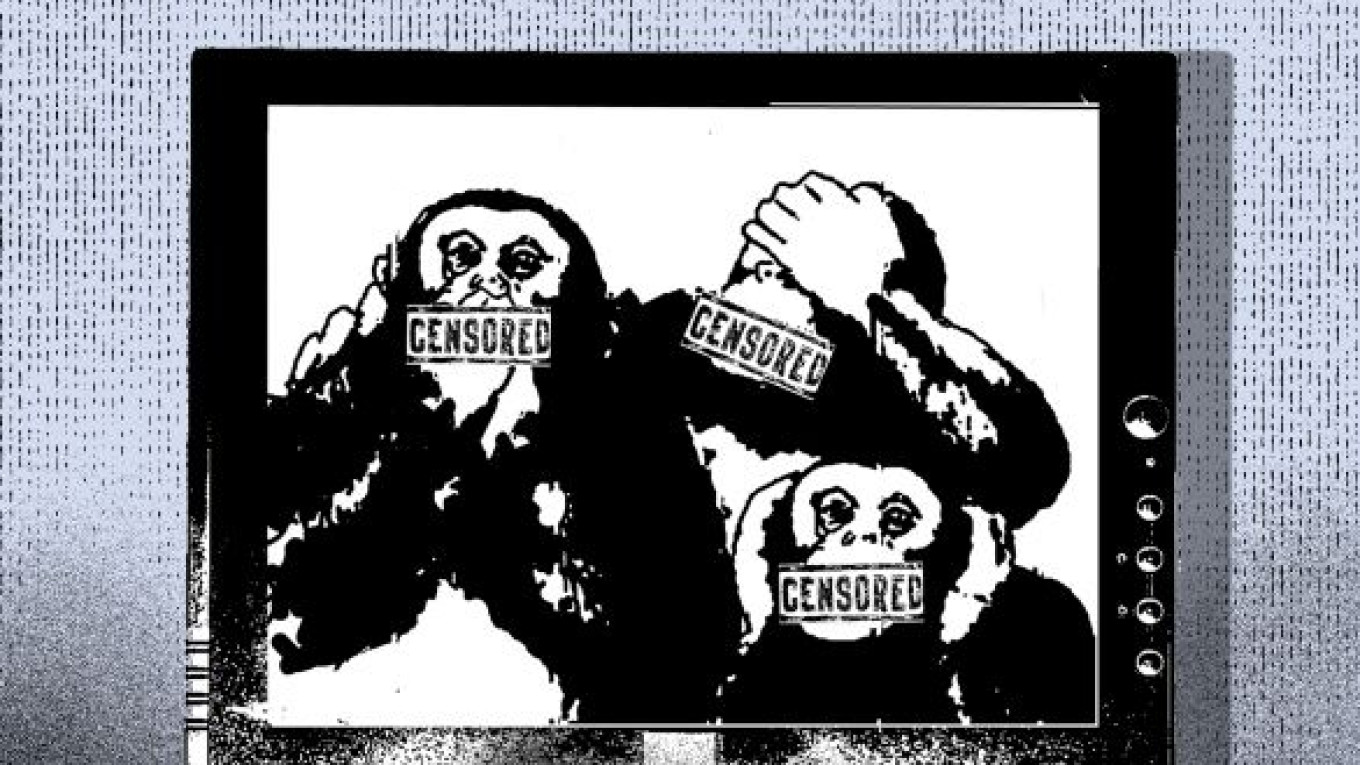
Just before it left for its summer recess, the State Duma passed legislation that will control the Internet. This is something authorities have been preparing for years. The first piece of legislation was adopted in 2007, which permitted courts to block access to specific Internet sites. Since then, regional courts have made occasional use of this option, but sites blocked in one region remained accessible in others. Now a legal mechanism has been created that enables the government to block "bad sites" throughout the country. For the first time, Russia will have an Internet censor on a national scale.
Lawmakers, of course, packaged the Internet legislation as a protection against child pornography, pedophilia and sites that propagandize terrorism and drug use. But this is only a pretext to crack down on other "harmful sites," including opposition ones.
The registry of banned sites will be prepared by a special federal agency. And nobody should be fooled by the fact that a nonprofit organization such as the Internet Defense League will have the right to identify "harmful sites" that should be blocked. The league's leadership has close ties to government structures and the ruling party.
The plan is for a special organization to monitor the Internet and then inform the Federal Mass Media Inspection Service if it finds harmful websites. That organization then calls on a special agency authorized by the Russian government. Next, the Federal Mass Media Inspection Service informs the owner of the site and the Internet provider hosting it. The site owner is given 24 hours to remove the dangerous content. If that is not done, the host is given one more day to do so. If neither comply, the pages or entire site in question, along with their IP addresses, are listed with the registry of harmful sites and blocked.
In addition, any Russian court can also add a site to this blacklist. In the past, there have been several court rulings against sites operated by opposition groups accused of extremism. What's more, it is no secret that courts in the regions might have a different understanding of what constitutes a harmful site than Moscow courts. But regional courts will have the right to ban a site of their choice throughout all of Russia, effectively giving them federal powers to censor the Internet.
Critics of the new legislation see it as a tool by which the government can silence the opposition. Their fear is that any undesirable opposition website can be blocked if the authorities surreptitiously attach information to it that pertains to child pornography or drugs. There are numerous cases of government-friendly hackers who can easily attach pornography to an opposition site. Recall how easily these hackers attacked opposition Internet resources during the December and March elections.
It seems that the legislation against harmful sites is only the first step toward imposing censorship across the entire Internet. Sooner or later, the authorities will apply a wide censorship to social networks as well, possibly even blocking them completely during political crises. The Kremlin is determined to prevent an Egyptian- or Tunisian-style "Twitter revolution" from occurring in Russia.
According to the legislation, the registry will contain not only the domain names and Internet addresses of those sites, but the addresses of individual pages as well. This requires Internet providers to purchase expensive deep-packet inspection, or DPI, equipment that will enable them to block those pages. That technology makes it possible for the provider to separate Internet traffic into separate flows of audio, video, images and spam. By installing such equipment, an Internet provider can block not only searches from and to specific addresses, but can also disable specific services such as Skype that provide IP telephony.
The DPI technology also enables the authorities to maintain control over Facebook, the site that the Federal Security Service is so concerned about. Intelligence agencies in Uzbekistan, for example, force Internet providers to use DPI to change the addresses of undesirable discussion groups that appear on social networks.
With the introduction of the registry and the inevitable adoption of DPI technology, Russia will join other countries that have instituted Internet censorship, such as Pakistan, China, Iran and other countries in the Middle East. All of them make use of DPI technology, a product manufactured and sold by a leading telecommunications companies from Huawei in China and Cisco in the United States to Sandvine in Canada and Narus in Israel (now owned by Boeing).
According to Infonetics Research, the global DPI market totals $470 million annually and is expected to reach $2 billion by 2016. Now, thanks to the Duma, Russia's contribution to that total will be very substantial.
Georgy Bovt is a political analyst.
A Message from The Moscow Times:
Dear readers,
We are facing unprecedented challenges. Russia's Prosecutor General's Office has designated The Moscow Times as an "undesirable" organization, criminalizing our work and putting our staff at risk of prosecution. This follows our earlier unjust labeling as a "foreign agent."
These actions are direct attempts to silence independent journalism in Russia. The authorities claim our work "discredits the decisions of the Russian leadership." We see things differently: we strive to provide accurate, unbiased reporting on Russia.
We, the journalists of The Moscow Times, refuse to be silenced. But to continue our work, we need your help.
Your support, no matter how small, makes a world of difference. If you can, please support us monthly starting from just $2. It's quick to set up, and every contribution makes a significant impact.
By supporting The Moscow Times, you're defending open, independent journalism in the face of repression. Thank you for standing with us.

Remind me later.