

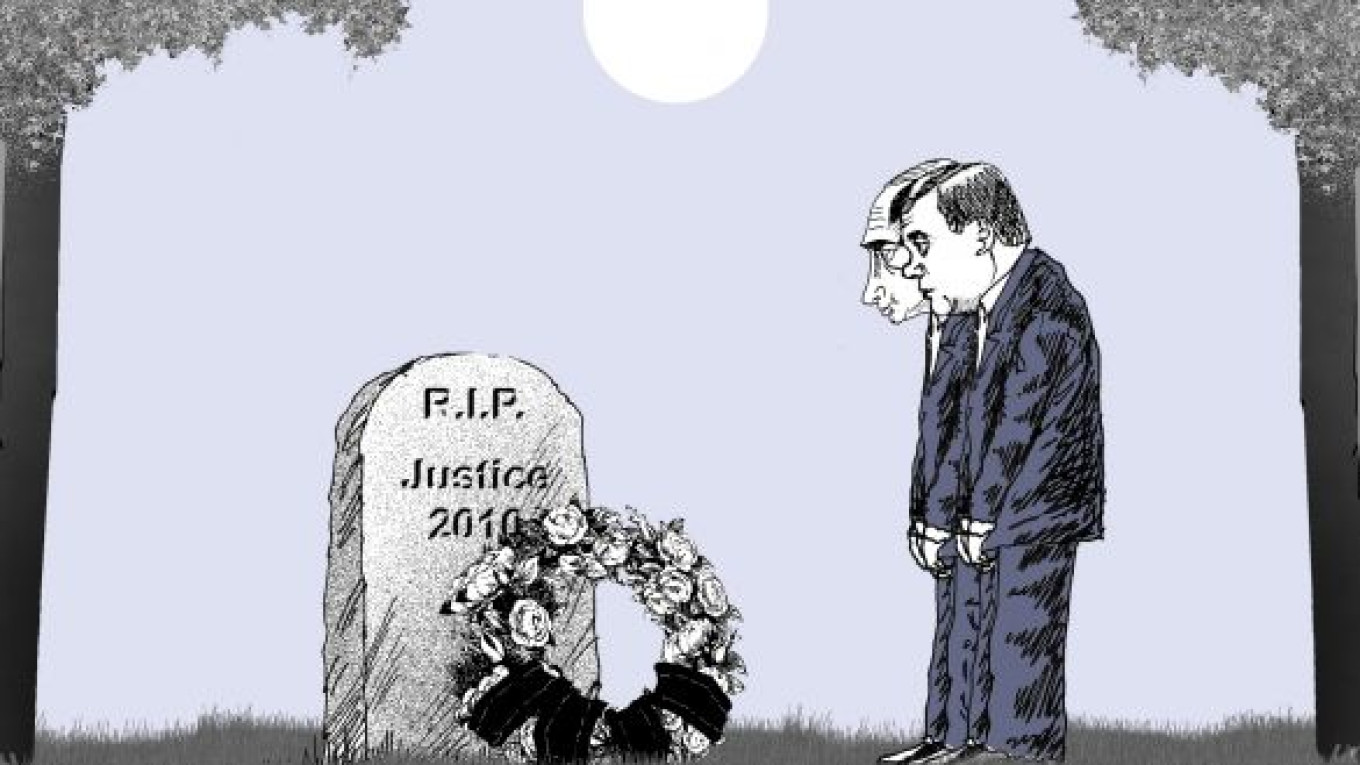
The death of Eduard Chuvashov, a judge killed in cold blood on April 12 in Moscow, is another in a long and growing list of murders perpetrated on those in Russia who try to seek justice for the victims of crimes — an essential task for the country’s future development.
Within the Russian judiciary, Chuvashov was one of the rare judges with the courage to rule against powerful local government officials as well as high-ranking officers of the Interior Ministry. Indeed, he dared to send a number of them to prison. Recently, Chuvashov defied personal threats made against him and sentenced members of a particularly nasty Moscow-based neo-Nazi group to prison.
The Western press has, up until now, often portrayed President Dmitry Medvedev’s term in office as a time of liberalization, a period when the government is beginning to loosen its authoritarian grip on society. Some even suggest that with Medvedev, a new era of perestroika is about to be launched.
But the pattern of assassination directed against Russian “troublemakers,” which started several years ago when human rights expert Nikolai Girenko and Novaya Gazeta journalist Anna Politkovskaya were murdered, has not been effectively addressed. In fact, in 2009, Medvedev’s second year in office, a devastating series of such killings occurred.
Stanislav Markelov, Natalya Estemirova, Maksharip Aushev and Ivan Khutorskoi were all alive at the beginning of 2009, determined to improve Russia’s human rights record and expose the truth about abuses. Markelov, a lawyer, routinely tackled the human rights cases that no one else was willing to take on. These were often cases related to the war and ongoing violence in Chechnya or the growing neo-Nazi terror found on the streets of Moscow, St. Petersburg and other Russian cities.
Estemirova, a key activist in Chechnya for the human rights group Memorial, which is determined to inform Russians about the truth of their modern history, investigated abductions and extrajudicial killings. Indeed, she was a crucial source of information about the situation in Chechnya.
Aushev, a leading Ingush opposition activist and journalist, ran the influential local news web site Ingushetia.org after the site’s founder, Magomed Yevloyev, was shot dead in police custody in 2008. And Khutoskoi, a leading Moscow-based anti-fascist activist, would organize security at anti-fascist concerts, as well as at Markelov’s press conferences.
All of their work was ended by assassins.
We urge the Russian government to break this chain of human tragedy once and for all. In permitting the murder of people whose only purpose is the preservation of human dignity, Russia is losing its hope for a better future. At the very least, the authorities are failing in the central task of any government: to protect the lives and physical safety of all its citizens. Making matters worse, none of these murders has been properly investigated and none of the perpetrators has been brought to justice.
Such impunity creates an atmosphere in which continued attacks are practically invited. The fact that Russian security forces are alleged to have been involved in some of the cases demonstrates the depth of the problem. These charges need to be investigated if Medvedev’s claims to want a society based on the rule of law are not to ring hollow. The more? authorities prove their determination to protect all citizens, the more this will further constructive international cooperation with Russia.
We ask Medvedev and urge the Russian government to protect people in danger and to ensure quick and effective investigations into the murders of human rights activists, journalists and independent-minded jurists. Political leaders must speak up loud and clear against these terrible crimes. They must underline the great danger posed for the health of both Russian society and the state when people who are acting in the public interest are silenced through murder. And the international community must find ways to provide support, protection and shelter to Russia’s endangered human rights defenders.
Vaclav Havel is a former president of the Czech Republic. Desmond Tutu is archbishop emeritus of Cape Town and a Nobel Peace Prize laureate. Grigory Yavlinsky is chairman of Yabloko. El Hassan Bin Talal of Jordan is a commissioner on legal empowerment of the poor and chairman of the West Asia-North Africa Forum. Andre Glucksmann is a philosopher and essayist. Frederik Willem de Klerk is a former president of South Africa. Hans Küng is president of the Foundation for a Global Ethic (Stiftung Weltethos) and professor emeritus of ecumenical theology at the University of Tubingen. Yohei Sasakawa is president of the Sasakawa Peace Foundation. Karel Schwarzenberg is a Czech senator and former Czech foreign minister. Richard von Weizsäcker is a former president of the Federal Republic of Germany. © Project Syndicate
A Message from The Moscow Times:
Dear readers,
We are facing unprecedented challenges. Russia's Prosecutor General's Office has designated The Moscow Times as an "undesirable" organization, criminalizing our work and putting our staff at risk of prosecution. This follows our earlier unjust labeling as a "foreign agent."
These actions are direct attempts to silence independent journalism in Russia. The authorities claim our work "discredits the decisions of the Russian leadership." We see things differently: we strive to provide accurate, unbiased reporting on Russia.
We, the journalists of The Moscow Times, refuse to be silenced. But to continue our work, we need your help.
Your support, no matter how small, makes a world of difference. If you can, please support us monthly starting from just $2. It's quick to set up, and every contribution makes a significant impact.
By supporting The Moscow Times, you're defending open, independent journalism in the face of repression. Thank you for standing with us.

Remind me later.