

Officials had hoped that military contracts for the submarine-launched missile could be negotiated next year, but the high-profile botches look likely to derail those plans.
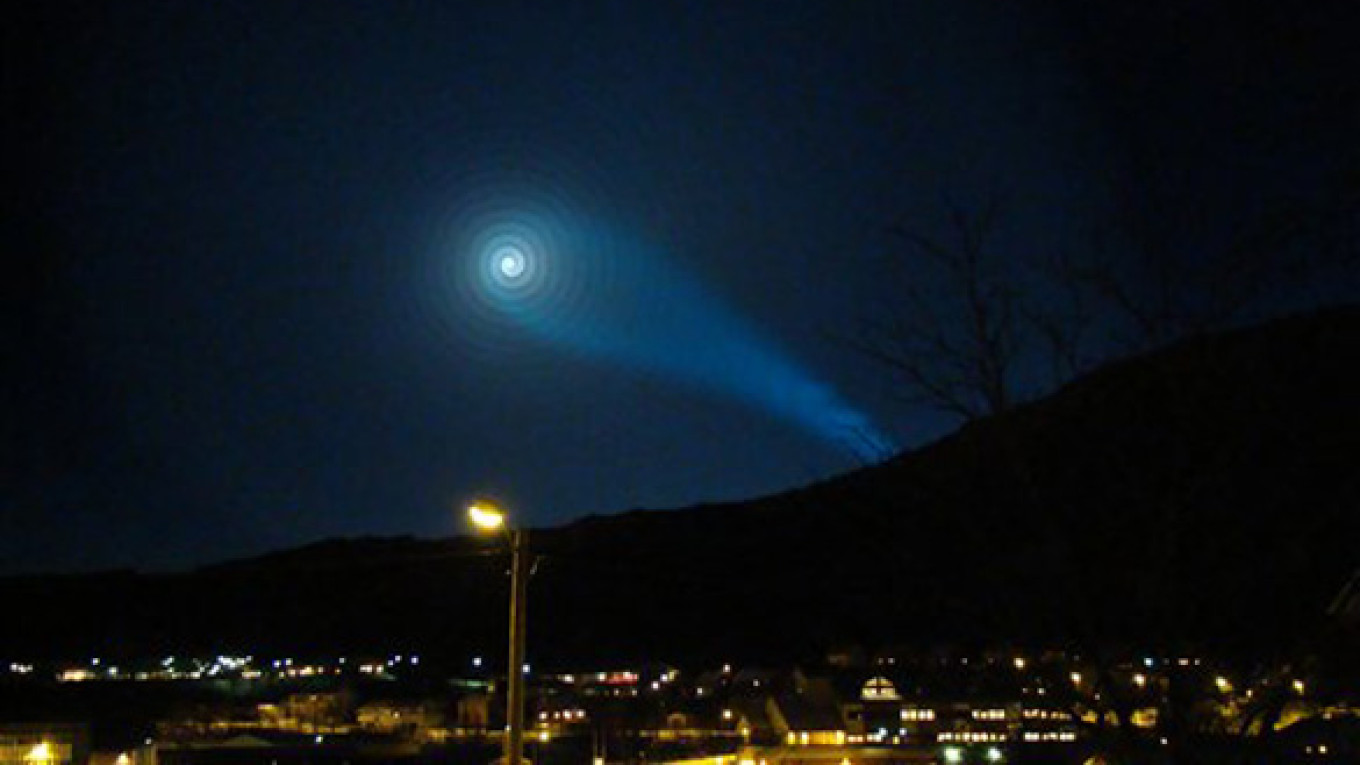
The Defense Ministry's statement announcing the latest failure, which it said occurred after Wednesday's launch from the White Sea just east of Scandinavia, came amid speculation about the origin of mysterious spiraling lights over northern parts of Norway. Photographs and amateur video footage of the lights have been circulating on the Internet since Wednesday.
The ministry said it did not know whether the lights were the Bulava, which can accommodate multiple nuclear warheads and has a range of 8,000 kilometers.
"The first two stages of the rocket worked as they should have, however, in the third and final stage of the flight a technical error occurred," the statement said. "According to tests, the third stage's engine was unstable."
Despite the repeated failures, which look set to torpedo plans to finish testing this year, Russian leaders have boasted about the Bulava's ability to penetrate missile defenses and have described it as a key part of the military's future nuclear arsenal.
Officials have insisted that the Bulava's design is fine and have blamed its failed tests on manufacturing flaws resulting from post-Soviet industrial degradation. They have said that it is difficult to control the quality of all the parts supplied by the 650 subcontractors involved in the program.
A Message from The Moscow Times:
Dear readers,
We are facing unprecedented challenges. Russia's Prosecutor General's Office has designated The Moscow Times as an "undesirable" organization, criminalizing our work and putting our staff at risk of prosecution. This follows our earlier unjust labeling as a "foreign agent."
These actions are direct attempts to silence independent journalism in Russia. The authorities claim our work "discredits the decisions of the Russian leadership." We see things differently: we strive to provide accurate, unbiased reporting on Russia.
We, the journalists of The Moscow Times, refuse to be silenced. But to continue our work, we need your help.
Your support, no matter how small, makes a world of difference. If you can, please support us monthly starting from just $2. It's quick to set up, and every contribution makes a significant impact.
By supporting The Moscow Times, you're defending open, independent journalism in the face of repression. Thank you for standing with us.

Remind me later.