

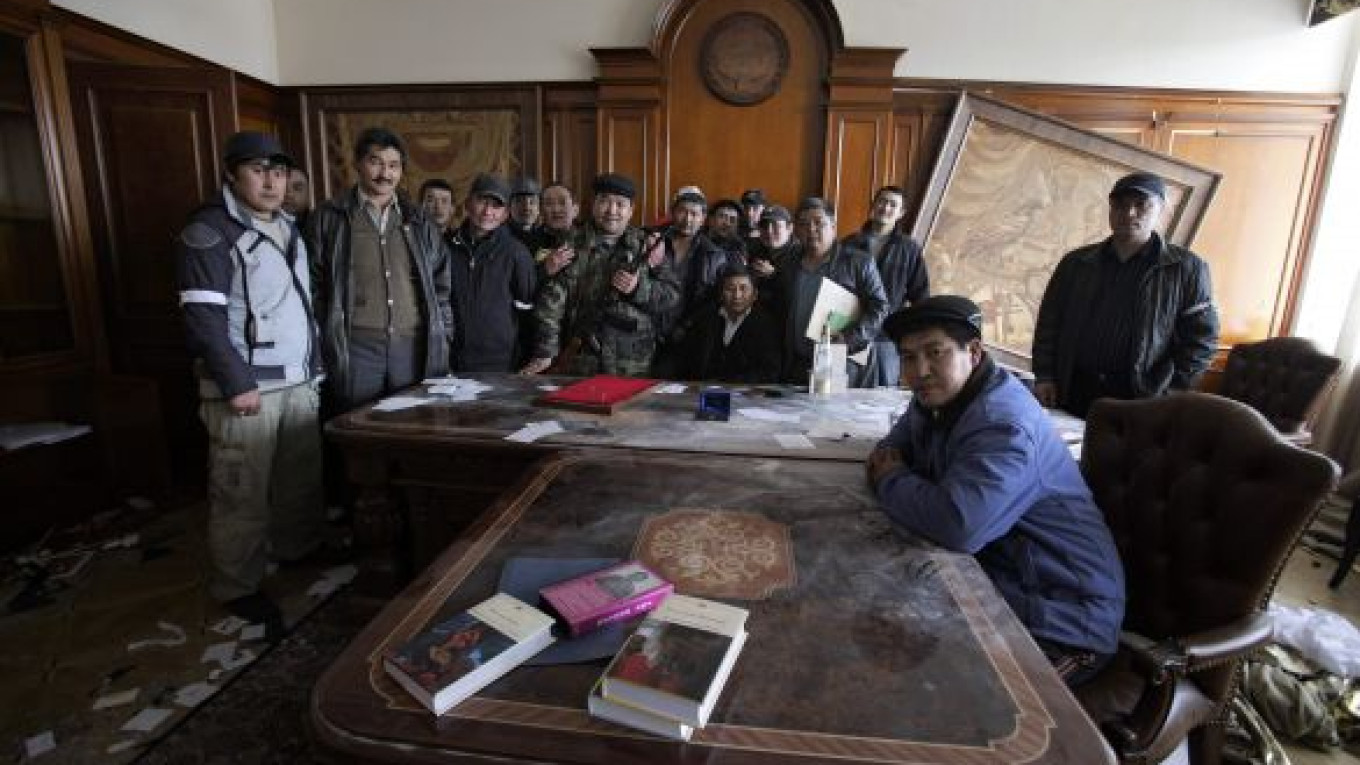
The sudden revolution in Kyrgyzstan prompted some nasty speculation about posturing by Moscow and Washington, just as Presidents Dmitry Medvedev and Barack Obama signed a long-awaited nuclear reduction pact Thursday meant to bolster their military cooperation.
Some observers said Moscow won a new ally in strategically valuable Central Asia, while the United States and Europe lost out by keeping silent over ousted President Kurmanbek Bakiyev’s increasingly authoritarian rule.
Prime Minister Vladimir Putin gave his official blessing to the new leadership in Bishkek by speaking with interim leader Roza Otunbayeva by telephone Thursday.
“It is important that the conversation was held with her in her role as the head of the government of national confidence,” Putin’s spokesman, Dmitry Peskov, told Reuters.
The Russian military also dispatched 150 paratroopers to its air base in Kyrgyzstan to protect the families of Russian servicemen, RIA-Novosti reported, citing the General Staff.
Observers agreed that Putin’s endorsement would boost the opposition tremendously.
In an interview to Ekho Moskvy later Thursday, Otunbayeva thanked Russia — and Putin personally — for the “significant help … exposing this corrupt family regime,” referring to criticism of rampant nepotism in Bakiyev’s government.
The comments did nothing to ease frustration among the ousted Kyrgyz leadership with Moscow’s stance on the violence and subsequent overthrow.
Shortly before being ousted, Kyrgyz Prime Minister Daniyar Usenov suggested that Moscow had actively worked to undermine his country, accusing Russian media of biased reporting that was unfit to “encourage the growth of friendship between both countries.”
“Our intelligence services will have to investigate whether any outside power is influencing the [unrest] in Talas,” he said, Interfax reported. The rioting, which swept away the government, started Tuesday in Talas, a town close to the Kazakh border.
The remarks prompted Putin to deny that he or his government played any role. “Neither Russia, nor your humble servant, nor Russian officials have any links whatsoever to these events,” Putin told reporters late Wednesday.
Washington, while in no hurry to recognize the new government, was also quick to tamp down speculation that foreign affairs were a factor.
“The people that are allegedly running Kyrgyzstan … these are all people we’ve had contact with for many years,” Michael McFaul, Obama’s top Russia adviser, told reporters in Prague. “This is not some anti-American coup, that we know for sure. And this is not some sponsored-by-the-Russians coup, there’s just no evidence of that.”
In an interview to Ekho Moskvy radio on Thursday, Bakiyev defended himself but said he “wouldn’t name a specific country” as being involved.
“But without foreign forces, it’s essentially impossible to conduct such a coordinated operation,” he said.
The coup was “unexpected, both for [Putin] and for me,” Bakiyev said, denying that he had been in contact with either Moscow or Washington in the preceding days. Kazakhstan and Uzbekistan offered assistance before Wednesday, he said, but he declined the offer.
The theory of foreign instigation hardly squares with observations from reporters in Bishkek, who said the protesters appeared to be leaderless — and some even drunk.
Independent analysts, however, noticed well before the putsch that Bakiyev had come under attack from state-controlled Russian media.
A paper published April 1 by the Jamestown Foundation, a Washington-based think tank, argued that unprecedented criticism in national media in recent weeks showed the Kremlin’s frustration with Bakiyev.
“The Russian media might eventually become Bakiyev’s greatest challenge,” the report said.
The paper’s author, Erica Marat, a research fellow at the Central Asia-Caucasus Institute, said Thursday that it was too early to say Moscow won and Washington lost.
“Obviously Moscow favors some of the opposition leaders and launched a mass media attack against Bakiyev in the past two months. … But I don’t think Russia in any way helped to organize the spontaneous riots,” she said in e-mailed comments.
Boris Nemtsov, a leader in the Solidarity opposition movement, also said he did not believe that the Kremlin had anything to do with the unrest.
This would be senseless since the governments in both Moscow and Bishkek were equally undemocratic and corrupt, he told The Moscow Times.
“Bakiyev did everything Putin did, but the difference is that he is a beggar while Putin is rich and can keep utility costs low,” Nemtsov said.
The Kyrgyz unrest was sparked by anger over a steep rise in the costs of electricity and housing services.
Yet Bakiyev’s close ties to the United States now seem like a heavy liability for the Obama administration. Last year, the Kyrgyz leader had played Moscow and Washington off each other over the issue of military bases in his country.
First, he promised to close the U.S. air base in Manas in exchange for a $2 billion loan from Russia and promises of investment to build new hydroelectric power plants.
He soon took a U-turn, however. In the summer, Bakiyev negotiated higher rent for the base, reportedly getting $170 million from the Obama administration to have the Manas lease extended.
After years of lobbying against the U.S. base, which provides vital logistics for military operations in Afghanistan, Moscow was left with a promise that it could build a second base, in addition to its existing one near Kant.
Experts have called this a worthless promise, not least because the location is in the volatile southern province Osh.
Additionally, Washington found itself in the awkward position of receiving two key officials from the disgraced Kyrgyz leadership this week.
Bakiyev’s son Maxim, who had been seen as a possible successor, arrived Wednesday in the U.S. capital, where he and Foreign Minister Kadyrbek Sarbayev were to hold official consultations with State Department officials and brief an investment conference.
The consultations were postponed, but there will be some meetings “while the foreign minister is here,” State Department spokesman Philip Crowley said Wednesday, according to a transcript published online.
Most experts agreed Otunbayeva, a Soviet-trained diplomat, would enjoy better relations with Moscow.
“They will move a little closer to Russia, but they will still have to balance ties with Washington,” said Alexei Malashenko, from the Carnegie Moscow Center.
Marat, from the Central Asia-Caucasus Institute, said Otunbayeva has also expressed strong pro-American views in the past.
Sergei Markov, a State Duma deputy for the ruling United Russia party and a Kremlin-connected pundit, said talk about winners and losers was useless because there is no zero-sum game for foreign states in Kyrgyzstan.
“Bishkek offers one problem for everyone — it is a failed state and something needs to be done about that,” he told The Moscow Times.
Asked why Washington seemingly misjudged the weakness of Bakiyev’s leadership, Markov said the United States was too focused on keeping its military foothold. “They did not want to understand [the political situation], they just wanted the base,” he said.
Any government in Bishkek will have to balance the interests of at least three powers, Malashenko said: “They are located in a triangle between Moscow, Washington and Beijing,” he said.
China is almost certainly the key foreign player in the country now, although it does not lay open its plans, said Chris Weafer, chief strategist at UralSib.
“Given that their most troublesome province is just next door, and Beijing is keen to keep a buffer between its territory and the increasing number of Islam militants in the Ferghana Valley, you can bet that they are keenly involved,” he said in a research note.
A Message from The Moscow Times:
Dear readers,
We are facing unprecedented challenges. Russia's Prosecutor General's Office has designated The Moscow Times as an "undesirable" organization, criminalizing our work and putting our staff at risk of prosecution. This follows our earlier unjust labeling as a "foreign agent."
These actions are direct attempts to silence independent journalism in Russia. The authorities claim our work "discredits the decisions of the Russian leadership." We see things differently: we strive to provide accurate, unbiased reporting on Russia.
We, the journalists of The Moscow Times, refuse to be silenced. But to continue our work, we need your help.
Your support, no matter how small, makes a world of difference. If you can, please support us monthly starting from just $2. It's quick to set up, and every contribution makes a significant impact.
By supporting The Moscow Times, you're defending open, independent journalism in the face of repression. Thank you for standing with us.

Remind me later.