

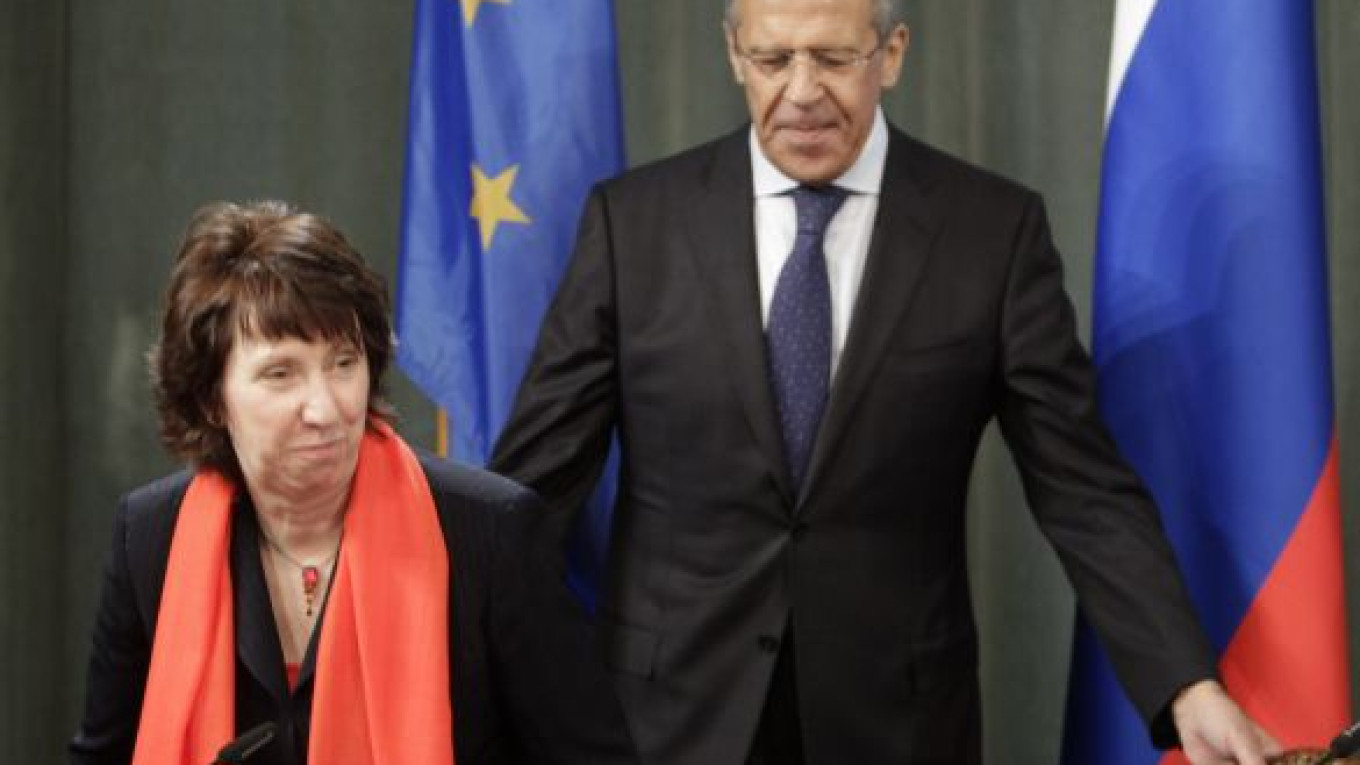
A daunting amount of work is necessary to achieve visa-free travel between Russia and Europe, but Moscow is promising maximum cooperation with Brussels on that issue, Foreign Minister Sergei Lavrov and new EU foreign policy chief Catherine Ashton said Wednesday.
A European initiative to lift travel restrictions could be put into practice "in a short time," Lavrov told reporters at a joint news conference with Ashton, Interfax reported.
"We are ready to introduce visa-free travel with Europe tomorrow," he said, adding that technical hurdles should be moved out of the way during expert consultations "in good time." Afterward, a time frame for agreements could be set.
Ashton, who was on her first visit to Moscow, cautioned that the process was just beginning.
“There is a substantial amount of work to be done," she told reporters at a separate briefing late Wednesday.
She refused to elaborate or give a time frame.
Spain, which currently holds the rotating EU presidency, announced last month that the EU would start a process to ultimately lift visa requirements. But similar attempts have yielded few results in the past, mainly because of technical difficulties and fears among EU members of a mass influx of refugees.
Migration rules are stringent on both sides, although Russians must undergo interviews and demonstrate that they have sufficient funds for travel before obtaining visas to the EU’s border-free Schengen zone. Europeans wishing to travel to Russia are spared those procedures but face stiff bureaucracy, having to register and deregister if they spend three or more working days at any place in the country.
Asked if registration rules might be eased during visa negotiations, Lavrov denied that the rules posed a bureaucratic burden.
“There is no registration requirement. There is a notification requirement that involves no permits. You fill out a simple form and send it stamped by post to the nearest migration service office. … If you stay in a hotel, you do not have to do anything," he said.
Yet the registration process, which is the bane of foreign visitors, has been further complicated with the introduction of a fee in late January. A registration now costs 2 rubles for each day of the visit, with a ceiling at 200 rubles ($6.50). “You must present a receipt from Sberbank showing that you have paid the fee," said Alexei Filipenkov of the Visa Delight agency.
Ashton has faced a series of challenges since assuming her job in December, when the Lisbon Treaty amalgamated the jobs of high representative (formerly Javier Solana) and external relations commissioner (formerly Benita Ferrero-Waldner).
Brussels has been awash with reports about doubts on whether the comparably unknown British Labour politician, who served as EU trade commissioner for just a year, has enough international experience for the job.
Questions have also been raised on the rotating presidency’s future role in foreign policy, and critics have said Spain stole the limelight from the high representative’s first weeks in office.
But Ashton was adamant Wednesday that she was the sole person in charge, having also assumed external policy obligations formerly held by the rotating presidency.
“The Lisbon Treaty is clear about my post. … The presidency will not disappear, but the responsibility [for foreign policy] will be in my office,” she said.
She added that no top Spanish government officials would attend the next EU-Russia summit, which is scheduled to be held in Rostov-on-Don in May.
A Message from The Moscow Times:
Dear readers,
We are facing unprecedented challenges. Russia's Prosecutor General's Office has designated The Moscow Times as an "undesirable" organization, criminalizing our work and putting our staff at risk of prosecution. This follows our earlier unjust labeling as a "foreign agent."
These actions are direct attempts to silence independent journalism in Russia. The authorities claim our work "discredits the decisions of the Russian leadership." We see things differently: we strive to provide accurate, unbiased reporting on Russia.
We, the journalists of The Moscow Times, refuse to be silenced. But to continue our work, we need your help.
Your support, no matter how small, makes a world of difference. If you can, please support us monthly starting from just $2. It's quick to set up, and every contribution makes a significant impact.
By supporting The Moscow Times, you're defending open, independent journalism in the face of repression. Thank you for standing with us.

Remind me later.