

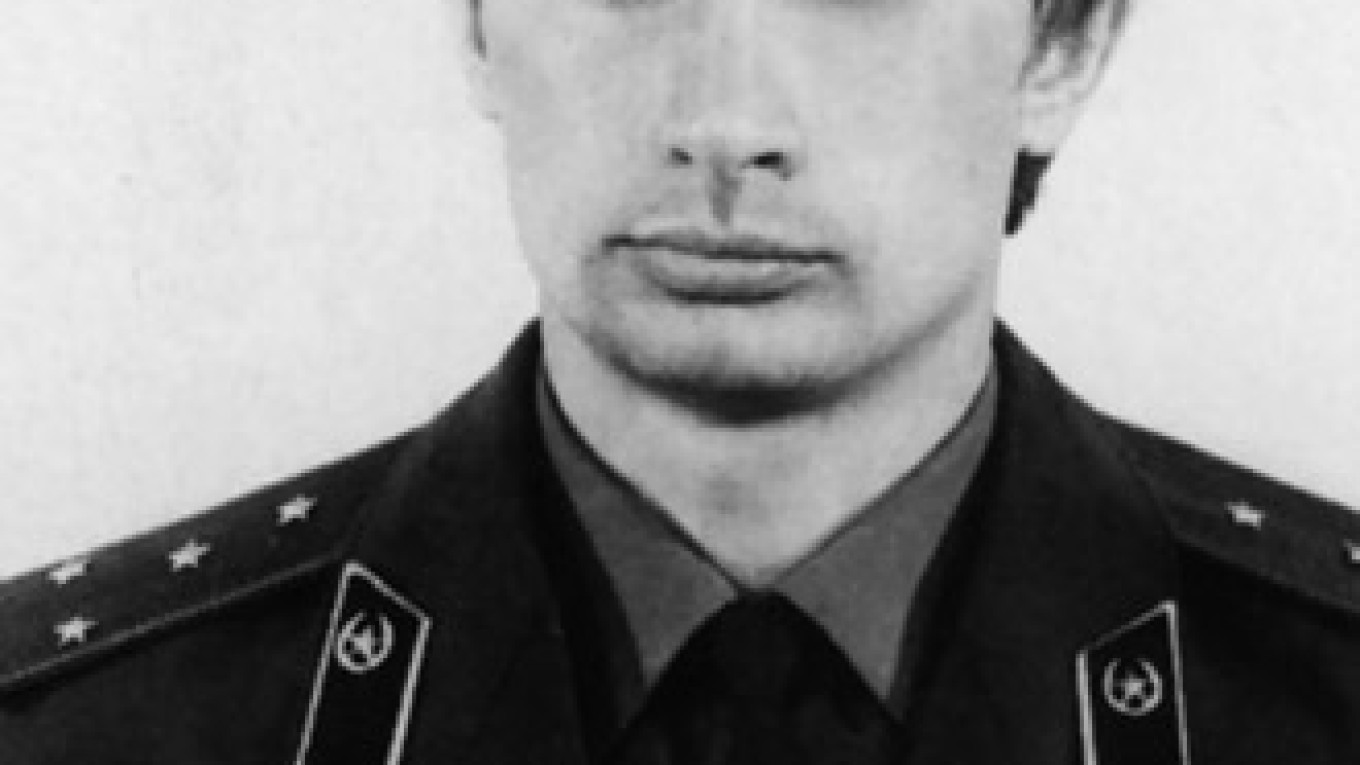
Twenty years after the fall of the Berlin Wall, Prime Minister Vladimir Putin has publicly recalled how he personally contributed to this turn in history as a Soviet spy in East Germany.
Putin told veteran NTV reporter Vladimir Kondratyev in a half-hour interview how he managed to calm down an angry crowd of East German protesters outside the KGB headquarters in Dresden in late 1989.
Putin rose from obscurity to the country’s most popular politician in 1999, serving as president from 2000 to 2008 and subsequently becoming the powerful prime minister.
Kondratyev said Wednesday that Putin had gladly recalled fond memories from his days in Cold War Germany and acknowledged the inevitability of the German Democratic Republic’s demise.
“He was very relaxed and smiled a lot, yet he expressed a very clear opinion about the fall of the wall — that what happened was bound to happen,” Kondratyev told The Moscow Times.
Kondratyev would not reveal how many minutes of his upcoming documentary film “Stena” (“The Wall”) would be devoted to Putin, but he denied that the prime minister was its main theme. “It is about the fall of the wall. Putin is just one of many characters who will appear,” he said.
He said, however, that he would travel to Dresden later this week to shoot the introduction.
Putin’s interview will be aired as part of the 50-minute film at 7:25 p.m on NTV on Sunday, Nov. 8 — one day before the 20th anniversary of the fall of the wall.
Putin served as a KGB officer in Dresden, which was then a provincial outpost so remote that locals could not receive West German television, from 1985 to 1990. His only brush with history there occurred on Dec. 5, 1989, almost a month after the wall fell.
After storming the nearby local headquarters of the East German Secret Police, or Stasi, protesters gathered outside his office building.
Public information about Putin’s ?service in East Germany is scarce, and the only reliable account is in “First Person,” a series of autobiographical ?interviews published in 2000. Here, Putin recalled how he met the crowd personally and told them in German that this was a Soviet military organization. When people replied suspiciously that he spoke German too well, “I told them I was a translator,” he said.
Kondratyev said Putin gave no new account of those events, but the prime minister made it clear that he understood at the time that the Soviet-inspired division of Germany had no future.
“He said that the wall was all unnatural and that he thought that its fall meant the end of the GDR,” Kondratyev said.
In “First Person,” Putin expressed his deep frustration about Moscow’s waning power when he called Soviet military headquarters for help against the protesters. “I was told that nothing could be done without orders from Moscow. And Moscow is silent,” he said.
Eventually, he said, military personnel did come and the crowd dispersed, but the words “Moscow is silent” remained with him. Putin said he got the feeling then that the Soviet Union had disappeared.
German media have reported that one Soviet official threatened to shoot at protesters, saying he was “a soldier until death,” and the quote was later ascribed to Putin, although Putin never mentioned it and it was never verified.
In the NTV interview, Kondratyev said Putin suggested that the protesters understood that the Stasi and not the Soviet Union should be the prime target of their anger.
“He spoke very positively about these events and stressed that German-Russian relations subsequently achieved a new quality and included a feeling of gratitude,” he said.
Under Putin’s eight years as president, relations with Berlin flourished, with Germany becoming both a key foreign investor and foreign policy ally. That privileged partnership, as dubbed by the Kremlin, was conceived under the close personal friendship between President Putin and German Chancellor Gerhard Schröder, and continues under their successors, Dmitry Medvedev and Angela Merkel.
However, Putin’s record as a democratic leader has been debated in Dresden just as much as anywhere else in the West.
Wolfgang Schälike, head of the city’s German-Russian Culture Institute, said Putin’s KGB background makes relations with him more complicated for East Germans than for West Germans.
Since the democratic upheaval of 1989, any record of employment or cooperation with Communist security services is seen as an utter disgrace, Schälike said by telephone from Dresden. “The Stasi here is the ultimate whipping boy,” he said.
He noted that in today’s Germany it is unthinkable for people who once worked for the secret police to take public office like Putin has done in Russia. “Even kindergarten workers lost their jobs after it was revealed that they had links to the Stasi,” he said.
Schälike said he credited Stanislav Tillich, prime minister of the local state of Saxony, for striving to improve local relations with Moscow.
But there was considerable outrage in local and national media when Tillich handed a medal of honor to Putin in Dresden in January, at the height of the gas war with Ukraine.
“And next year the medal will go to Colonel Gaddafi,” Antje Hermenau, a local leader of the Green party, said at the time.
n Nearly a quarter of Russians believe that there is a personality cult of Putin in the country, according to a new poll by the independent Levada Center. A total of 23 percent of respondents said they saw evidence for this, an increase from 22 percent last year.
In a sign that such tendencies can spill over as far as the United States’ West Coast, a media report said the Russian Bodybuilding Federation was planning to present a bust of Putin to Californian Governor Arnold Schwarzenegger.
Alexander Chernoshchyokov, a St. Petersburg-based sculptor, told Agence-France Press that the bust was being created as a gift for the former Hollywood bodybuilder and would be delivered in March. “Putin is such a complex personality. He’s left no one indifferent,” Chernoshchyokov told AFP.
A Message from The Moscow Times:
Dear readers,
We are facing unprecedented challenges. Russia's Prosecutor General's Office has designated The Moscow Times as an "undesirable" organization, criminalizing our work and putting our staff at risk of prosecution. This follows our earlier unjust labeling as a "foreign agent."
These actions are direct attempts to silence independent journalism in Russia. The authorities claim our work "discredits the decisions of the Russian leadership." We see things differently: we strive to provide accurate, unbiased reporting on Russia.
We, the journalists of The Moscow Times, refuse to be silenced. But to continue our work, we need your help.
Your support, no matter how small, makes a world of difference. If you can, please support us monthly starting from just $2. It's quick to set up, and every contribution makes a significant impact.
By supporting The Moscow Times, you're defending open, independent journalism in the face of repression. Thank you for standing with us.

Remind me later.