

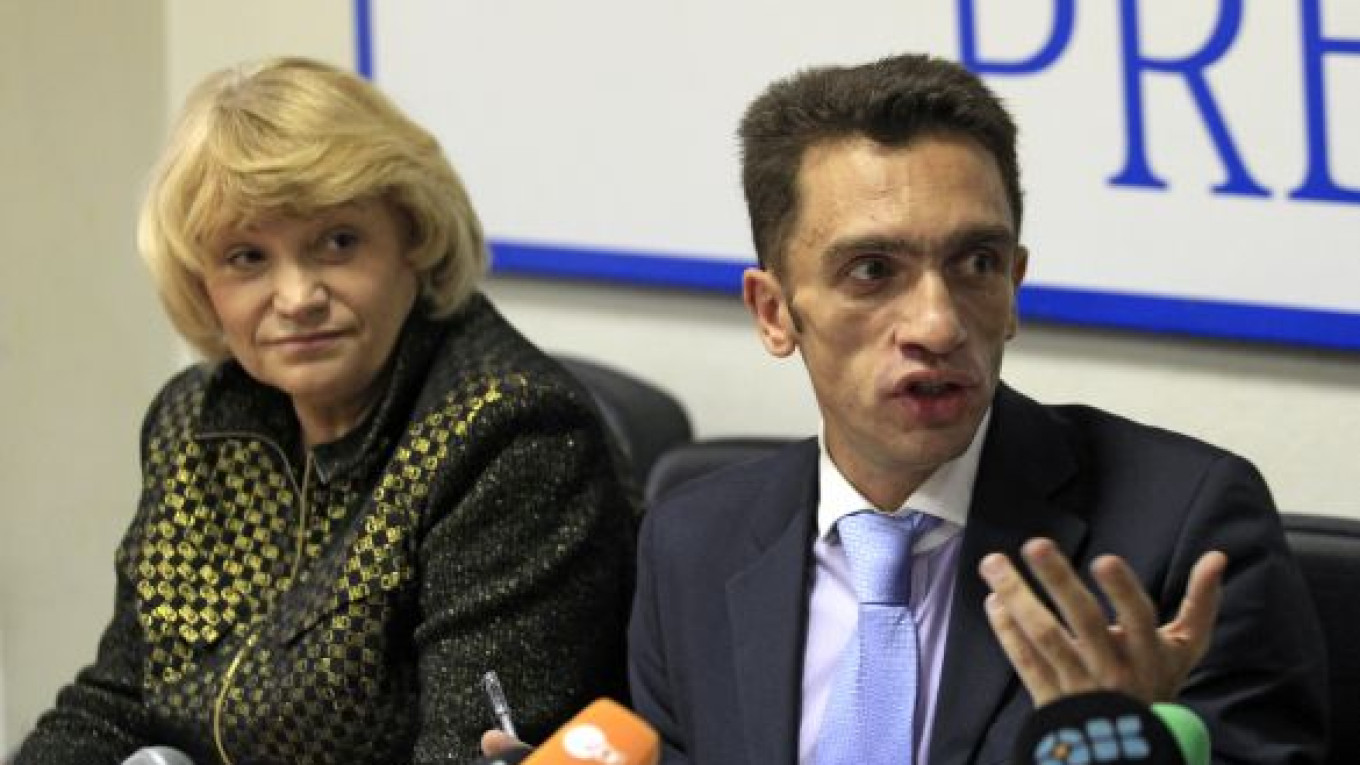
The country's only independent elections watchdog said it has detected fewer violations in the run-up to the presidential election than the State Duma vote but that one of the main violators is Prime Minister Vladimir Putin.
Putin, who is widely expected to return to the Kremlin for a six-year term, has illegally started campaigning before the official opening of the campaign season and has used his official status to promote his bid, Golos officials said Monday, presenting their first report on the March 4 election.
Golos also spoke of unfair measures being used against opposition candidates, lambasting a requirement that independents must submit 2 million signatures, and noted that many United Russia candidates have distanced themselves from Putin's ruling party and are running as independents in hope of winning local elections also scheduled for March 4.
Putin, therefore, broke electoral law by publishing his election platform in three articles this month, the first in Izvestia, the second in Nezavisimaya Gazeta and the third in Vedomosti, Golos official Arkady Lyubarev told Russian and foreign journalists at the Moscow Independent Press Center.
By law, presidential campaigning starts for each candidate after they have registered with the Central Elections Commission. But candidates cannot start campaigning in the mass media until Feb. 4.
Putin also has been promoting his bid through the All-Russia People's Front movement, which was founded on the basis of his public offices, which amounts to the unfair use of his position, Golos officials said.
"The work of the leading mass media is directed at promoting one candidate under the guise of covering his professional activities," Golos said in a 16-page distributed at the news conference.
Although technically not breaking the law, Putin also is violating the spirit of the law by "refusing to lead political debates," Golos head Lilia Shibanova said, referring to Putin's recent declaration through his spokesman to skip debates.
A 2003 regulating presidential elections allows candidates to choose their own form of campaigning, be it debates or something else.
Overall, however, fewer violations have been found than before the Duma elections on Dec. 4, perhaps because the authorities realized that they cracked down on opposition candidates and election observers too much last fall, provoking public discontent, Golos official Alexander Kynev said.
"We have the impression that lessons have been learned from last fall," Kynev said.
So far, the main violations that Golos has registered are attempts to force people to get absentee ballots, Kynev said. Absentee ballots are often used in vote fraud.
Although on a smaller scale, "active steps are being taken to obstruct the activities of both the opposition and nongovernmental organizations," in connection with the presidential and local elections, he said. These steps include bugging telephone conversations, cracking e-mail accounts, and the intimidation and eviction of people and organizations from offices, Kynev said.
"We have certain facts about pressure being placed on certain people," Kynev said.
Golos is one of the organizations that has complained of pressure. Its landlord has asked it to vacate its Moscow offices.
A total of 4,092 local elections will take place on March 4, to the Central Elections Commission. Among them are mayoral elections in five cities: Gorno-Altaisk, Yakutsk, Arkhangelsk, Yaroslavl and Naryan-Mar, and elections to five municipal legislatures Gorno-Altaisk, Ufa, Nalchik, Kirov and Pskov.
The campaigns for local elections are distinguished by a new trend — many United Russia candidates are formally running as independents in an "attempt to distance themselves from the party, which has a negative image," Kynev said.
Opinion polls for both the presidential and local campaigns show that people are ready to "vote for any candidate" as long as he or she is not a United Russia candidate, Kynev said.
Meanwhile, federal authorities "informally task [local] administrations to secure a [certain] voter turnout and percentage for the 'needed' candidate" and fire heads of local administrations who secured an "insufficiently high result" for United Russia, the Golos booklet said.
The "activities of presidential candidates, compared to the Duma campaign, is much smaller, partially because candidates put forward by the political parties represented in the Duma didn't have to collect signatures in support of their bids, Kynev said. Four of the five registered candidates are linked to parties in the Duma.
A Just Russia founder Sergei Mironov has not been campaigning and his popularity depends on the activities of his party in the regions, Kynev said.
The Communist Party, which has put forward its leader, Gennady Zyuganov, "traditionally has a large network" of activists and "always tries to hold protests," regardless of whether it is in an election cycle, Kynev said.
The campaigns of Grigory Yavlinsky, founder of the liberal opposition Yabloko party, and billionaire Mikhail Prokhorov, widely seen as a tame pro-Kremlin candidate, have been "noticeable" mostly because of people collecting signatures in support of their bids, Kynev said.
Yavlinsky and Irkutsk Governor Dmitry Mezentsev were denied registration after the Central Elections Commission declared a large part of their signatures to be invalid. By law, candidates put forward by political parties not represented in the Duma have to submit 2 million signatures in their support.
Kynev called the figure "excessive," saying that candidates actually have to submit 3 million signatures because a large part will be declared invalid. But to collect the 3 million signatures, he said, activists have to visit 25 million to 30 million apartments while all of Russia only has about 40 million apartments.
"The principle in action here is: Everything for our friends, nothing for others," Kynev said.
The Duma parties are widely seen as a puppet opposition.
Golos said in the booklet that Russian laws and election officials make the registration of independent and opposition candidates not "possible" because of "unfeasible" requirements and the granting of "unequal rights" to candidates.
Kynev also noted that by law, presidential candidates who were denied registration can't field their election observers, in which case neither the web cameras now being installed at polling stations nor transparent ballot boxes would help. "There are attempts to reduce public discontent by these separate concessions," he said.
But more stunts could lie ahead as the election nears, he said.
"The biggest publicity stunts often fall during the last two weeks of the campaign," he said.
The Central Elections Commission has registered five presidential hopefuls, including United Russia leader Vladimir Putin, Mironov, Zyuganov and Liberal Democratic Party leader Vladimir Zhirinovsky. Billionaire Mikhail Prokhorov is running as an independent.
The Central Elections Commission has denied registration to five independent or opposition candidates. Four other candidates have withdrawn their bids, including Eduard Limonov, leader of The Other Russia opposition movement.
A Message from The Moscow Times:
Dear readers,
We are facing unprecedented challenges. Russia's Prosecutor General's Office has designated The Moscow Times as an "undesirable" organization, criminalizing our work and putting our staff at risk of prosecution. This follows our earlier unjust labeling as a "foreign agent."
These actions are direct attempts to silence independent journalism in Russia. The authorities claim our work "discredits the decisions of the Russian leadership." We see things differently: we strive to provide accurate, unbiased reporting on Russia.
We, the journalists of The Moscow Times, refuse to be silenced. But to continue our work, we need your help.
Your support, no matter how small, makes a world of difference. If you can, please support us monthly starting from just $2. It's quick to set up, and every contribution makes a significant impact.
By supporting The Moscow Times, you're defending open, independent journalism in the face of repression. Thank you for standing with us.

Remind me later.