

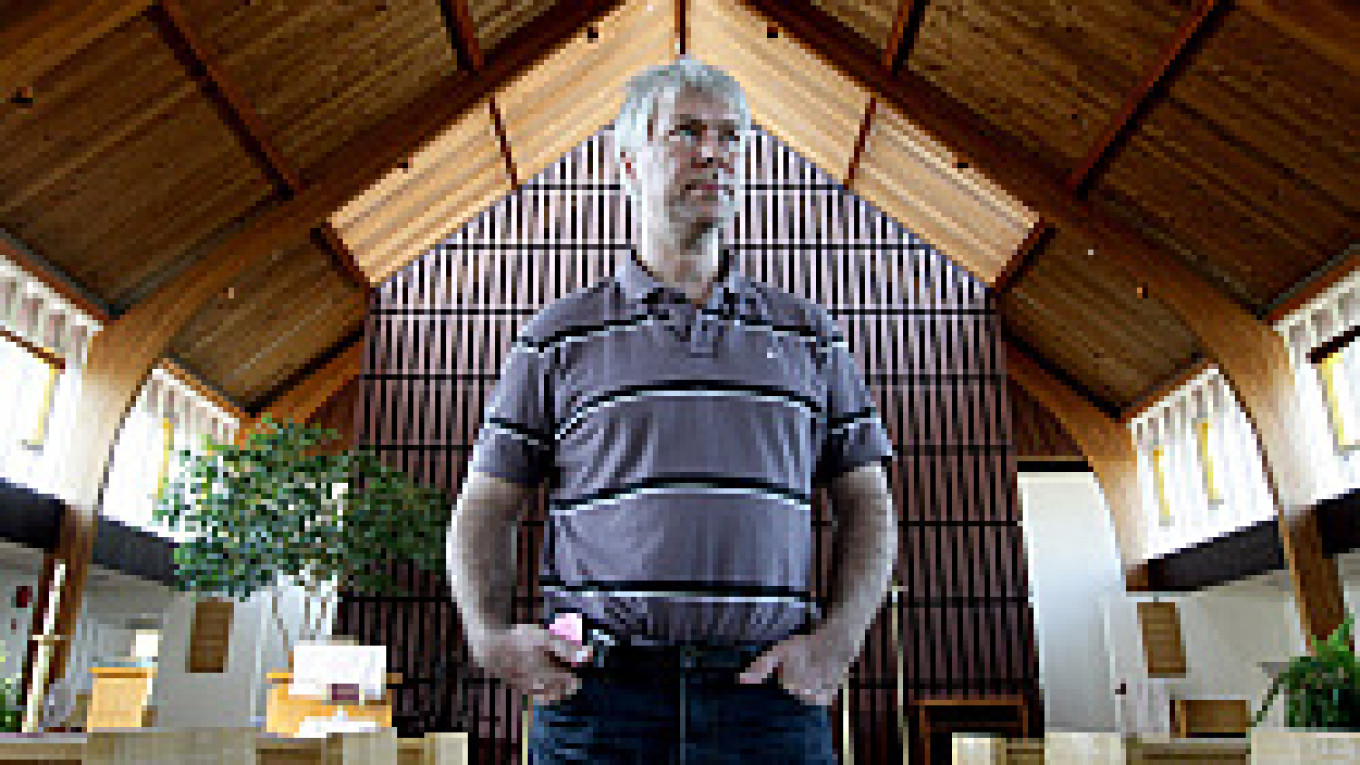
Mikhail Lennikov, 48, a Vladivostok native, was granted refuge at the First Lutheran Church in Vancouver on Tuesday after a court on Monday ordered him to be deported.
Lennikov said he was pressured into joining the KGB in 1982 for his knowledge of Japanese and quit in 1988 because he didn't like the work.
"I didn't want to work for the KGB because it didn't correspond to my beliefs," Lennikov said by telephone Wednesday.
He said his former KGB colleagues had told him that the Federal Security Service, or FSB, the agency's main successor, considered him a traitor, and he feared retribution if he returned to Russia.
Lennikov, who has lived in Canada for 11 years, said he never hid his involvement with the KGB and debriefed Canadian intelligence about his past work after moving to Canada.
But the Canadian Border Services Agency decided in 2004 that Lennikov should not be allowed to stay because of his KGB past, and the Immigration and Refugee Board agreed in 2006.
Lennikov's final appeal to remain in Canada was rejected by the court on Monday.
Canadian authorities have allowed Lennikov's wife and 17-year-old son to remain in Canada "for compassionate and humanitarian reasons," Lennikov said.
A number of former intelligence officers have fled Russia over the years. Former FSB Colonel Alexander Litvinenko received asylum in Britain in May 2001, two years after publicly accusing his FSB superiors of ordering him to kill exiled tycoon Boris Berezovsky, at the time a powerful Kremlin insider. Litvinenko died in London in 2006 after being poisoned with a radioactive substance.
Retired KGB Major General Oleg Kalugin, who worked as a spy in New York and Washington in the late 1960s and early 1970s, moved to the United States in 1994. In 2002, a Moscow court tried and convicted him in absentia of spying for the United States.
An FSB spokesman declined immediate comment on the Lennikov case Wednesday.
Lennikov said he left Russia for Japan in 1995 and moved to Canada two years later. He arrived in Canada on a student visa, and his wife and son were issued visas to accompany him, said Monday's court order, a copy of which was posted on the web site of the Vancouver Sun newspaper. From 1999 to February 2009, his visa was extended to allow him to complete various university degrees, but a request for another extension was refused on May 19, the court order said.
Lennikov said he is a longtime member of the Lutheran church where he is now staying.
The church's pastor, Richard Hergesheimer, said he had no qualms about offering Lennikov sanctuary. "We have worked with the family and suffered with them through all their ups and downs, and it was clear that sanctuary might have to be an option, a last resort," he told AP.
A Message from The Moscow Times:
Dear readers,
We are facing unprecedented challenges. Russia's Prosecutor General's Office has designated The Moscow Times as an "undesirable" organization, criminalizing our work and putting our staff at risk of prosecution. This follows our earlier unjust labeling as a "foreign agent."
These actions are direct attempts to silence independent journalism in Russia. The authorities claim our work "discredits the decisions of the Russian leadership." We see things differently: we strive to provide accurate, unbiased reporting on Russia.
We, the journalists of The Moscow Times, refuse to be silenced. But to continue our work, we need your help.
Your support, no matter how small, makes a world of difference. If you can, please support us monthly starting from just $2. It's quick to set up, and every contribution makes a significant impact.
By supporting The Moscow Times, you're defending open, independent journalism in the face of repression. Thank you for standing with us.

Remind me later.