

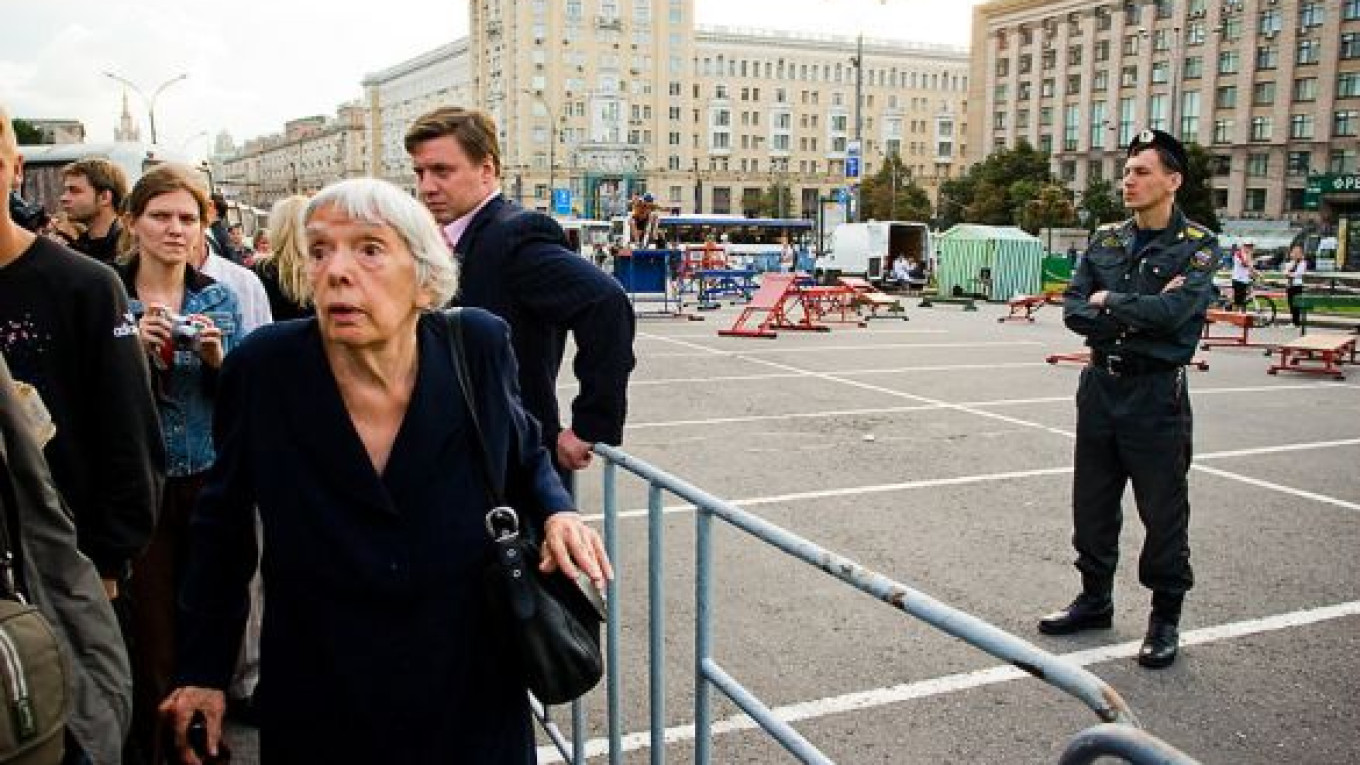
As the State Duma considers a bill countering the U.S. Magnitsky Act, a group of lawmakers is threatening to add a provision that would massively increase pressure on nongovernmental organizations they believe to be meddling in domestic politics.
The deputies support amendments that would enable authorities to close any NGO operating in the country if it either employs U.S. citizens or accepts U.S. funding and if its activities are deemed political.
The changes to the bill were presented at a Duma committee meeting Monday by two United Russia deputies, Dmitry Vyatkin and Mikhail Starshinov, as well as Igor Zotov of A Just Russia and Liberal Democrat Andrei Lugovoi, national media reported Tuesday.
The amendments stipulate that NGOs conducting "political activity" must not employ staff with dual Russian-U.S. citizenship, nor can they accept any money originating from U.S. citizens or organizations. In case of violation, the organization would be closed and its assets seized, Vedomosti reported.
It was unclear whether the changes would make it into the bill for its second reading, which the Duma is expected to hold Wednesday.
The proposals, which had not been published on the Duma's website by late Tuesday, were unanimously denounced by civil rights activists, who also questioned their viability.
"There is no logical explanation for this," said Yelena Panfilova, the director of the Russian branch of anti-corruption watchdog Transparency International.
She added that the proposal would hugely add to the challenges of enforcing the latest tightening of the country's NGO laws.
Panfilova said a lot of U.S. money goes to social organizations, where the differences between political and nonpolitical activities are blurred.
"Who is going to draw the line and how?" she asked.
The issue has been a sore point since last month, when a law came into effect that forces NGOs to register as foreign agents if they finance political activity with foreign funds. The law has been widely denounced by civil rights groups, many of which vowed to boycott it.
Significantly, the new proposals would not be limited to locally registered organizations but would include offices of foreign NGOs, which are not covered by the "foreign agent" law.
Lyudmila Alexeyeva, the veteran human rights campaigner and founder of the Moscow Helsinki Group, said the latest changes were tailored to target her.
"It looks like the amendments are meant for me personally. I do not know other NGO heads with two passports," she told Vedomosti.
Alexeyeva was forced to emigrate from the Soviet Union in 1977 and received U.S. citizenship in 1982. She returned to Russia in 1993 and received a Russian passport as well.
Irina Yarovaya, the head of the Duma's Security Committee, lashed out at Alexeyeva by questioning her loyalty.
"As a U.S. citizen, Ms. Alexeyeva has taken an oath of loyalty to the United States," Yarovaya, a senior United Russia deputy, said in comments carried on the party . "She has fully renounced Russia and has even obliged herself to fight only on the U.S. side, even by taking up arms."
Alexeyeva retorted that it was "ridiculous" for Yarovaya to tell her which country she owes loyalty to, and she stressed that she returned Russia as soon as she could.
"If citizen Yarovaya had lived somewhere sweeter, I do not think she would have returned," Alexeyeva, who is 85, told Interfax.
Sergei Markov, a pro-Kremlin pundit and vice rector of the Plekhanov Institute, defended the law as a symbolic move.
Markov said the Magnistky Act, which slaps sanctions on Russian officials implicated in human rights violations, is "imperial" because it chips away at sovereignty.
"We must decide ourselves who is good and who is not," he said.
He acknowledged, however, that Moscow's answer is not fully rational.
"Maybe this is emotional and psychological," he said. "[But] nowhere is politics 100 percent rational."
Related articles:
A Message from The Moscow Times:
Dear readers,
We are facing unprecedented challenges. Russia's Prosecutor General's Office has designated The Moscow Times as an "undesirable" organization, criminalizing our work and putting our staff at risk of prosecution. This follows our earlier unjust labeling as a "foreign agent."
These actions are direct attempts to silence independent journalism in Russia. The authorities claim our work "discredits the decisions of the Russian leadership." We see things differently: we strive to provide accurate, unbiased reporting on Russia.
We, the journalists of The Moscow Times, refuse to be silenced. But to continue our work, we need your help.
Your support, no matter how small, makes a world of difference. If you can, please support us monthly starting from just $2. It's quick to set up, and every contribution makes a significant impact.
By supporting The Moscow Times, you're defending open, independent journalism in the face of repression. Thank you for standing with us.

Remind me later.