

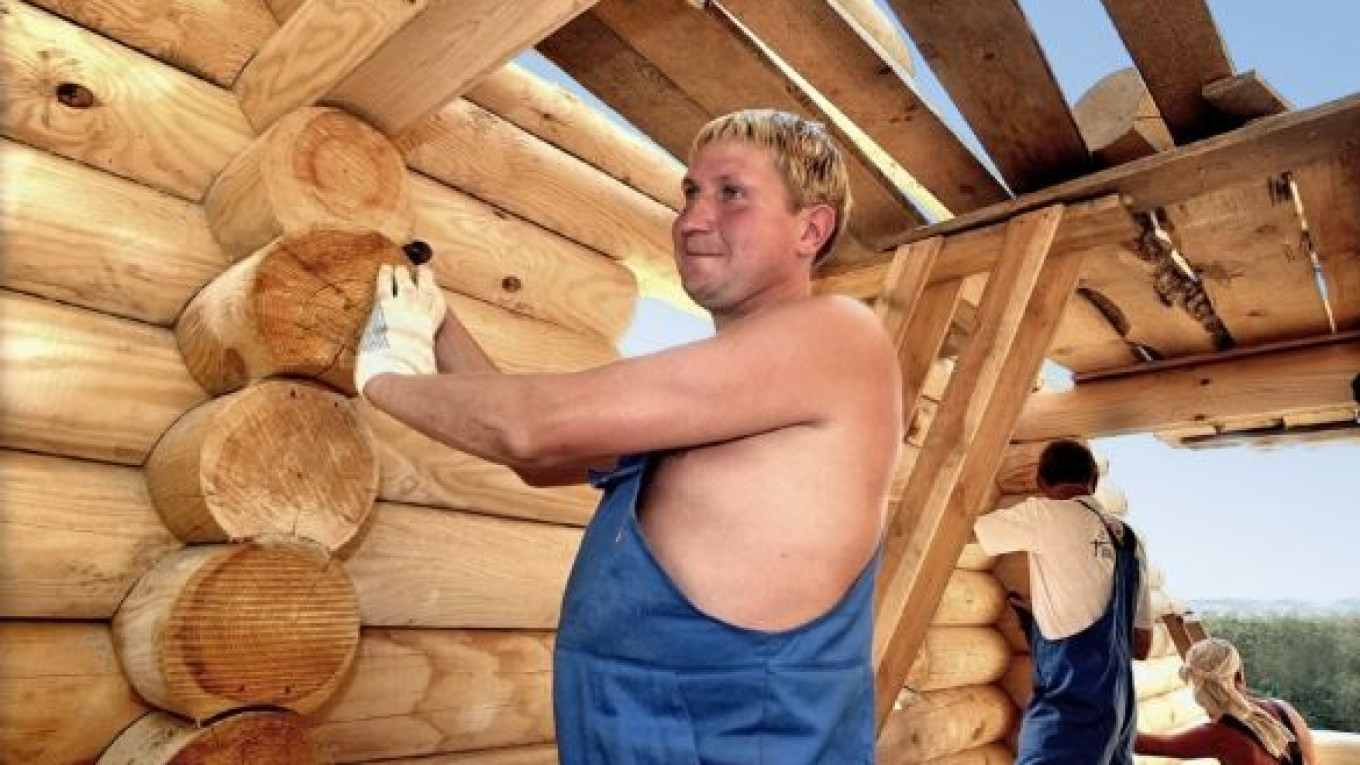
The classic Russian izba, or log house, is holding its own in the post-Soviet construction boom, with nearly 40 percent of single-family houses being made of logs, while contemporary construction methods aim to make building the traditional dwelling more efficient.
The Association of Wood Housing recently reported that 7.3 million single-family wooden houses were built in Russia in 2010, a 25 percent increase over the last five years.
"Russians pride themselves on their log-house tradition," stated Dmitry Panin, owner of Solga, a builder of traditional log houses. "A few centuries ago, they were even built without nails."
Made of hewn trees, they can be built using only hand tools and if properly constructed can last several hundred years. Wooden logs are often left untreated and turn gray naturally over time, while flax and moss are sometimes used as insulation in between.
But the age-old method is seeing competition from new technology, mostly coming from Finland, in which logs are uniformly cut, dried and laminated.
Finnish firms like Rovaniemi, Honka and Finnlamelli are cashing in on the local wooden house market and laud the laminated log for its ecological friendliness and ability to maintain ideal indoor moisture levels. President Dmitry Medvedev's recently constructed 540-square-meter villa in the Murmansk region is made by Finland's Puukeskus and cost 4 million euros ($5.4 million).
"I would say with 100 percent certainty that the market is moving to laminated wood — it doesn't have cracks nor will it deform to the same extent as whole logs," said Georgy Sidelnikov, sales manager at Rossa Rakenne, the exclusive distributor of Honka in Russia.
For every 50 orders, Honka only receives one for a traditional wood-log home. With a price of 2,000 euros per square meter, laminated wood-beam homes from Honka are not yet within the reach of the average homebuyer.
One factor that brings up the price of a laminated-beam home is the amount of additional fitting-out that can be required on the inside, including secondary walls, painting and ventilation systems. Traditional nonlaminated wooden houses often rely on the bare wood for their interior walls. Finnish suppliers do all their wood processing in their own country, which adds import and transportation costs.
"The technology of the home doesn't influence the price all that much. Wooden homes range from 20,000 to 40,000 rubles per square meter," said Alexander Dubovenko, director for development at wooden-house builder Good Wood. "In 2007, we even initiated a program selling laminated logs for 16,800 rubles per square meter, so it is possible to lower costs."
Enthusiasts say wooden houses have the unique ability to naturally regulate their environment, stabilizing humidity levels. Some companies maintain that laminated wood does this better than traditional uncoated logs, but industry experts say it is not an accurate claim.
"Only 20 to 25 millimeters of wood is necessary to absorb the highest levels of moisture in a room, preventing the likelihood of mold and releasing moisture to prevent respiratory infections caused by low humidity levels," said Tuomo Ojanen, a senior scientist at VTT Technical Research Center of Finland whose research on wooden structures is cited on many web sites for wooden-home construction. "In this sense, there is not much difference between laminated wood and a log," Ojanen told The Moscow Times.
Traditional Russian log homes, however, demand patience from the client and a high degree of expertise from the builder. Trees are felled in the middle of winter to minimize sap levels, and then the bark is removed by hand. The logs are placed on a foundation and left to dry and settle for six to 12 months. If they do not settle or dry correctly, they can deform, destroying window and door frames. After the drying period, interior finishing work is completed — leading to a construction cycle of at least 1 1/2 years and sometimes lasting up to twice that long, depending on the size and design.
"If [a traditional log house is] built properly," Sidelnikov stated, "they are capable of standing at least two generations, even up to 500 years. Laminated log technology is fairly young, we have only been producing it for 30 years, but according to virtual tests we guarantee a 30- to 40-year life."
"Log homes are not for everyone, if the client is demanding quick results then the best option is a laminated log house," Panin said. "But they are not 100 percent natural, since they utilize glue made with chemicals and metal braces."
A Message from The Moscow Times:
Dear readers,
We are facing unprecedented challenges. Russia's Prosecutor General's Office has designated The Moscow Times as an "undesirable" organization, criminalizing our work and putting our staff at risk of prosecution. This follows our earlier unjust labeling as a "foreign agent."
These actions are direct attempts to silence independent journalism in Russia. The authorities claim our work "discredits the decisions of the Russian leadership." We see things differently: we strive to provide accurate, unbiased reporting on Russia.
We, the journalists of The Moscow Times, refuse to be silenced. But to continue our work, we need your help.
Your support, no matter how small, makes a world of difference. If you can, please support us monthly starting from just $2. It's quick to set up, and every contribution makes a significant impact.
By supporting The Moscow Times, you're defending open, independent journalism in the face of repression. Thank you for standing with us.

Remind me later.