

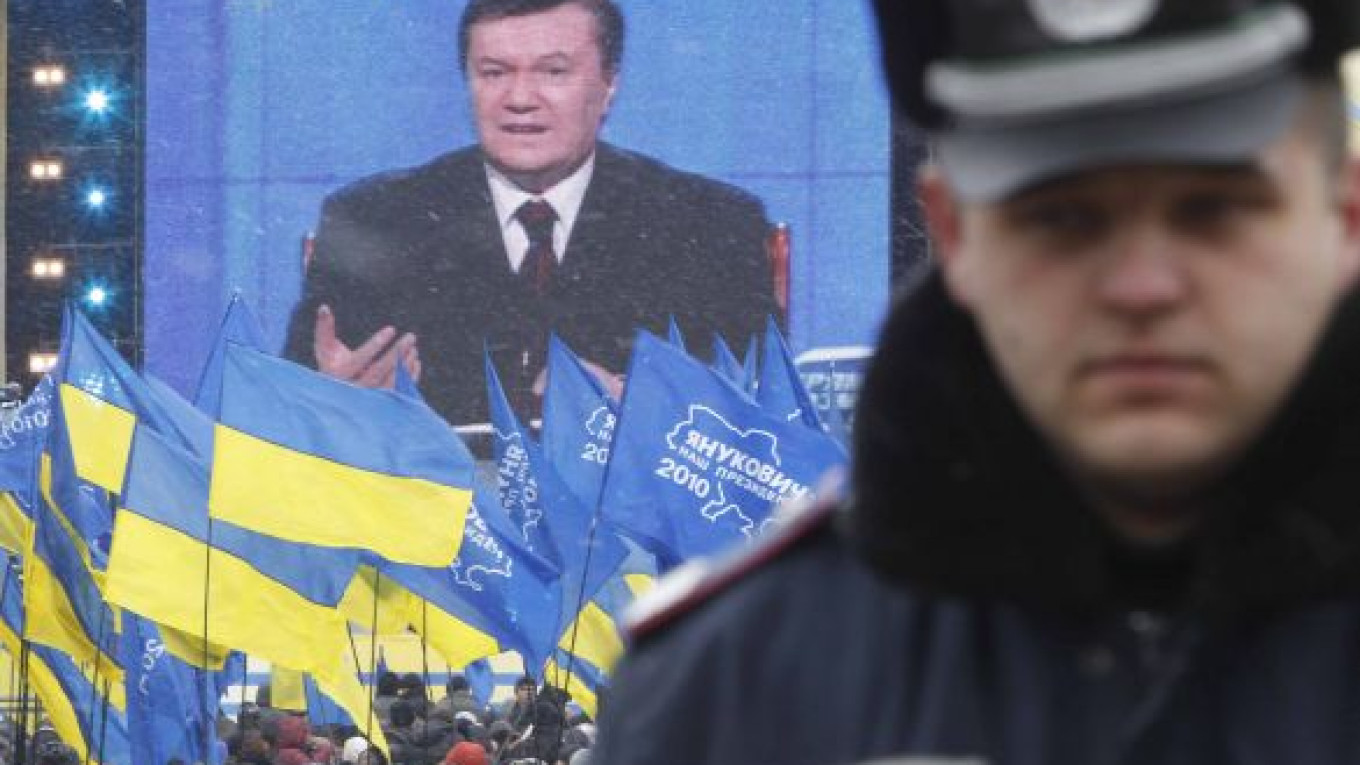
KIEV — Ukraine must gradually raise its retirement age, otherwise its pension system will collapse, President Viktor Yanukovych said Friday, signaling that the government will follow IMF advice on reforming pensions.
Economists, including those at the International Monetary Fund, have long urged the former Soviet republic to raise the retirement age, but the government has appeared hesitant to press ahead with such an unpopular move.
Ukraine did not pass the pension reform law in line with its $15 billion deal with the IMF, and the fund is unlikely to issue the next $1.6 billion loan tranche unless the bill is adopted.
"If we leave the retirement age at the current level, we will not be able to support the pension system within a few years," Yanukovych said in a live
televised question-and-answer session on the first anniversary of his election.
"Therefore we need to raise the retirement age," he said.
Ukrainian women retire at 55, while men go at 60. The IMF-sponsored plan would gradually raise the retirement age for women to 60 within 10 years. But Yanukovych said the retirement age for men would also rise at some point.
"I am against doing this quickly from 55 today to 60 tomorrow, but I support the idea of gradually raising the [retirement] age for women and, eventually, men. We will have to do this," he said.
Relatively small on an individual basis ?€” about $140 a month on average ?€” total pension expenditure is a big burden on the ex-Soviet republic's budget, making up 18 percent of gross domestic product in 2009, one of the highest rates in Europe.
The conventional thinking is that Yanukovych's team is steeling itself to push through unpopular reforms, like changes to the pension system and raising gas prices, this year rather than put them off until next year when his party faces a parliamentary election.
Rating agency Standard and Poor's said in a report Friday that further reforms
were indeed necessary.
"In our opinion, the pay-as-you-go system in Ukraine suffers from some serious structural weaknesses, such as the low retirement age, a low minimum contribution period, and generous early retirement provisions," S&P said.
"In addition, we believe there is a systemic compliance problem on the revenue side as a lot of employers prefer to pay 'gray' salaries to avoid paying social contribution tax."
The reform suggested by the IMF will improve the situation but will not be enough to eliminate the pension fund deficit, S&P said.
"We think it likely that the reform will be partially diluted when passed through parliament, in response to public hostility to the intended changes," the agency said.
"Even if the reform were to be implemented, we believe the government would
have to take additional measures to put long-term public finances on a sustainable path and comply with its long-term contingent liabilities coming from the pension system."
S&P said these measures would include the introduction of a working mandatory "second-pillar" system ?€” collecting additional contributions from
workers for their personal pension accounts. Ukraine has said such a system
could be introduced in 2013.
"The window of opportunities for the implementation of such measures, however, is now closing," S&P said.
A Message from The Moscow Times:
Dear readers,
We are facing unprecedented challenges. Russia's Prosecutor General's Office has designated The Moscow Times as an "undesirable" organization, criminalizing our work and putting our staff at risk of prosecution. This follows our earlier unjust labeling as a "foreign agent."
These actions are direct attempts to silence independent journalism in Russia. The authorities claim our work "discredits the decisions of the Russian leadership." We see things differently: we strive to provide accurate, unbiased reporting on Russia.
We, the journalists of The Moscow Times, refuse to be silenced. But to continue our work, we need your help.
Your support, no matter how small, makes a world of difference. If you can, please support us monthly starting from just $2. It's quick to set up, and every contribution makes a significant impact.
By supporting The Moscow Times, you're defending open, independent journalism in the face of repression. Thank you for standing with us.

Remind me later.