

X5 Retail Group and Magnit posted unexpectedly high profits last week despite falling sales throughout the sector, but looming regulation and wary consumers are likely to cause trouble for food retailers down the road.
X5, which owns supermarket chains Perekryostok and Pyatyorochka, reported on Thursday an 87 percent increase in second-quarter net profit to $130 million, while margins fell after it cut prices to attract customers. London-traded shares in X5 gained 7.6 percent on the week, closing at 19.37.
Magnit, which runs discount grocery stores in towns with fewer than 500,000 residents, boosted net income 79 percent to $117.9 in the first half from $65.9 million a year earlier after implementing strict cost controls. The retailer’s shares on MICEX rose 8.5 percent on the week, finishing at 1593.19 rubles.
The ruble-denominated MICEX Index ended the week up a slight 0.5 percent, while the dollar-denominated RTS Index finished with a 3.7 percent gain.
The country’s two largest food retailers managed to increase their profits during the recession by operating in the low-price discounter segment, keeping existing customers and attracting new ones by lowering prices, analysts said.
“Both retailers have strong positions and can afford to keep up existing prices or lower them further,” said Natalya Zagvozdina, a retail analyst Renaissance Capital. “They get discounts from food producers and are therefore able to increase their margins.”
Moreover, they were efficiently using their own cash and loans to open new stores, which played a big role in the profit gains, she said.
Magnit added 226 stores in the first six months of the year, increasing selling space by 27 percent, and it plans to have 3,100 convenience stores by the end of the year.
X5 had 1,164 stores and 605 franchisees as of June 30 and plans to open 100 new stores in 2009, chief executive Lev Khasis said in a statement.
In July, the government proposed new legislation that would put strict regulations on large retailers. Chains that have nationwide sales of more than 1 billion rubles and that control more than a quarter of the market in any city would be prohibited from buying or leasing any new stores.
The proposed measures come amid heavy pressure from the state on big retailers to lower food prices. Prime Minister Vladimir Putin paid a surprise visit in June to a Moscow Perekryostok, where he scolded executives for charging too much for sausages and meat. X5 responded shortly afterward by slashing prices in a “grand sale.”
“The policy to set upper limits for prices and retail margin are inefficient and will not bring a positive result,” said Yekaterina Loshchakova, a consumer goods analyst at Financial Bridge. “A better route would be stimulating market competitiveness, which would force every retailer to sacrifice profitability and offer lower prices to attract customers.”
Despite the strong performance of X5 and Magnit, the rest of the sector may have trouble keeping profits up in the face of a mammoth drop in consumer spending.
“X5 and Magnit are the most experienced and efficient operating companies in the sector, and the data they released does not represent the overall situation,” Loshchakova said.
“The majority of companies in the sector have an excessive debt burden, while earnings and transaction flow are down,” she said. “The result is that it is unsafe to loan money to small chains, as there is a high probability of overdue loans in the future.”
Among the retailers that have a significant debt burden are medium-size retailers, including Sedmoi Kontinent, which owns 150 shops in Moscow, and Dixy Group with 425 outlets.
Dixy, which has a ratio of debt to earnings before interest, depreciation, taxation and amortization of about 2.89, said last week that its profits increased 16 percent in the first seven months of the year to 31.2 billion rubles. Dixy’s shares closed the week up 2.9 percent at 155.83.
Sedmoi Kontinent defaulted on 1.9 billion rubles of debt in June after creditors demanded early repayment. The high-end grocery store’s stock managed a slight gain, rising 0.4 percent on the week to 237.93.
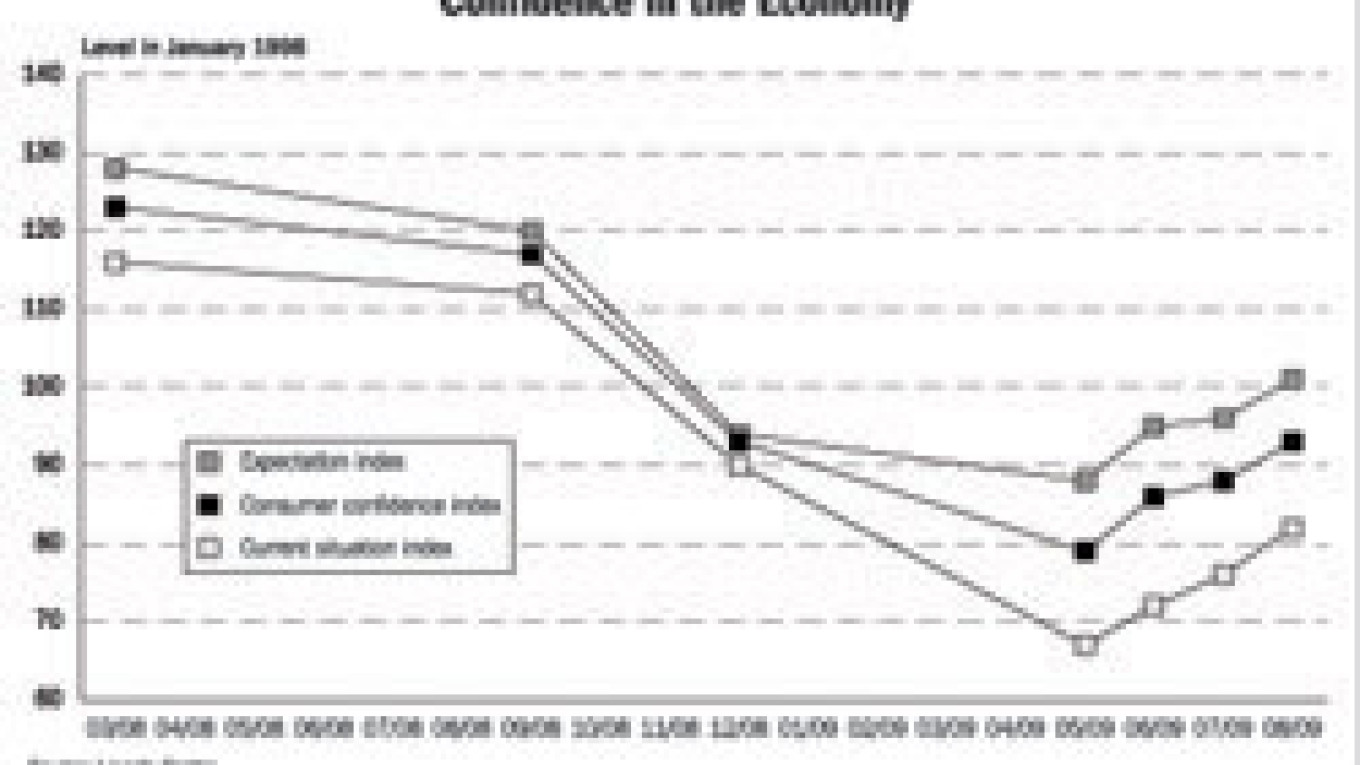
Despite a recent uptick in consumer confidence, the sector as a whole is unlikely to get any major help from consumers any time soon.
The Levada Center’s consumer confidence index showed an increase of 5 percentage points in August compared with the previous month. That puts the figure back at the same level as December 2008.
“Consumption is unlikely to grow significantly in the next six to eight months, until people are sure the ruble won’t weaken and salaries are no longer cut,” Zagvozdina said. “An increase of pensions and salaries in the public sector will not cause people to spend more, as they would basically try to save money for fear of another economic downturn.”
“People are getting used to living in the new conditions,” Loshchakova said. “This may explain the growth of consumer moods index.”
A Message from The Moscow Times:
Dear readers,
We are facing unprecedented challenges. Russia's Prosecutor General's Office has designated The Moscow Times as an "undesirable" organization, criminalizing our work and putting our staff at risk of prosecution. This follows our earlier unjust labeling as a "foreign agent."
These actions are direct attempts to silence independent journalism in Russia. The authorities claim our work "discredits the decisions of the Russian leadership." We see things differently: we strive to provide accurate, unbiased reporting on Russia.
We, the journalists of The Moscow Times, refuse to be silenced. But to continue our work, we need your help.
Your support, no matter how small, makes a world of difference. If you can, please support us monthly starting from just $2. It's quick to set up, and every contribution makes a significant impact.
By supporting The Moscow Times, you're defending open, independent journalism in the face of repression. Thank you for standing with us.

Remind me later.