

Prime Minister Vladimir Putin is on course to win next weekend's presidential election, but at what cost?
About $161 billion, according to some estimates.
Some observers see government spending rocketing by as much as $161 billion through 2018 on the back of popular pledges designed to guarantee Putin's return to the Kremlin and shore up support that has wobbled amid large street demonstrations.
Putin's government has postponed utility tariff price rises, hiked pensions and frozen gasoline prices, while more colorful moments of largesse have included proposals to buy back 16 billion rubles ($550 million) of VTB shares and give fans free flights to the Euro 2012 football tournament.
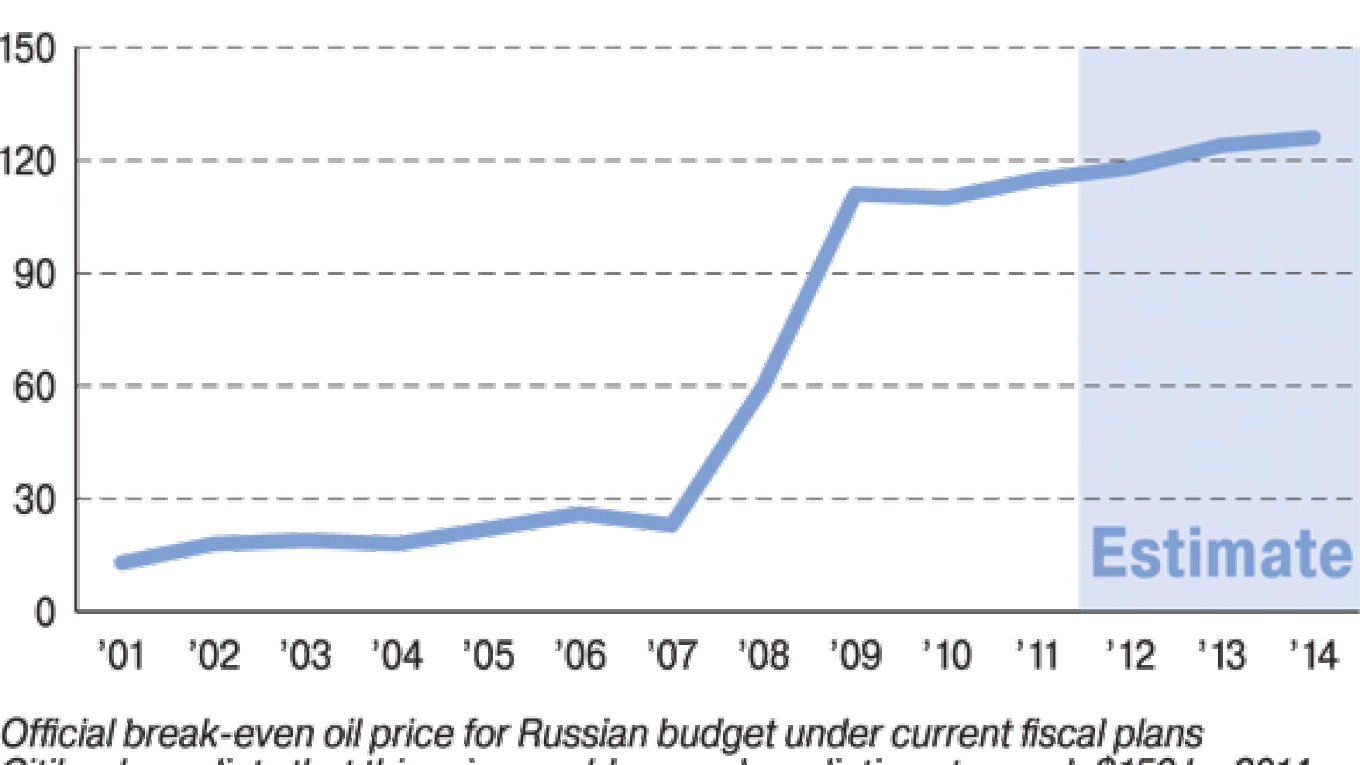
Rising expenditures could push the break-even oil price for Russia's budget to $150 a barrel over the next few years, Citibank said last week. The government needed $115 a barrel to cover spending in 2011 and just $23 a barrel in 2007 on the eve of the financial crisis.
Such a drain on the nation's finances would be disastrous, said Sergei Guriev, rector of the New Economic School. "If the oil price is where it is now and if Putin wins in the first round, he will mostly implement his promises, which will have serious negative implications for long-term macroeconomic stability," he told The Moscow Times.
Oil hit record levels last week, with its price in rubles now at its highest point since record keeping began. On the back of rising tensions between the United States and Iran, Russian benchmark Urals crude was flirting with the $125 mark Friday, closing at $124.99 a barrel.
Finance Minister Anton Siluanov said Monday that Putin's pre-election commitments will cost up to 2 percent of GDP — about $34 billion. He said the break-even oil price for the budget should be $90 by 2016 for fiscal stability, Reuters reported.
But in a sign that even the Finance Ministry is concerned about the risk of rapid increases in expenditure, Siluanov warned of the threats linked to irresponsible spending.
"It's a choice either of stability or of decisions that are not secured by real financing," he said.
Putin's campaign trail pledges have included promises to raise the salaries of teachers, doctors and university staff, additional allowances to families with three children, more scholarships and expanding the provision of living accommodations for military personnel.
In a Feb. 20 newspaper commentary on defense, Putin said he would increase military spending by $768 billion more than was earmarked in a 2008 modernization program. Military wages were doubled in January. Police officers' salaries were more than doubled the same month.
Former Finance Minister Alexei Kudrin left the government last year after publicly criticizing unsustainable levels of military expenditures.
Pensions were boosted by 7 percent in January and will go up again — by 2.4 percent — in April. On Feb. 13, Putin proposed that a strategy be developed to reduce the cost of housing by up to 30 percent. Social outlays have risen to 27 percent of GDP, up from 21 percent over the last four years, Siluanov said Monday.
Like in any country, there is an understanding that pre-election commitments are often reneged on, said Yulia Tseplyayeva, chief economist at BNP Paribas in Moscow. But "you have to take the promises seriously because they show the trajectory of development," she said.
Some investors are taking Putin seriously. VTB stock jumped 4 percent within minutes after Putin announced plans earlier this month to buy small investors out of their shares, which have plummeted in value since a 2007 initial public offering.
The prime minister said Jan. 19 that Russian fans deserved to fly for free to football matches in Ukraine and Poland later this year. He said Aeroflot and Transaero should donate planes and suggested that they could recoup losses through publicity.
Putin's campaign has not just been predicated on promises. Energy Minister Sergei Shmatko announced in January that informal agreements with energy companies would ensure a freeze on fuel and electricity prices until after the election. Rises in gas prices and building services payments have also been delayed to the second half of the year.
Price freezes have helped reduce inflation to a record low of 4.2 percent in January, but analysts are almost universally predicting a sharp uptick as they are reversed later in the year.
Even Putin himself admitted last week that he "wasn't sure" inflation this year could be held at a level lower than last year's 6.1 percent.
Freezes also hit businesses. In one example, TNK-BP said Monday that it was halting operations at its Ukrainian Lisichansk refinery. "The tolling scheme that TNK-BP uses at the refinery has become unprofitable since the government 'froze' fuel prices," VTB Capital analysts said in a research note.
"Artificial restraints on prices work on the spring principle," business daily Vedemosti wrote in a January editorial. "The harder you lean on them, the more they bounce back."
Boris Titov, chairman of Delovaya Rossia, the pro-Putin business-lobbying group, said companies would use the freeing of prices to raise them more than they would otherwise have grown. "After you remove the barrier the inflow will be significantly bigger and might destroy the economy," he said in an interview.
While some see high oil prices tempting Putin to delay reforms, others hope that his expected return will usher in a period of change. Titov said Putin could only fulfill his obligations if he pushed ahead with fundamental economic restructuring.
"Putin is going in the right direction judging by his rhetoric," he said. "We'll wait and see what he'll actually do."
A Message from The Moscow Times:
Dear readers,
We are facing unprecedented challenges. Russia's Prosecutor General's Office has designated The Moscow Times as an "undesirable" organization, criminalizing our work and putting our staff at risk of prosecution. This follows our earlier unjust labeling as a "foreign agent."
These actions are direct attempts to silence independent journalism in Russia. The authorities claim our work "discredits the decisions of the Russian leadership." We see things differently: we strive to provide accurate, unbiased reporting on Russia.
We, the journalists of The Moscow Times, refuse to be silenced. But to continue our work, we need your help.
Your support, no matter how small, makes a world of difference. If you can, please support us monthly starting from just $2. It's quick to set up, and every contribution makes a significant impact.
By supporting The Moscow Times, you're defending open, independent journalism in the face of repression. Thank you for standing with us.

Remind me later.