

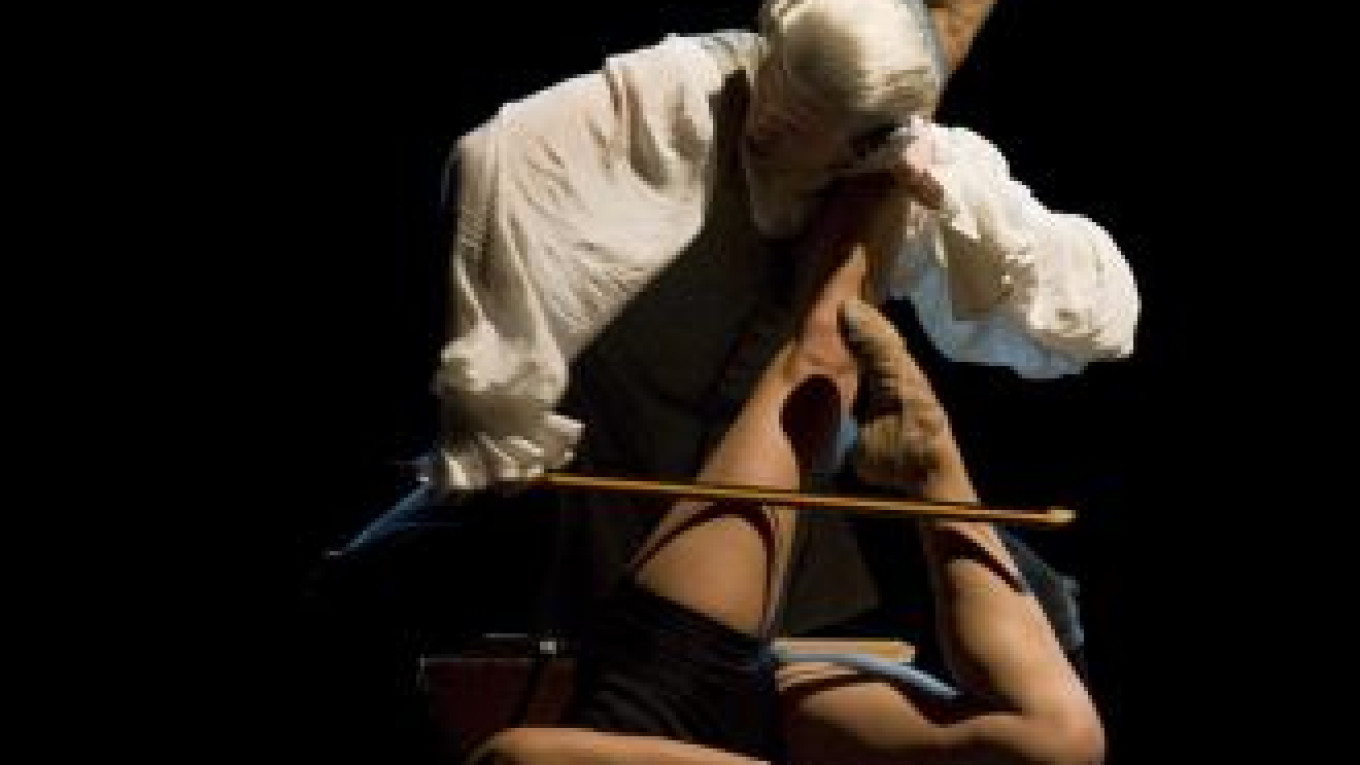
For many dance enthusiasts, myself included, the season of 2009-10 reached its high point with the appearance in the last two weeks of July of the National Dance Company of Spain, led by its artistic director, the acclaimed choreographer Nacho Duato.
Performing under the auspices of the International Chekhov Festival, the Spanish troupe first presented a new work of Duato’s centered on Anton Chekhov and titled “The Infinite Orchard” and went on to perform one of the choreographer’s acknowledged masterpieces, “Multiplicity. Forms of Silence and Emptiness,” which premiered in 1999.
Like “Na Floresta,” which Duato staged with enormous success last summer at the Stanislavsky and Nemirovich-Danchenko Musical Theater, both ballets that he brought to the Chekhov Festival explored a highly original vocabulary of dance and pushed the human body to what seemed its very limits. Both were marked as well by dance that appeared to arise organically from its accompanying music. And both, though lacking specific scenarios and defined characters, contained an abundance of thought-provoking substance.
“The Infinite Garden” concerned Chekhov the man, not his literary works, and was inspired by the writer’s notebooks and diaries, as well as visits by Duato to places where Chekhov had lived and worked. At a news conference prior to opening night, Duato explained that for him, “the creativity of Chekhov was infinite … and it was in a garden that his words grew.”
The ballet was set to a minimalist score by contemporary Spanish composers Pedro Alcalde and Sergio Caballero, with bits thrown in from Pyotr Tchaikovsky and Alfred Schnittke, plus equally musical and danceable interludes and interpolations that consisted of birdsong, other recorded sounds of nature and a narration — beautifully spoken in Russian — of sentences, phrases and individual words taken from Chekhov’s writings.
Fleeting allusions were made along the way to Chekhov’s literary works, among them, subtle but unmistakable moments that referred to his plays “The Three Sisters” and “The Seagull,” as well as his short story “Ward No. 6.”? ? ?
“Multiplicity. Forms of Silence and Emptiness” was set to brief excerpts from the music of Johann Sebastian Bach. “Multiplicity” could be found in the astounding variety of musical forms employed by Bach, of dance forms and combinations to which his music was set and of human movement within each dance sequence. “Forms of silence and emptiness” were more difficult to discern, probably in need of a number of viewings to become fully apparent.
The 30 dancers of the Spanish troupe not only performed the two ballets with consummate skill, but also brought to them energy of a sort that is not often seen even among the very best of Russian dance companies. ?
It was widely known in advance that Duato had decided to terminate his 20-year-long association with the National Dance Company of Spain at the end of its appearance at the Chekhov Festival. Though there was much speculation about his future, it seemed virtually certain that the 53-year-old Duato, probably among the top half dozen on nearly any expert’s list of the world’s best choreographers, would find himself with no shortage of offers to work elsewhere.
Halfway through the Spanish company’s Moscow run came the surprising announcement that Duato had accepted the post of ballet artistic director at St. Petersburg’s Mikhailovsky Theater, with the objective of turning the Mikhailovsky into a major contemporary dance center.
Largely a phenomenon of post-Soviet times, contemporary dance has never really taken off in Russia. A lack of talented choreographers is usually cited as the reason. Duato’s large repertoire of ballets created in Spain will become available to the Mikhailovsky in a year’s time. He will also undoubtedly continue to create new ballets, and he intends as well to present the works of leading choreographers from abroad and of whatever homegrown talent he can uncover. Combining all of that with Duato’s proven talent as a trainer, the result should be a major step toward Russia’s becoming a serious competitor in the world of 21st-century dance. ?
“This won’t happen quickly,” Duato told me following the final Chekhov Festival performance. “I’ll be taking it on a step-by-step basis. But I’m pretty sure we will eventually succeed.”
Fortunately, Duato is not altogether abandoning Moscow. In January, he is due to take part in a project at the Bolshoi Theater titled “Reflections,” which will feature four prominent ballerinas from various parts of the world, all of them graduates of the Bolshoi’s training school, the Moscow Choreographic Academy. And next May, he returns to the Stanislavsky and Nemirovich-Danchenko to stage one of his most popular works, “Por Vos Muero” (I Die for Thee), created for his Spanish company in 1996. Beyond that, Moscow seems very likely to be visited, perhaps on a regular basis, by the ballet company of the Mikhailovsky, once Duato has had a chance to raise its standards of performance and create a new repertoire of his own.
A Message from The Moscow Times:
Dear readers,
We are facing unprecedented challenges. Russia's Prosecutor General's Office has designated The Moscow Times as an "undesirable" organization, criminalizing our work and putting our staff at risk of prosecution. This follows our earlier unjust labeling as a "foreign agent."
These actions are direct attempts to silence independent journalism in Russia. The authorities claim our work "discredits the decisions of the Russian leadership." We see things differently: we strive to provide accurate, unbiased reporting on Russia.
We, the journalists of The Moscow Times, refuse to be silenced. But to continue our work, we need your help.
Your support, no matter how small, makes a world of difference. If you can, please support us monthly starting from just $2. It's quick to set up, and every contribution makes a significant impact.
By supporting The Moscow Times, you're defending open, independent journalism in the face of repression. Thank you for standing with us.

Remind me later.