

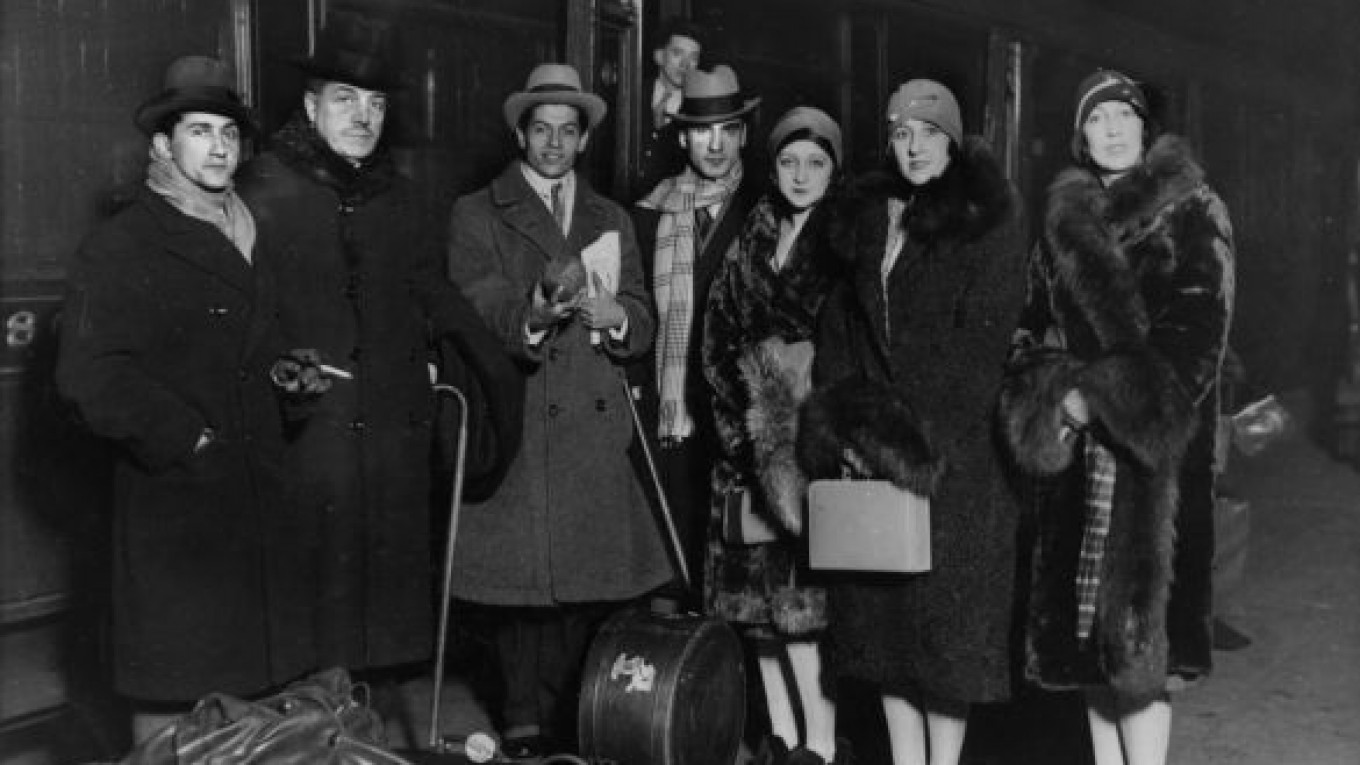
Sjeng Scheijen’s “Diaghilev: A Life” is a superb biography of the world’s greatest artistic trailblazer and impresario, Sergei Pavlovich Diaghilev (1872–1929). In this fascinating and moving account, Scheijen clearly describes the life of a complex man who started as an art critic, publisher, art historian and exhibitions organizer and later founded the Ballets Russes.
Scheijen carried out extensive research in archives in Russia, which produced a wealth of interesting new material about Diaghilev’s family and personal life. Previous biographies have told us about the Diaghilev who discovered and nurtured dancers, choreographers, musicians and painters. He and his Ballets Russes left a legacy of ideas and ideals for dance that still influence the art form. Many of his ballets are still in the repertoire of ballet companies all over the world. Scheijen covers all this but also tells us about the shattering bankruptcy of Diaghilev’s father and the loss of the family’s vodka distillery and their two houses. This happened just as the 18-year-old Diaghilev left Perm to study law in St. Petersburg. At about this time, he came into an inheritance from his mother, who died shortly after he was born. As the only member of the family with an income, he suddenly found himself taking care of his two younger half-brothers and his beloved old nurse. Until now, he has always been described as a carefree and arrogant dandy during his university years.
Scheijen also reveals that in the summer of 1902, Diaghilev spent a few weeks at the famous Krafft-Ebing Sanatorium in Graz while seeking a cure for his nerves. The founder of the sanatorium was Dr. Baron Richard von Krafft-Ebing, a noted psychiatrist and psychologist. It would seem that it was during his stay in Graz that Diaghilev first fully acknowledged his sexuality. Another revelation is that the dancer, Vaslav Nijinsky, who was also Diaghilev’s lover for five passionate years, was not Diaghilev’s victim, which Nijinsky’s biographers have claimed. Scheijen produces evidence that the young dancer actively pursued Diaghilev, realizing that it would further his career.
Diaghilev’s stated goal as an exhibitions organizer was to bring European art to Russia and Russian art to Europe. He succeeded in a series of impressive, well-attended exhibitions between 1897 and 1906. He then decided to present concerts of Russian music in Paris followed by Russian opera starring the great bass Fyodor Chaliapin, and from 1909 onwards, Russian ballet. The pre-World War I seasons of the Ballets Russes and its stars, Nijinsky, Anna Pavlova and Tamara Karsavina, dazzled and thrilled audiences in Paris, London, Berlin and Brussels. All contemporary sources speak of an entirely novel, even life-changing experience.
Diaghilev’s chief choreographers were Mikhail Fokine, briefly followed by Nijinsky, then Leonide Massine, Bronislava Nijinska and George Balanchine. His designers before World War I were Russians including Leon Bakst, Alexandre Benois, Alexander Golovine and Nikolai Roerich. During the war and later, he commissioned designs from the Russian modernists Natalia Gontcharova and Mikhail Larionov, followed by many non-Russians including Pablo Picasso, Jean Cocteau, Georges Braque, Andre Derain, and Henri Matisse. It is thanks to the Ballets Russes that new art forms such as Cubism became rapidly known internationally. Picasso is on record as saying that Diaghilev did more to disseminate his fame internationally than his dealer Rosenberg’s shows in Paris. Last but not least, Diaghilev commissioned music from Claude Debussy, Sergey Prokofiev and Maurice Ravel, and he also discovered Igor Stravinsky. Their collaboration was to make a lasting mark on the sound and rhythm of music. Scheijen gives us a detailed account of the genesis and first performances of all the ballets, particularly “Le Sacre du Printemps,” that most cataclysmic piece of 20th-century music.
Scheijen is excellent in describing the complex and frequently antagonistic web of choreographers, musicians, designers and dancers surrounding Diaghilev. The triumph of this book lies in the degree to which the biographer has achieved something like a group biography, analyzing Diaghilev and all the stars of the Ballets Russes in a rich and exhilarating story.
“Diaghilev: A Life” by Sjeng Scheijen, published by Profile Books, 2009, 552 pages, $41.
A Message from The Moscow Times:
Dear readers,
We are facing unprecedented challenges. Russia's Prosecutor General's Office has designated The Moscow Times as an "undesirable" organization, criminalizing our work and putting our staff at risk of prosecution. This follows our earlier unjust labeling as a "foreign agent."
These actions are direct attempts to silence independent journalism in Russia. The authorities claim our work "discredits the decisions of the Russian leadership." We see things differently: we strive to provide accurate, unbiased reporting on Russia.
We, the journalists of The Moscow Times, refuse to be silenced. But to continue our work, we need your help.
Your support, no matter how small, makes a world of difference. If you can, please support us monthly starting from just $2. It's quick to set up, and every contribution makes a significant impact.
By supporting The Moscow Times, you're defending open, independent journalism in the face of repression. Thank you for standing with us.

Remind me later.