

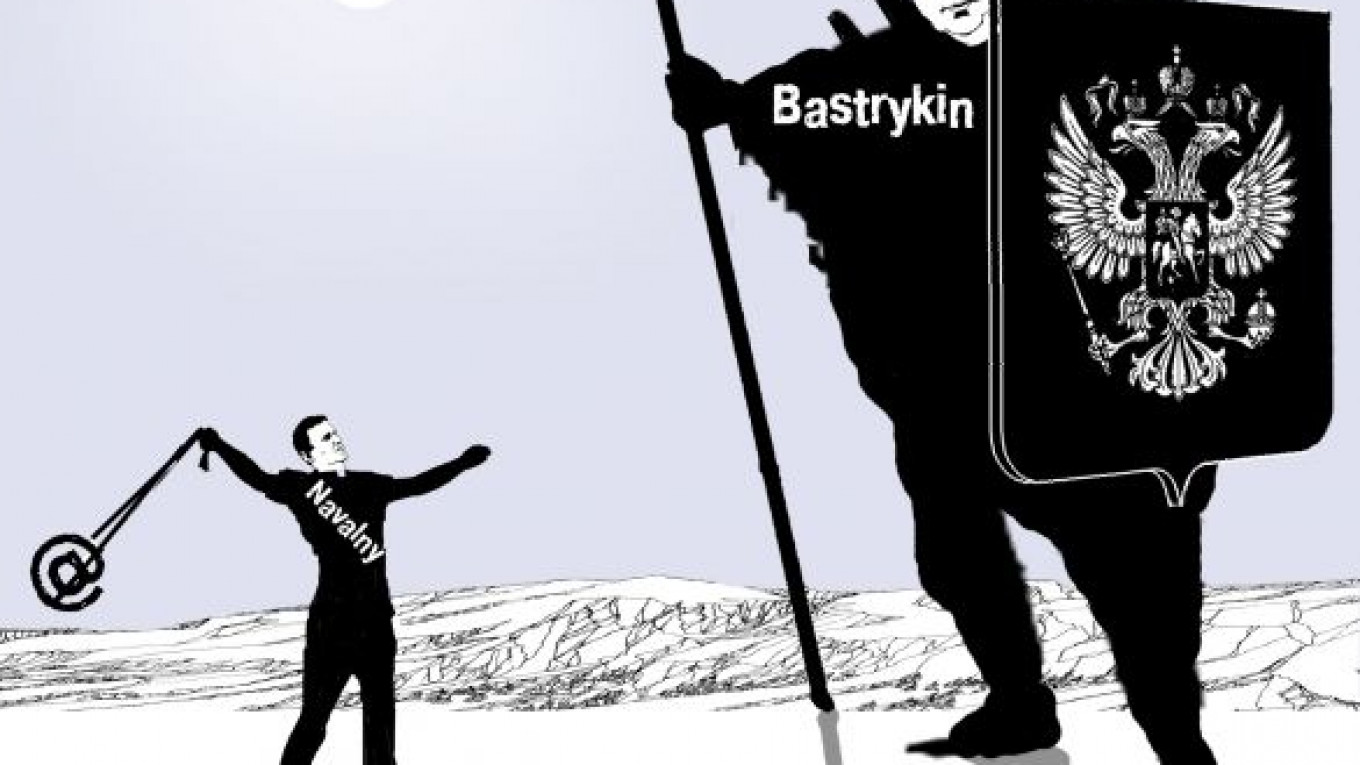
When President Vladimir Putin's press secretary, Dmitry Peskov, was asked whether he reads anti-corruption activist Alexei Navalny's , Peskov replied that he "didn't think it was necessary," Rbc.ru . That's a pity, because if he did read it, Peskov could learn a great deal of interesting information about the country that is not reported on the censored state television channels. Besides, Navalny's investigations make for entertaining reading. They are like real-life thrillers.
For several years, Navalny has been uncovering corruption in high places, especially in two leading state companies, Transneft and Rosneft. With his organization, Rospil, he monitors purchases by state organizations and has already found several dozen dubious contracts totaling the astronomical sum of 40.4 billion rubles ($1.26 billion).
The state hasn't been grateful to Navalny for his investigations. Instead his reward has been a lot of intimidation and a smear campaign in the state media. Nonetheless, in July, when the State Duma passed its "foreign agent" law for nongovernmental organizations, Navalny also started looking for other "foreign agents" who receive funds from abroad. And it didn't take him long to find his first one.
But this "foreign agent" wasn't the leader of an NGO. It was Alexander Bastrykin, the head of the Investigative Committee. According to documents Navalny found and posted on his LiveJournal blog, Bastrykin owned a company and apartment in the Czech Republic for many years and had a residence permit there. All this was hidden from society.
Navalny's information indicates that Bastrykin and his wife became owners of the Prague-registered company LAW Bohemia in 2000. At the time, Bastrykin was not a state employee, so he had not violated any Russian laws. But in July 2001, Bastrykin was appointed acting head of the Justice Ministry for the Northwest Federal District. From that day on, in accordance with the law "On Government Service," Bastrykin should have left or sold LAW Bohemia.
But he didn't. In 2004 the company bought an apartment in Prague, and in 2007 Bastrykin received a residence permit for the Czech Republic. By then, he already held his present post as head of the Investigative Committee and was in violation of another law, "On the Prosecutor's Office," which categorically forbids its employees from any kind of business activity — all the more so abroad.
Navalny's blog might not be read in the Kremlin, but it is read all over the world. The Financial Times covered the story in an on July 26 and included an interview of Czech police officials who disclosed one more interesting nuance. It turns out that Bastrykin finally sold his company and apartment in 2008. But according to Czech law, he should have notified the police and should have lost his residence permit. Bastrykin apparently failed to comply and continued to illegally use his residence permit for another six months.
When journalist Julia Ioffe asked on Twitter, "What would happen if the FBI director was found to have business, property, permanent residency in, say, Nicaragua?" Navalny replied with a question of his own: "Are you asking how many minutes he'd keep his post after that?"
When the scandal grew to international proportions, Bastrykin had to break his silence. He gave an to Izvestia on July 27 in which he laid out his version of event. He said that the apartment had been purchased in 2000 and that he'd never had a residence permit for the Czech Republic. He'd just had a long-term visa. The company just existed as a legal requirement for buying real estate and didn't do anything. "If you find even 1 euro in profits, I'll resign," he said.
But that version lasted only 72 hours. Using the Czech Republic's transparent e-government system, Navalny easily found documents on Czech government sites proving that the building where Bastrykin had an apartment wasn't even built before 2004. Moreover, Bastrykin had a long-term residence document, not a visa. As for profits, it didn't take long to find them as well. Bastrykin received 681 euros ($843) in capital gains from fluctuations in the currency exchange rates when he sold his company.
Navalny believes that the case is solid: A top public official in a key law enforcement agency had a fictional company in a NATO member country, hid his income from the Russian tax service and gave false testimony. But this thriller still doesn't have an ending, since Navalny has yet to get a response to his official inquiries.
Or maybe he has. On July 31, the Investigative Committee accused Navalny of embezzling state funds. This old case against Navalny has already been investigated three times and closed three times for lack of evidence. But back then, Navalny hadn't written anything about Bastrykin, and Bastrykin's former schoolmate, Putin, wasn't president.
Will the corrupt cop be punished, or will the private detective end up in handcuffs? The ending of this thriller hasn't been written yet.
Victor Davidoff is a Moscow-based writer and journalist whose blog is
A Message from The Moscow Times:
Dear readers,
We are facing unprecedented challenges. Russia's Prosecutor General's Office has designated The Moscow Times as an "undesirable" organization, criminalizing our work and putting our staff at risk of prosecution. This follows our earlier unjust labeling as a "foreign agent."
These actions are direct attempts to silence independent journalism in Russia. The authorities claim our work "discredits the decisions of the Russian leadership." We see things differently: we strive to provide accurate, unbiased reporting on Russia.
We, the journalists of The Moscow Times, refuse to be silenced. But to continue our work, we need your help.
Your support, no matter how small, makes a world of difference. If you can, please support us monthly starting from just $2. It's quick to set up, and every contribution makes a significant impact.
By supporting The Moscow Times, you're defending open, independent journalism in the face of repression. Thank you for standing with us.

Remind me later.