

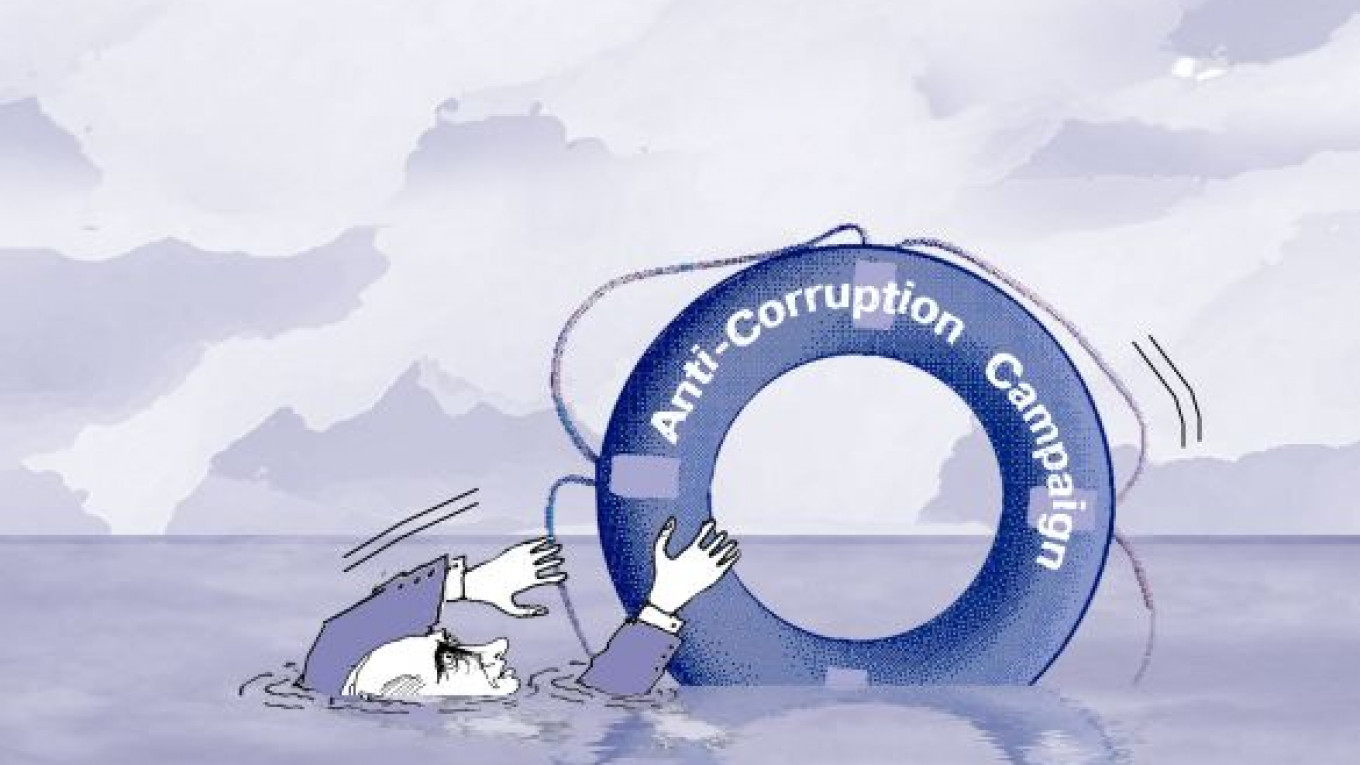
The first shot fired by President Vladimir Putin in his anti-corruption battle was aimed at former Defense Minister Anatoly Serdyukov. This was followed by the investigation into the large-scale embezzlement at Rosagroleasing, Rostelecom and the Federal Space Agency. What's more, municipal officials and businesspeople were detained in St. Petersburg on charges of embezzling 3 billion rubles ($97.3 million) from funds allocated to repair the city's heating system. The detainees were hastily transferred to Moscow by train to prevent them from using their local ties in St. Petersburg to escape arrest. If that were not enough, investigators have opened cases involving the misappropriation of state funds involving the Regional Development Ministry and the APEC summit held in Vladivostok in September.
Meanwhile, Putin signed a law last week that would have been unthinkable only a short time ago. The legislation, which goes into effect Jan. 1, requires ministers and other senior officials to declare all major expenditures, including those made by their spouses.
The Kremlin's new catch phrase seems to be: "We will throw all the crooks in jail, including ministers!" For now, however, Serdyukov and former Agriculture Minister Yelena Skrynnik have only been called to testify as witnesses in the corruption cases that are linked to them.
On the surface, it would seem that Putin has finally become serious about cracking down on corrupt officials. After 13 years of tolerating corruption as a necessary evil that guarantees the loyalty of bureaucrats, it seems that the Kremlin has finally decided to initiate a tough anti-corruption campaign against mid-level and senior officials. Of course, only Putin himself will give final approval for the arrest or jailing of ministers or anyone else closely tied to him. But there can be no doubt that a new policy has been adopted. ?
The main reason for shifting the focus is the country's growing number of serious economic problems. In recent years, economic growth has slowed and has fallen below other BRIC nations. In addition, capital flight has increased, and foreign investment has declined. The shortfall in the Pension Fund amounts to 1 trillion rubles ($32.4 billion) and is growing. According to the Audit Chamber, more than 1 trillion rubles were stolen last year from government contracts. As a result, there is a chronic shortage of funds for housing, education, health care, pensions and other key social sectors.
Putin's declining popularity is the second reason the Kremlin initiated its anti-corruption battle. Putin has realized what the opposition had been shouting about for years — that ubiquitous corruption has halted the economy, social services, infrastructure and any hope for modernizing the country. Russia has broken international records for its excessively high cost of building roads, bridges, stadiums, hospitals, schools and street underpasses.
You would think that at these prices, these structures were built of solid gold except that they often collapse or are never even built in the first place. The final price tag is often six times higher than the initial cost estimate, with little oversight and far too few cases in which embezzlers have been tried and convicted.
Nonetheless, by focusing on high-profile corruption cases, such as those involving Serdyukov and Skrynnik, Putin may be trying to emulate China's seemingly strong-armed methods of fighting corruption. But in reality, the Chinese have achieved only modest success in their battle, despite capital punishment against those found guilty of large-scale corruption. The Chinese experience shows that the temptation to get rich quickly all too often is more powerful than the fear of severe prison sentences or even death.
In Russia, corruption has spread to law enforcement and intelligence agencies. The system of parliamentary, public and media control over public officials has been destroyed. At the same time, Russia's list of "untouchable officials"remains large. To be effective, the battle against corruption requires the observance of one basic rule: that no top official, including the president, is above the law.
In the end, Putin's anti-corruption campaign doesn't stand a chance. Mark my words: In a year from now, the recent high-profile corruption cases that everyone is talking about will fade away with few people ever serving time for their crimes. As a result, the level of corruption will only continue to grow each year.
Vladimir Ryzhkov, a State Duma deputy from 1993 to 2007, hosts a political talk show on Ekho Moskvy radio and is a co-founder of the opposition Party of People's Freedom.
Related articles:
A Message from The Moscow Times:
Dear readers,
We are facing unprecedented challenges. Russia's Prosecutor General's Office has designated The Moscow Times as an "undesirable" organization, criminalizing our work and putting our staff at risk of prosecution. This follows our earlier unjust labeling as a "foreign agent."
These actions are direct attempts to silence independent journalism in Russia. The authorities claim our work "discredits the decisions of the Russian leadership." We see things differently: we strive to provide accurate, unbiased reporting on Russia.
We, the journalists of The Moscow Times, refuse to be silenced. But to continue our work, we need your help.
Your support, no matter how small, makes a world of difference. If you can, please support us monthly starting from just $2. It's quick to set up, and every contribution makes a significant impact.
By supporting The Moscow Times, you're defending open, independent journalism in the face of repression. Thank you for standing with us.

Remind me later.