

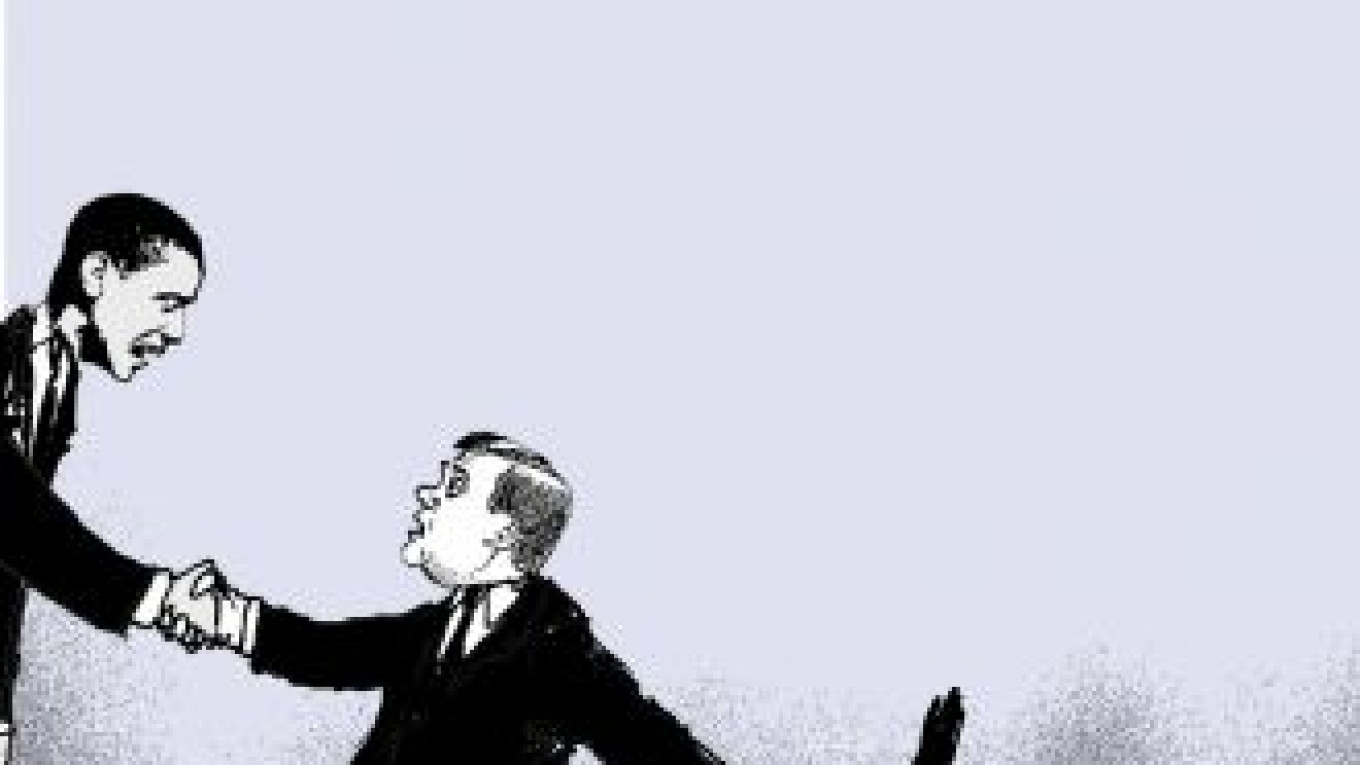
What's next for the U.S.-Russian reset? Having already succeeded in ramming the ambitious New START arms control treaty through a reluctant Senate late last year, the administration of U.S. President Barack Obama is now eyeing the next step in its reboot of relations with Moscow: integrating Russia into the world economy.
“Our trade and investment relationship is nowhere near where it could or should be,” U.S. Vice President Joe Biden wrote recently in the International Herald Tribune. “Russia was America’s 37th largest export market in 2010, and the value of goods that cross our borders with Canada and Mexico every few days exceeds the annual value of our trade with Russia.”
Further improvements to U.S.-Russian ties, Biden believes, require the United States to support Russia’s ongoing efforts to join the World Trade Organization.
As even Biden recognizes, however, doing so faces a formidable hurdle. More than a decade after then-President Boris Yeltsin termed Russia a “criminal state,” the country still suffers from pervasive corruption. Changing that culture and restoring investor confidence are prerequisites for Russia to be seriously considered for membership in the world’s largest trading bloc. All of which, in turn, requires serious, systemic alterations to how the country and its government operates.
But that’s easier said than done. Just ask President Dmitry Medvedev, who has repeatedly attempted to impose greater official accountability since inheriting the post from Vladimir Putin back in 2008. His administration has produced a national plan to combat corruption, fired numerous regional and local officials for abuse of office and imposed tighter regulations on the country’s notoriously unruly police.
Yet these efforts have had no discernible effect on Russia’s accelerating drop to the worst spots on the global corruption lists. For example, between 2000 and 2009, Russia plunged 64 notches on Transparency International’s annual Corruption Perceptions Index. Last year, Russia slid still further, ranking 154th out of a possible 178 countries — putting it on a par with Kenya and the Congo in terms of graft.
Medvedev’s lack of success in his battle against corruption is because he has little political muscle to fight the entrenched Kremlin machine. After all, by some estimates, as many of 73 of the 75 most influential government posts in Russia are held by members of the amalgam of intelligence, economic and political interests that cumulatively make up the country’s ruling elite.
International financial institutions understand this very well, which is why they are making a beeline for the exits. In recent weeks, at least six European and U.S. banks have announced plans to scale back their operations in Russia — or shutter them outright — as a result of unfair competition, corrupt business practices and an uncertain investment climate. The casualties include Morgan Stanley, Banco Santander and Barclay’s.
It would be foolish for Washington to expect the Kremlin to voluntarily enact measures that would alter the prevailing status quo. It’s a safe bet that Russia’s entrenched interests will have to be dragged kicking and screaming toward transparency and good governance.
Maybe they will be. Recent moves by Medvedev hold out at least some promise of beginning to address the country’s entrenched culture of corruption, provided they are allowed to see the light of day and then, even more crucially, enforced. Chief among them is a proposed bill to fine corrupt officials up to 100 times the sum of a bribe.
Still, given the nature of the country’s government, such change won’t come easy. And if in its pursuit of better ties with Moscow, Washington succumbs to the temptation to paper over the Kremlin’s internal deformities, it’s a safe bet that such change won’t come at all.
Ilan Berman is vice president of the American Foreign Policy Council in Washington.
A Message from The Moscow Times:
Dear readers,
We are facing unprecedented challenges. Russia's Prosecutor General's Office has designated The Moscow Times as an "undesirable" organization, criminalizing our work and putting our staff at risk of prosecution. This follows our earlier unjust labeling as a "foreign agent."
These actions are direct attempts to silence independent journalism in Russia. The authorities claim our work "discredits the decisions of the Russian leadership." We see things differently: we strive to provide accurate, unbiased reporting on Russia.
We, the journalists of The Moscow Times, refuse to be silenced. But to continue our work, we need your help.
Your support, no matter how small, makes a world of difference. If you can, please support us monthly starting from just $2. It's quick to set up, and every contribution makes a significant impact.
By supporting The Moscow Times, you're defending open, independent journalism in the face of repression. Thank you for standing with us.

Remind me later.