

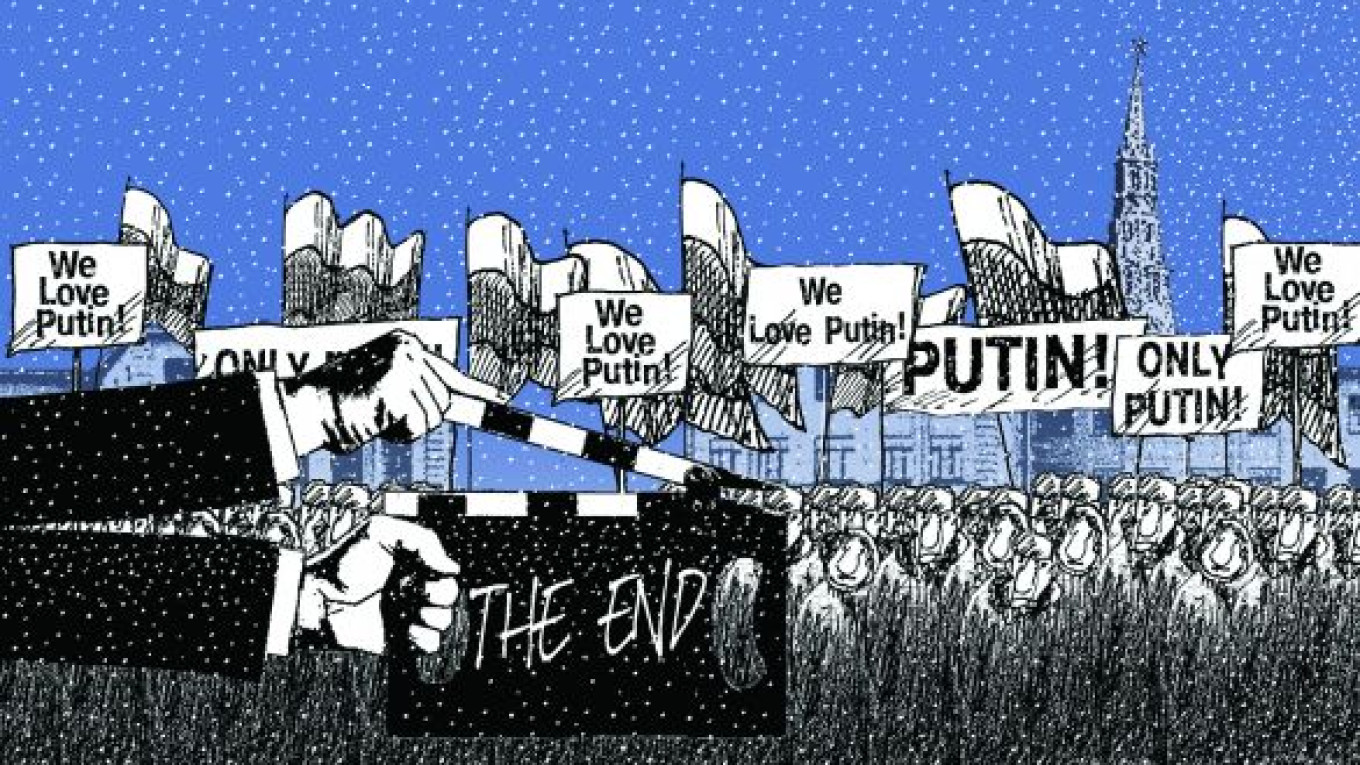
The main lesson from the rival anti-Putin and pro-Putin demonstrations held on Feb. 4 is that both civil society and the authorities are walking down a dangerous path of escalation.
After angry protests broke out in response to the rigged State Duma elections on Dec. 4, the authorities chose not to implement reforms to meet some of the protesters' demands. On the contrary, the Anti-Orange protest on Poklonnaya Gora that the authorities threw together at the last moment showed that the Kremlin is as determined as ever to try to discredit and marginalize the grassroots protest movement.
After three large rallies on Bolotnaya Ploshchad, Prospekt Sakharova and Bolshaya Yakimanka, the protesters' demands have become stronger as the authorities continue to stonewall. The first rallies focused on political reforms, falsified elections and the dismissal of Central Elections Commission head Vladimir Churov. By Dec. 24, however, demonstrators had focused their animosity on Putin.
The actions of the authorities mirror the strategy of the opposition. They have stepped up their ideological rhetoric and are actively attempting to co-opt, or at least redirect, the energy of public protests. The pro-government rally on Poklonnaya Gora gathered — or, more accurately, dragged out — far fewer participants than the anti-government rally on Yakimanka, but more than enough to create the illusion of strong support for Putin. In fact, the sham worked so well that Putin's spokesman Dmitry Peskov claimed afterward that Putin would win the presidential election in the first round of voting.
As a preventative measure, the Kremlin decided to renew their persecution of the most active nongovernmental organizations. Golos, the independent elections watchdog, found itself evicted from its offices overnight. Moreover, the Justice Ministry is planning to conduct new reviews of the "illegal activities" of other NGOs.
The authorities are justifying their witch-hunt on the patently false charge that the West is bankrolling the protesters to foment a Color Revolution in Russia. As evidence, they point to the routine meeting that protest leaders held with U.S. Deputy Undersecretary of State William Burns and new U.S. Ambassador to Russia Michael McFaul on Jan. 17. Exhibiting the kind of paranoia that infected the Soviet Union in its worst years of spy mania, that event has been portrayed on state-controlled television as proof that foreign powers are orchestrating and financing the protests.
Moreover, Putin's series of articles published in leading Russian newspapers dispelled once and for all any illusions some might have had that the authorities were prepared to reach an agreement with protesters. Now we know to expect a further strengthening of Putin's autocracy.
Russia's urban middle class is demanding political representation and systemic political reforms, while the regime refuses to make any concessions. It is highly doubtful that the protesters will give up the fight.
Meanwhile, Putin remains out of touch with reality. In his article published in Kommersant, Putin wrote: "Our society has changed radically since the early 2000s. Many people have become more prosperous, are better educated and are therefore more critical. New demands on the government and the advance of the middle class above the narrow objective of guaranteeing their own prosperity are the results of our efforts. This is what we wanted to achieve."
It is clear that Putin is appealing largely to the poor, blue-collar workers and pensioners. He is trying to curry favor among disadvantaged and economically vulnerable citizens by tacking a few hundred extra rubles onto pensions, military salaries and paychecks to state employees. The more loyal these people are toward Putin, the less likely they will join the educated middle class in public protests.
There is only one peaceful resolution to this standoff. The authorities must hold real and sincere negotiations with the opposition. When authorities and Kremlin-friendly journalists and analysts label the opposition "radical," it is a clear attempt to demonize the protesters and delegitimize their legitimate complaints. The opposition is ready and willing to engage in substantial talks. It advocates reforms, not revolution.
Soon, millions of Russians will be convinced that the country's leader has usurped power through illegitimate means. This is a ticking time bomb that threatens all of us, and it is important that the Kremlin negotiates with the opposition before it blows up.
Vladimir Ryzhkov, a State Duma deputy from 1993 to 2007, hosts a political talk show on Ekho Moskvy radio and is a co-founder of the opposition Party of People's Freedom.
A Message from The Moscow Times:
Dear readers,
We are facing unprecedented challenges. Russia's Prosecutor General's Office has designated The Moscow Times as an "undesirable" organization, criminalizing our work and putting our staff at risk of prosecution. This follows our earlier unjust labeling as a "foreign agent."
These actions are direct attempts to silence independent journalism in Russia. The authorities claim our work "discredits the decisions of the Russian leadership." We see things differently: we strive to provide accurate, unbiased reporting on Russia.
We, the journalists of The Moscow Times, refuse to be silenced. But to continue our work, we need your help.
Your support, no matter how small, makes a world of difference. If you can, please support us monthly starting from just $2. It's quick to set up, and every contribution makes a significant impact.
By supporting The Moscow Times, you're defending open, independent journalism in the face of repression. Thank you for standing with us.

Remind me later.